
Construction Financial Visibility: Protect Margins and Cash Flow

Construction financial visibility means having near-real-time access to project-level costs, revenue, margins, and cash flow across every active job, so you can intervene before a problem becomes a loss. It is the difference between managing your projects and reacting to them.
When visibility is working, you know your exposure before the invoice arrives. You catch margin fade in week three, not at month-end close. You make cash-flow decisions with current numbers, not four-week-old data.
Here is what real financial visibility covers at a glance:
- Work-in-progress (WIP): Revenue earned vs. billed, and the over/under-billing position on every job
- Committed costs: Subcontracts, purchase orders, and approved change orders that will hit your books
- Change-order pipeline: Pending, approved, and disputed changes with dollar exposure tracked
- AR/AP aging: Outstanding receivables (including retention) and payables by due date
- Job cost actuals vs. budget: Cost-code-level variance updated as field data arrives
Key Takeaways
Construction financial visibility requires near-real-time access to job cost actuals, committed costs, WIP, and cash-flow data at the project level, updated continuously as field data arrives.
| Point | Details |
|---|---|
| Start with cost-code standardization | Align cost codes across estimating, procurement, and accounting before touching any other system. |
| Track cost-to-complete weekly | This single forward-looking metric forces PM and accounting alignment and is your earliest margin warning. |
| Close the four-week lag first | Daily timesheet posting and AP commitment matching cut the visibility gap faster than any other change. |
| Assign clear data owners | Every core dataset needs one accountable owner; without ownership, data drifts stale within weeks. |
| Automate AP and field capture early | These two automations deliver the fastest ROI and free your finance team to focus on forecasting. |
Table of Contents
- What construction financial visibility actually covers
- Why financial visibility changes your project outcomes
- What poor visibility actually costs your business
- The core components that create financial visibility
- The KPIs that give you early warning signals
- A practical roadmap to build financial visibility in phases
- What to look for in software that enables visibility
- Who owns what: aligning your project and finance teams
- What a realistic implementation timeline and ROI look like
- How integrated ERP delivers measurable visibility gains
- Warning signs your company lacks financial visibility right now
- The visibility gap is a leadership problem, not a software problem
- Ready to close your visibility gap?
- Sources
What construction financial visibility actually covers
Financial visibility brings financial information from different systems into a single view so you can answer “where are we at?” in near real time. For construction, that definition needs a sharper edge, because the industry runs on project-level economics, not just corporate P&L.
Visibility in construction requires six data categories working together:
- Job cost ledger by cost code: Labor, materials, equipment, subcontractors, and overhead tracked against the original estimate at the activity level
- Committed costs: Every signed subcontract and PO, plus approved change orders, whether or not the invoice has arrived yet
- Timesheets and daily field reports: Labor hours posted to the correct cost code within 24 hours, not at week’s end
- Invoices and AP: Subcontractor and vendor invoices matched to commitments and coded on receipt
- Change orders: A live pipeline showing requested, approved, and disputed changes with revenue and cost impact
- WIP schedule: The formal reconciliation of costs incurred, revenue earned, billings to date, and the resulting over/under-billing position
The AICPA Construction Contractors audit and accounting guide underscores that construction accounting requires industry-specific controls, including job-costing and revenue recognition rules, that are foundational to any reliable visibility framework.
The timing test is where most companies fail. Monthly close data is historical accounting. Visibility requires data that is current enough to change a decision today. If your cost-to-complete estimate is based on last month’s actuals, you are flying on a delayed instrument. Real visibility means field costs post within hours, not weeks.
Visibility vs. historical accounting: Historical accounting tells you what happened. Financial visibility tells you what is happening and what will happen if nothing changes. The distinction is not semantic; it determines whether you can act before a margin erodes or only after it already has.
Why financial visibility changes your project outcomes
Better bidding is the first place visibility pays off. When you can see actual cost performance by cost code across completed jobs, your next estimate is grounded in reality, not optimism. You stop repeating the same underestimates on concrete or MEP rough-in because the data is right in front of you.
Margin protection is where the financial impact is most direct. Real-time data for construction managers shows that early detection of cost overruns gives project teams time to adjust scope, renegotiate subcontracts, or accelerate billing before the margin is gone. A project that is slightly over budget in the early weeks is recoverable. The same project at week twelve, discovered at month-end close, often is not.

Cash-flow planning improves sharply when committed costs are visible. If you can see subcontractor invoices that are approved but not yet submitted, you can plan your draw request and line-of-credit usage accordingly. Without that committed-cost view, cash shortfalls arrive as surprises.
The benefits that matter most to your day-to-day work:
- Earlier corrective action on cost overruns, scope creep, and labor inefficiencies
- Accurate backlog valuation based on real margin, not contract value
- Faster, more defensible billing because the cost documentation is already organized
- Reduced audit exposure because cost verification is continuous, not a closeout scramble
What poor visibility actually costs your business
The most common failure mode is not a single catastrophic event. It is a slow accumulation of small blind spots: a timesheet posted three weeks late, a change order approved verbally but never logged, a subcontractor invoice that bypasses the commitment register and hits the books as a surprise.
The warning signs that visibility has broken down:
- Invoices arrive that have no matching purchase order or subcontract commitment
- Month-end close reveals variances that no one on the project team saw coming
- Different teams are working from different cost numbers for the same job
- Change orders are tracked in a spreadsheet that only one person can access
- WIP reconciliation is done quarterly, if at all
K-38 Consulting’s diagnostic guide identifies persistent cash-flow problems, missed payroll cycles, and supplier delivery issues as common warning signs that a construction company’s financial controls have broken down. These are not isolated events; they are downstream symptoms of a visibility gap upstream.
The archetype that most contractors recognize is the four-week reporting lag. Field costs incurred in week one do not appear in the job cost report until week five, after timesheets are approved, payroll is processed, invoices are coded, and the monthly close is run. By then, a project that needed a corrective action in week two has had three additional weeks of unchecked cost accumulation.
The four-week lag in numbers: A project burning $50,000 per week that is running 10% over budget accumulates an additional $20,000 in excess cost during a four-week visibility gap, before anyone with authority to act even knows there is a problem.
The financial consequences compound: overbilling risk rises when WIP is not reconciled, retention disputes become harder to resolve without documentation, and lenders or bonding companies lose confidence when your financials are consistently stale.
The core components that create financial visibility
Carnegie Mellon’s project control guidance recommends converting the detailed estimate into a project budget tied to job cost accounts, then using those accounts as the control framework throughout execution. That principle defines the architecture of financial visibility.
The systems you need working together:
- Accounting/ERP with a construction-specific job cost module
- Field capture tools (mobile timesheets, daily reports, photo documentation)
- Procurement and AP with commitment tracking against POs and subcontracts
- Estimating system that exports cost codes directly into the job cost ledger
- Subcontract management with lien waiver and compliance tracking
- Scheduling integration so percent-complete from the schedule feeds the WIP calculation
The core datasets those systems must produce:
- Job cost ledger by cost code (labor, material, equipment, sub, overhead)
- Committed cost register (all POs and subcontracts, approved changes included)
- Change-order pipeline with status, dollar value, and billing impact
- Progressive billing schedule with retention tracked separately
- Certified payroll records for prevailing-wage jobs
- WIP schedule reconciled at least monthly
Carr, Riggs & Ingram’s guidance on construction cost verification makes the case that cost verification during execution, not just at closeout, strengthens oversight and reduces surprise exposures. That means your AP process needs to verify that every invoice is supported by a commitment before it posts.
The dataset-to-question mapping below shows why each component earns its place:
| Dataset | Business question it answers |
|---|---|
| Job cost ledger by cost code | Are we over or under budget on each activity right now? |
| Committed cost register | What is our total exposure including costs not yet invoiced? |
| Change-order pipeline | How much approved revenue and cost is still unbilled? |
| WIP schedule | Are we over-billed or under-billed, and by how much? |
| AR aging with retention | When will we collect, and how much is held in retention? |
| Certified payroll | Are we compliant on prevailing-wage jobs? |
The KPIs that give you early warning signals
Tracking the right metrics at the right frequency is what separates financial oversight from financial reporting. Reporting tells you what happened. KPIs tracked at the right cadence tell you what to do next.
Priority KPIs by role and frequency:
- Cash burn vs. forecasted cash position (PMs: weekly; controllers: weekly): Actual cash out vs. the draw schedule. A widening gap signals either a billing delay or an unplanned cost surge.
- Cost-to-complete (PMs: weekly; controllers: weekly): The forward-looking estimate of remaining cost to finish the job. This is the single most important number for margin protection, per CMU’s project control framework. A bad signal: cost-to-complete keeps rising even as the schedule shows progress.
- Percent complete (earned revenue) (PMs: weekly; controllers: monthly): Physical progress translated into earned revenue. Divergence between percent complete and percent billed flags an over- or under-billing risk.
- Margin by cost code (PMs: biweekly; controllers: monthly): Gross margin broken down by labor, materials, subcontractors, and equipment. A bad signal: one cost code consistently running 15%+ over estimate while others are on track.
- Committed cost exposure (PMs: weekly; controllers: weekly): Total contracted commitments plus approved changes vs. the remaining budget. A bad signal: committed costs exceed the remaining budget before the job is 60% complete.
- AR days with retention detail (controllers: weekly; executives: monthly): How long receivables are outstanding, with retention separated out. Retention aging beyond contract terms is a cash-flow risk that compounds over time.
- WIP ratio (controllers: monthly; executives: monthly): The ratio of costs in excess of billings to billings in excess of costs across the portfolio. A skewed WIP ratio signals either aggressive billing or revenue recognition risk.
Pro Tip: Start tracking cost-to-complete weekly before you tackle any other KPI. It is the one number that forces both the PM and the accountant to agree on the same forward-looking picture of the job, and that alignment is where visibility actually begins.
A practical roadmap to build financial visibility in phases
Moving from blind to visible does not require a six-month ERP implementation before you see any benefit. A phased approach delivers early wins while building toward a complete system.
Phase 1: Assess your current state (weeks 1–2)
Run a gap analysis against the core components listed above. For each dataset, ask: Does it exist? Is it current? Is it trusted? Map where data lives today (spreadsheets, standalone apps, accounting software) and identify the biggest gaps.
Phase 2: Standardize cost codes and data rules (weeks 2–4)
Standardized cost coding is a high-impact, low-cost control. Align your cost code structure (MasterFormat extensions work well for most contractors) across estimating, procurement, and accounting so that a budget line in the estimate maps directly to a job cost account in the ledger. Without this, every report requires manual reconciliation. Document naming conventions, approval rules, and who can create new cost codes.
Phase 3: Integrate your systems (weeks 4–12)
Connect field capture to accounting so timesheets post without re-keying. Link your estimating export to the job cost setup. Connect procurement to the commitment register. The goal is a single data flow: field data enters once and flows through to the financial report. Engineering firm integration checklists provide a practical starting point for mapping the connections between systems.
Phase 4: Automate high-volume processes (weeks 8–16)
AP automation, timesheet capture, and approval workflows are the fastest wins. Automating AP matching alone removes a major source of posting delays and coding errors. Carr, Riggs & Ingram’s cost verification guidance confirms that automating invoice matching against commitments reduces surprise exposures and speeds up the billing cycle.
Phase 5: Establish governance (ongoing from week 4)
Assign data owners for each dataset. Set a reporting cadence: daily field data, weekly cost-to-complete updates, monthly WIP reconciliation. Define escalation paths: who gets notified when a cost code exceeds budget by more than 10%, and what happens next. Without governance, even a well-integrated system drifts back toward stale data within a few months.
4-week visibility checklist:
- Complete gap analysis against core components
- Draft and publish a standardized cost code list
- Identify the top three manual re-keying points in your current workflow
- Set up a weekly cost-to-complete review meeting between PMs and accounting
- Assign a data owner for each core dataset
Pro Tip: The fastest visibility win in most companies is getting timesheets posted daily to the correct cost code. It costs nothing to enforce and immediately improves the accuracy of your cost-to-complete estimate.
What to look for in software that enables visibility
The technology question is not which vendor to choose; it is which capabilities you need and in what order to implement them. Capability gaps are more expensive than licensing costs.
Essential capabilities, in priority order:
- Unified job-cost model: A single cost structure shared by estimating, procurement, and accounting. If these three systems use different cost codes, every report requires a manual crosswalk.
- Field mobile capture: Timesheets, daily reports, and material receipts entered from the field on a mobile device, posted directly to the job cost ledger without re-keying.
- AP automation with commitment matching: Invoices matched to POs and subcontracts automatically, with exceptions flagged for review rather than manual processing of every line.
- WIP engine: Automated calculation of over/under-billing based on percent complete and billings to date, updated as field data arrives.
- Real-time dashboards with role-based access: PMs see their job-level numbers; controllers see the portfolio; executives see margin and cash-flow summaries. Each role gets the view they need without navigating a full accounting system.
- Integration layer: API connections to payroll, estimating, scheduling, and document controls so data flows without manual export/import cycles.
API-based integration vs. a native unified platform: API integrations between best-of-breed tools can work, but they introduce latency, maintenance overhead, and reconciliation risk every time one system updates its data model. A native unified platform, where project management, accounting, and field operations share a single database, eliminates the reconciliation step entirely. The tradeoff is that unified platforms require more upfront configuration but deliver cleaner, more trustworthy data over time.
Real-time budget tracking guidance reinforces that keeping budgets current requires field data to flow into the financial model without manual intervention, which is the core argument for native integration over point-to-point API connections.
Who owns what: aligning your project and finance teams
CFMA’s roles and responsibilities framework makes clear that effective financial controls in construction depend on clear role alignment between financial staff and project teams. Without that alignment, the same job can have two different cost numbers depending on who you ask.
Role assignments that work in practice:
- Project managers: Own cost-to-complete estimates, change-order documentation, and daily field data entry. They are the source of site reality.
- Project accountants: Own the job cost ledger, WIP reconciliation, and billing preparation. They are the source of ledger discipline.
- Controllers: Own the WIP schedule, portfolio-level reporting, and exception escalation. They set the reporting cadence and enforce data standards.
- Procurement: Own the commitment register, PO issuance, and subcontract compliance (COI, lien waivers). They are the link between field commitments and financial exposure.
- Operations leadership: Consume the weekly cost-to-complete and cash-flow reports. They make the go/no-go decisions on corrective actions.
Suggested reporting cadence:
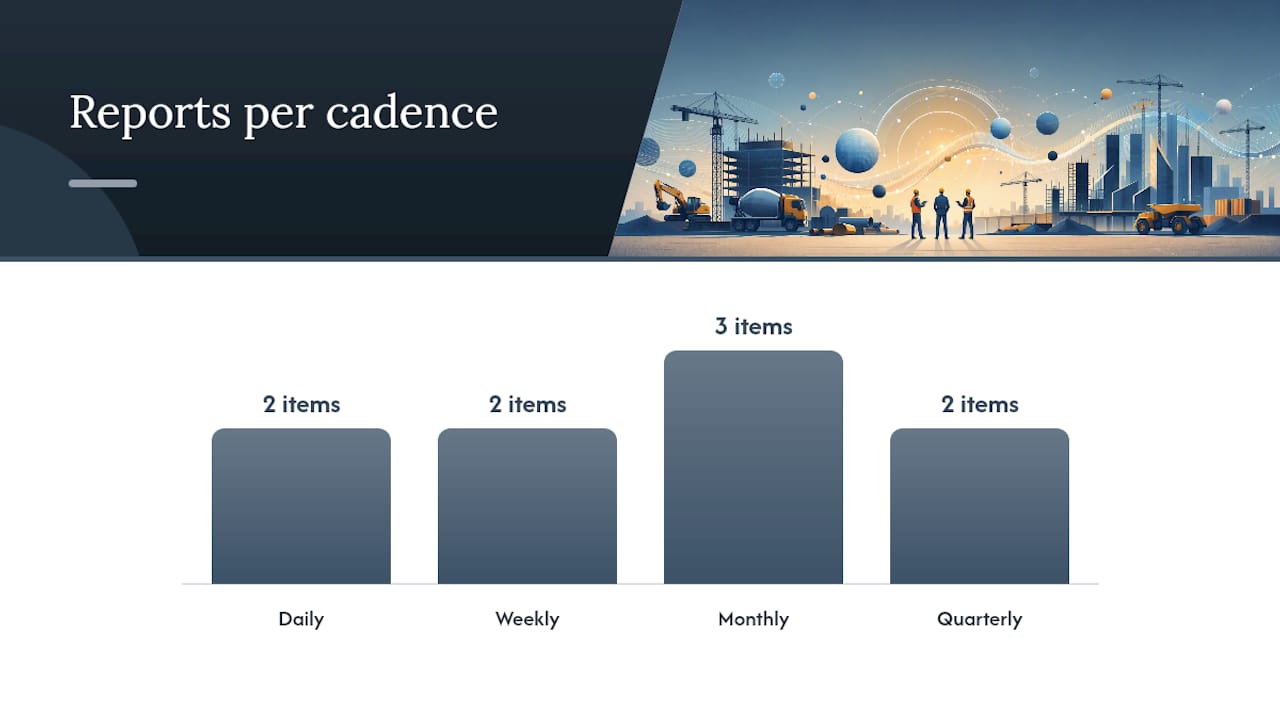
- Daily: Field timesheets and daily reports posted by PMs or field supervisors
- Weekly: Cost-to-complete review between PM and project accountant; committed cost register updated
- Monthly: WIP reconciliation completed by controller; AR aging reviewed; margin-by-cost-code report distributed to operations leadership
- Quarterly: Portfolio-level financial review with executives; bidding accuracy analysis against completed jobs
RACI summary for the three most critical processes:
- Cost-to-complete update: PM is responsible, project accountant is accountable, controller reviews
- Change-order approval: PM initiates, operations leadership approves, project accountant posts to ledger
- WIP reconciliation: Project accountant prepares, controller approves, CFO/executive reviews
What a realistic implementation timeline and ROI look like
Small contractors typically reach basic visibility, meaning daily field data, weekly cost-to-complete, and monthly WIP, within a few weeks when they start with cost-code standardization and field mobile capture. The investment is primarily time: two to four hours per week from a controller or senior accountant during setup.
Mid-size contractors with multiple active projects and more complex subcontract structures typically need several weeks to a few months to reach full integration across estimating, procurement, accounting, and field capture. The main cost driver is change management: getting PMs to post timesheets daily and use the system rather than their own spreadsheets.
Enterprise contractors with multi-entity structures, certified payroll requirements, and complex billing schedules should plan for a multi-month rollout, with phased go-live by project type or division.
Where the ROI comes from:
- Margin preservation: Catching a 5% cost overrun on a $2 million job in week four rather than week twelve saves roughly $100,000 in unrecoverable margin, assuming the overrun compounds at the same rate.
- Faster collections: Reducing AR days from 60 to 45 on a $10 million annual revenue base frees approximately $410,000 in working capital.
- Reduced rework: Eliminating manual re-keying between field, procurement, and accounting cuts data entry errors and the labor cost of correcting them.
- Audit readiness: Continuous cost verification, as recommended by Carr, Riggs & Ingram, reduces closeout disputes and accelerates final billing.
A simple ROI calculation: if your average project margin is 8% on $5 million in annual revenue, a 1% improvement in margin retention from earlier corrective action adds $50,000 to your bottom line. That figure typically exceeds the annual licensing cost of a mid-tier construction ERP.
How integrated ERP delivers measurable visibility gains
Consider a mid-size general contractor running eight active projects with a combined contract value of $18 million. Before integrating their systems, the finance team was closing the books 25 days after month-end, WIP reconciliation was done quarterly, and cost-to-complete estimates were updated by PMs in a shared spreadsheet that accounting could not trust.
Before integration:
- Visibility lag: 4–5 weeks from cost incurrence to financial report
- WIP reconciliation: quarterly, with frequent restatements
- Change-order tracking: spreadsheet managed by one PM, not connected to billing
- AR days: averaging 68 days, with retention aging beyond contract terms on three jobs
After implementing an integrated ERP with unified job costing, field mobile capture, and AP automation:
- Visibility lag reduced to 1–2 days as field timesheets posted directly to the job cost ledger
- WIP reconciliation moved to monthly with no restatements in the first six months
- Change-order pipeline connected to billing, reducing unbilled change exposure by a material amount
- AR days dropped as billing became faster and better documented
The AICPA’s construction accounting guide notes that reliable revenue recognition and job-costing controls are the foundation of audit-ready financials. When those controls are automated rather than manual, the audit preparation time drops significantly.
The roles involved in this kind of transition are always the same: a controller who champions the data standards, PMs who commit to daily field entry, and an operations leader who uses the weekly report to make decisions. Technology accelerates the process; role alignment makes it stick.
Warning signs your company lacks financial visibility right now
Run through this checklist today. If you check more than three boxes, your visibility gap is already costing you money.
Red flags to look for:
- Month-end close reveals cost variances that no one on the project team anticipated
- Your PM and your accountant give different cost numbers for the same job when asked
- Change orders are tracked in a spreadsheet or email thread, not in your accounting system
- Subcontractor invoices arrive without a matching PO or commitment in the system
- WIP reconciliation has not been completed in the last 30 days
- You cannot state your current cash-to-complete position for each active job without pulling multiple reports
- Retention aging is not tracked separately from standard AR
- Payroll is posted to overhead rather than to specific job cost codes
- You have had a payroll delay or a missed vendor payment in the last 12 months
K-38 Consulting’s warning signs guide confirms that missed payroll and persistent cash-flow problems are downstream symptoms of upstream visibility failures, not standalone financial events.
Quick fixes that deliver fast improvement:
- Enforce daily timesheet submission to the correct cost code starting this week, no exceptions
- Run an interim WIP reconciliation this month, even if it is manual, to establish a baseline
- Triage your AP queue: identify every invoice over $5,000 that does not have a matching commitment in the system and resolve it before the next close
- Pull your construction financial waste checklist and identify the top three sources of manual rework in your current process
None of these fixes require new software. They require discipline and a clear owner for each task.
The visibility gap is a leadership problem, not a software problem
Here is what most articles on construction financial visibility get wrong: they frame it as a technology problem. Buy the right ERP, connect the right integrations, and visibility appears. That is not how it works in practice.
The real obstacle is almost always alignment. Project managers and accountants are working from different versions of reality because no one has made it their job to reconcile those versions weekly. The PM knows what is happening on site. The accountant knows what has posted to the ledger. Visibility is what happens when those two perspectives are forced to agree on the same forward-looking number, every week, before the close.
The three actions worth taking this quarter, in order: first, standardize your cost codes so that estimating, procurement, and accounting are speaking the same language. Second, enforce daily timesheet posting to those cost codes, because without current labor data, your cost-to-complete estimate is a guess. Third, schedule a weekly 30-minute cost-to-complete review between each PM and their project accountant. No agenda other than: what does the job cost to complete, and does everyone agree?
The cultural shift is harder than the technical one. PMs resist daily timesheet entry because it feels like administrative overhead. Finance resists sharing draft numbers because they are not “official” yet. Both of those instincts protect individuals at the expense of the company. Leadership has to make it clear that the weekly number does not need to be perfect; it needs to be shared.
Software accelerates all of this, but it does not substitute for the alignment. The best ERP in the industry will produce stale, untrustworthy data if PMs are not posting field costs daily and accountants are not reconciling WIP monthly. Start with the process. Then automate it.
Ready to close your visibility gap?
Designflow-build is an AI-native construction ERP that combines project management, job costing, field operations, and accounting in one platform, with no army of consultants required to get started. Implementation takes 2–4 weeks, and the platform reports a 98% user adoption rate because it is built for the way construction teams actually work.
If you are ready to move from monthly close to near-real-time project visibility, explore the Designflow-build platform and see how unified job costing, AP automation, and field mobile capture work together from day one.
Sources
The sources below back the key claims in this article and offer deeper reading on construction finance management and financial oversight in construction.
- Construction Contractors audit and accounting guide
- CFM roles & responsibilities
- Strengthening Capital Project Oversight Through Construction Cost Verification | Carr, Riggs & Ingram
- Signs Your Construction Company is in Financial Trouble - K-38 Consulting
- What is Financial Visibility? - DealHub