
Avoid Payroll Shortfalls: 13 Week Cash Forecast for Contractors

Project cash flow is the week-by-week timing of receipts and disbursements for a single job, and it is not the same thing as profit. The 13-week rolling cash forecast is the tool that lets you see and act on a cash gap before payroll is due. The biggest drivers to watch are retainage, payment lag, and mobilization costs. Start one this week, and update it every Friday.
TL;DR:
- Accurate 13-week cash forecasts must incorporate owner payment lag, retainage delays, and upfront mobilization costs, especially for projects with multiple simultaneous jobs.
- Monitoring weekly inflows and outflows with real data helps identify a peak funding gap early, allowing proactive measures like enhanced billing or credit line use.
- Raising mobilization deposits and negotiating staged retainage reductions significantly reduce the minimum starting cash needed before project start.
- Manual spreadsheets often fail due to disconnected data sources; integrated systems that sync job costs, retainage, and cash activity improve forecast reliability.
- Updating the forecast every Friday based on actual bank activity and billing velocity prevents cash shortfalls and supports timely financial decisions.
Table of Contents
- How Cash Moves on a Construction Project
- What Causes Cash Flow Problems on Construction Projects
- How Do You Build a 13-Week Rolling Cash Flow Forecast?
- How to Calculate Your Peak Funding Gap
- Practical Ways to Manage Project Cash Flow
- Why Your Spreadsheet Keeps Breaking Your Forecast
- What I’d Tell Any Project Manager Starting Their First Forecast
- Get a Faster, More Reliable Cash Forecast With Designflow-build
- Sources
- FAQ
How Cash Moves on a Construction Project
A job can carry a healthy profit margin on paper and still run out of money in week nine. That is the core disconnect in construction accounting: your profit and loss statement records revenue when it is earned, but your bank account only moves when cash actually lands or leaves. Billing velocity, not profitability, determines whether a project funds itself, which is why two contractors on identical margins can have wildly different cash positions.

Every job has a predictable set of inflows and outflows, and mapping them correctly is the foundation of any usable forecast.
Inflows typically include:
- Mobilization deposit or initial draw at contract signing
- Progress payments tied to monthly pay applications
- Approved change orders and variations
- Retainage release at substantial completion or final acceptance
- Final payment after closeout
Outflows typically include:
- Weekly payroll, fully burdened with taxes and insurance
- Subcontractor draws and material supplier invoices
- Equipment rental or lease payments
- Permits, bonding costs, and local taxes
- Scheduled loan or line-of-credit payments
The gap between these two lists is where trouble starts. Payroll runs every week regardless of what stage a pay application is at. Owner approval, by contrast, can take 30, 45, or 60 days depending on the contract and the owner’s internal process. That mismatch, multiplied across a multi-month schedule, is what creates a cash gap even on a profitable job.
What Causes Cash Flow Problems on Construction Projects
Most cash crunches trace back to a small set of repeat offenders, and diagnosing which one is hitting your job tells you exactly where to apply pressure.
- Payment lag. Slow owner review and approval of pay applications pushes collection weeks past when the work was actually performed, and each delay compounds into the next billing cycle.
- Retainage. Owners typically hold back 5 to 10 percent of every progress payment until substantial completion or final acceptance, which locks up real cash for months while payroll keeps running on schedule.
- Front-loaded mobilization. Site setup, long-lead material procurement, and early staffing costs hit hardest in the first four to six weeks, well before the first pay application clears.
- Underbilling and late billing. Crews that fall behind on documenting completed work, or project managers who submit pay apps late, delay the entire collection cycle by a full billing period.
- Change orders paid late. Work performed under a change order often gets executed before it is priced and approved, meaning the cash outlay happens weeks before the corresponding inflow.
- Schedule slippage. A delayed milestone pushes the associated payment milestone with it, but weekly costs like payroll and equipment rental don’t slip along with it.
Run more than one job at a time and these effects stack. A retainage-heavy job winding down can quietly drain the cash a newly mobilized job needs to get started.
Pro Tip: If you manage multiple active jobs, track each one’s cash position separately before you roll them into a company-wide view. A healthy consolidated number can hide one job that’s bleeding cash into another’s reserves.
How Do You Build a 13-Week Rolling Cash Flow Forecast?
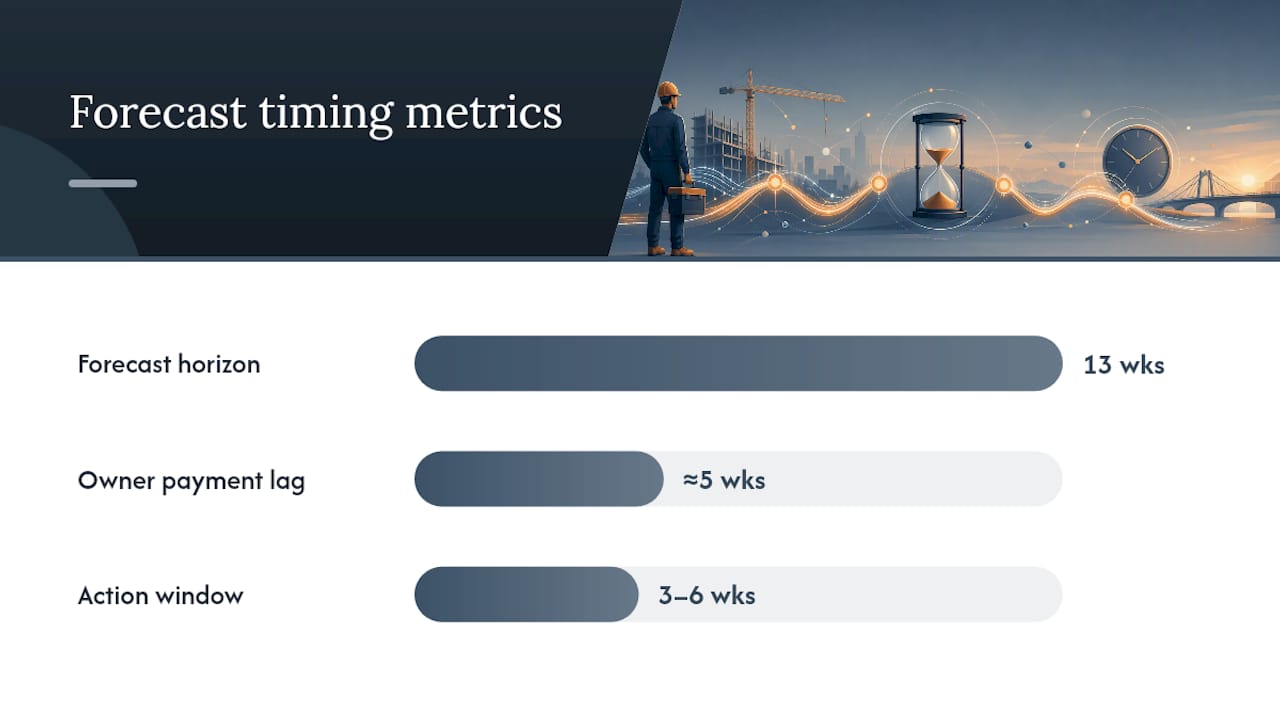
A 13-week rolling forecast gives you roughly a full quarter of forward visibility, updated every week so the picture never goes stale. It is the single most effective tool for catching a funding gap early enough to actually fix it, and it’s the reason experienced project accountants build one for every job over a certain size.
Before you build it, gather five inputs:
- Your pay application schedule and the expected collection lag for this specific owner (use their payment history, not the contract’s stated terms).
- The retainage percentage and release trigger written into the contract.
- Weekly burdened payroll for the crew assigned to the job.
- Payment terms for subcontractors and material suppliers.
- Any scheduled debt payments or equipment lease obligations tied to the project.
With those in hand, build the forecast in four steps:
- Map inflows to probable collection weeks, not billing weeks. If you submit a pay app in week 4 and the owner typically takes 35 days to pay, that cash lands in week 9, not week 4.
- List every outflow by week, including payroll, sub draws, and material deliveries, using actual due dates rather than invoice dates.
- Calculate net cash and running balance for each of the 13 weeks, so you can see exactly which week the balance goes negative if it’s going to.
- Apply probability weighting to uncertain inflows, discounting a pending change order or a disputed pay app until it’s actually approved.
Sub-contractors who maintain this discipline report the weekly update taking about 15 minutes once actuals and pay-app dates feed directly into the model, which makes the weekly cadence sustainable even on a busy job.
When the forecast shows a shortfall three to six weeks out, you have options, and the earlier you see the gap, the more of them are still on the table: accelerate billing on completed work, request a retainage reduction from the owner, renegotiate vendor terms for near-term flexibility, or draw on a line of credit before the gap becomes urgent. Forward visibility of three to six weeks is what actually creates room to act, rather than reacting after payroll is already short.
How to Calculate Your Peak Funding Gap
The number that matters most for bidding and mobilization decisions is your peak funding gap, the largest cumulative cash shortfall the project will hit at any single point before final payment clears. Forecasting tools model contract value, retainage, payment terms, and cost distribution to output this figure directly, and running that calculation before you mobilize tells you the minimum starting cash the job actually requires.
Here’s a simplified version of that math for a $2 million contract:
| Variable | Assumption | Effect on cash |
|---|---|---|
| Contract value | $2 million | Total inflow over project life |
| Mobilization deposit | 10% at signing | A mobilization deposit is immediately |
| Retainage held | 8% per pay app | Trapped until final acceptance |
| Payment lag | 45 days | Delays every collection by 6+ weeks |
| Monthly cost curve | Front-loaded, peak in months 2 to 4 | Highest outflow before biggest inflows land |
Run this job’s costs and collections week by week, and the worst month typically lands right where mobilization spending overlaps with the first payment lag, before any retainage has started releasing. That’s your peak funding gap: the amount of working capital or credit capacity you need in reserve before you break ground.
Once you have that baseline number, stress-test it. Calculator outputs consistently show that raising the mobilization deposit or tightening billing cadence reduces the worst month’s gap more than almost any other lever available, while increasing payment lag or retainage percentage pushes it in the opposite direction fast. Run the sensitivity check before you sign, not after. A forecast that sets a minimum starting cash requirement up front keeps you from committing to a job that will strain the rest of your company’s liquidity.
Practical Ways to Manage Project Cash Flow
Five controls move the needle more than anything else, and none of them require a finance degree to implement.
- Make billing velocity a weekly KPI. Bill on schedule, to the full defensible amount, every single cycle. This is the most controllable lever you have, because you can’t control an owner’s payment habits but you can absolutely control how fast and how completely you bill.
- Negotiate mobilization deposits and staged retainage reduction. A 10 percent mobilization deposit and a clause that steps retainage down as the job nears completion both pull cash forward when you need it most.
- Keep a live retainage release schedule per contract. Track the balance, the release trigger, and the estimated collection date for every job, and feed it straight into your 13-week forecast instead of guessing at the number.
- Set staged payment terms with subs and suppliers. Tie their draws to milestones rather than flat net-30 terms, so your outflows track your actual progress.
- Use a line of credit for timing, not for shortfalls. A revolver bridges the gap between billing and collection. It should never be a substitute for disciplined billing.
Pro Tip: Close out punch lists early and document completion conditions the moment work wraps, since retainage almost never releases until an owner signs off on a clean closeout, and a sloppy punch list is the single most common reason retainage sits uncollected for months.
Why Your Spreadsheet Keeps Breaking Your Forecast
A 13-week forecast is only as good as the data feeding it, and that’s where most spreadsheet-based systems fall apart. When your project accounting lives in QuickBooks, your schedule lives in a separate app, and your job costs live in a third spreadsheet nobody updates in real time, every forecast update becomes a manual reconciliation exercise. Miss one retainage release date or one sub invoice, and the whole 13-week picture is wrong.
An integrated system closes that loop by keeping the inputs connected instead of scattered:
- Automated pay applications that generate directly from job cost data
- Retainage tracking that updates the release schedule as milestones clear
- Job-cost sync that feeds weekly actuals into the forecast without re-entry
- AR/AP visibility in the same system as the schedule, not a separate export
Designflow-build combines project management, accounting, and field operations into one AI-native ERP built specifically for this problem. Picture a retainage release schedule that updates itself the moment a milestone clears in the field, feeding straight into next Friday’s forecast instead of waiting for someone to remember to update a spreadsheet.
What I’d Tell Any Project Manager Starting Their First Forecast
The weekly rolling forecast is not a reporting exercise. It’s the single habit that separates contractors who see a cash gap coming from those who find out about it when payroll bounces. Update it every Friday against actual bank activity, not projected activity, and track billing velocity as its own number every week, separate from job cost reports. Most cash crises I’ve seen traced back through construction financial planning were visible in the data three to five weeks before anyone acted on them. The forecast isn’t the hard part. Looking at it every week and actually making a decision from it is.
— Keith
Get a Faster, More Reliable Cash Forecast With Designflow-build
Designflow-build is the alternative to stitching together spreadsheets, QuickBooks, and a separate scheduling tool for every job you run. Instead of rebuilding your 13-week forecast by hand each Friday, your job costing, AR/AP, and retainage schedule live in one system that updates as the field reports progress.
That means automated pay applications tied directly to job cost data, a retainage tracker that rolls straight into your rolling forecast, and weekly actuals that sync without a re-entry step. If you’re running multiple jobs and tired of reconciling three tools just to know your cash position, check the Construction ERP page or see current plans on the pricing page for current pricing details.
Sources
Run your own numbers with the project cash gap calculator or the construction cash flow forecast calculator. Always verify retainage clauses against your actual contract, and base payment-lag assumptions on the owner’s real payment history, not their stated terms.
- Construction cash flow issues: retainage and payment lag (Corpay blog)
- 13-week cash flow forecast guide (Whipplewood)
- The 13-Week Cash Flow Forecast Every Sub Needs — Construction CFO
- Project Cash Flow Forecaster | Project Cash Gap Calculator
- Construction cash flow forecast calculator (Quoteloc)
FAQ
What Is Project Cash Flow in Construction?
Project cash flow is the timing of cash moving in and out of a single job, tracked week by week rather than by total profit. A job can be profitable on paper and still run short on cash if collections lag behind payroll and vendor payments.
How Do You Calculate Project Cash Flow?
Calculate it by listing every expected inflow (pay app collections, retainage release, deposits) and every outflow (payroll, sub draws, material costs) by the week they actually hit the bank, then running a cumulative balance across a rolling 13-week window. This weekly mapping approach is what reveals the peak funding gap before it becomes an emergency.
What Are the Five Rules of Cash Flow?
There’s no single official “five rules,” but the construction industry consensus centers on: bill promptly and to the full amount earned, track retainage separately from operating cash, forecast weekly rather than monthly, negotiate mobilization funding before you start, and keep a credit line for timing gaps rather than shortfalls. These principles show up consistently across cash flow analysis in construction and form the backbone of most effective cash flow management programs.
What Are Common Cash Flow Problems in Construction?
The most common issues are payment lag from slow owner approvals, retainage holding 5 to 10 percent of every progress payment, front-loaded mobilization costs, and change orders performed before they’re priced and approved. Running multiple projects at once can compound these problems if you don’t track each job’s cash position separately.
Can Software Actually Reduce Cash Flow Forecasting Work?
Yes. Platforms that sync job costing, AR/AP, and field data automatically remove the manual reconciliation that breaks most spreadsheet-based forecasts.