
MEP Project Scheduling Checklist for Contractors

An MEP project scheduling checklist is a structured, phase-by-phase tool that coordinates mechanical, electrical, and plumbing trades across a construction timeline to prevent clashes, idle labor, and costly rework. Without one, trade crews work in isolation, procurement gaps create hidden delays, and commissioning gets rushed at the end. The most effective MEP project scheduling checklist integrates pre-construction coordination, installation sequencing, BIM-based clash detection, long-lead procurement tracking, and structured commissioning. Tools like Critical Path Method (CPM) scheduling and Building Information Modeling (BIM) are the industry-standard backbone of any credible MEP planning checklist.
1. What are the critical phases in an MEP project scheduling checklist?
MEP work sequence breaks into three distinct phases: planning and coordination first, then mechanical, electrical, and plumbing installation, followed by testing and commissioning. Each phase carries its own checklist items, and skipping steps in phase one creates compounding problems in phases two and three.
Phase 1: Pre-construction planning
-
Review architectural and structural drawings for MEP routing conflicts
-
Confirm scope freeze dates with the design team
-
Identify long-lead equipment and issue purchase orders early
-
Establish BIM coordination schedule with weekly cycle dates
-
Assign trade coordination leads and define decision authority
Phase 2: Installation sequencing
-
Sequence mechanical rough-in before electrical conduit runs in shared ceiling spaces
-
Confirm plumbing stack locations before framing is closed
-
Schedule inspections at defined rough-in milestones, not at project end
-
Tie installation start dates to confirmed material delivery dates
Phase 3: Testing and commissioning
-
Schedule pre-commissioning checks before system integration testing
-
Build deficiency correction time into the commissioning window
-
Document all test results and corrective actions in a central log
Pro Tip: Lock your BIM coordination schedule before mobilization. Projects that start BIM clash detection after installation begins spend three to four times longer resolving conflicts.
2. Which checklist items lock MEP scope to avoid rework?
Scope locking is the single most underused step in MEP coordination. A freeze-phase checklist must confirm that shaft sizes, main routes, penetrations, and access clearances are finalized before any Good-for-Construction (GFC) drawings are issued. Checklists that omit these freeze gates allow isolated systems to compete for the same space, which is the leading cause of field rework.
The scope-locking checklist includes:
-
Coordinated shop drawings reviewed and approved by all trades
-
Clash list issued with a defined closure date
-
Approved penetration and sleeve locations documented
-
Core cut plans signed off by the structural engineer
-
Access and maintenance clearances confirmed against equipment specs
-
Responsibility matrix completed with named sign-off contacts at each freeze point
| Freeze gate item | Who signs off |
|---|---|
| Main duct and pipe routes locked | MEP coordinator and architect |
| Shaft sizes confirmed | Structural engineer and MEP lead |
| Penetrations and sleeves approved | Structural engineer |
| Access clearances verified | MEP contractor and owner’s rep |
| Coordinated shop drawings issued | All trade leads |
Pro Tip: Treat each freeze gate as a contract condition, not a courtesy. If a trade misses a sign-off deadline, escalate immediately. Delays at freeze points cascade directly into procurement and installation schedules.

3. How do weekly BIM coordination cycles improve schedule adherence?
Weekly BIM coordination is the operational engine of any MEP scheduling guide. A structured weekly cycle with clash detection, coordination meetings, and assigned resolution tasks keeps the schedule on track across 6–10 cycles on a typical commercial project. That cycle count matters because it tells you how much coordination buffer to build into your MEP project timeline before installation can begin.
The weekly cycle runs in four steps:
-
Federate trade models. Each trade submits updated models by a set cutoff, usually monday morning. Late submissions delay the entire cycle.
-
Run automated clash detection. Use BIM software to generate a clash report sorted by priority and location. Hard clashes (physical conflicts) get resolved before soft clashes (clearance violations).
-
Hold the OAC coordination meeting. Effective coordination meetings require empowered trade representatives who can make routing decisions on the spot. Meetings without decision authority stall on every major clash.
-
Assign resolution owners and deadlines. Every clash gets a named owner and a resolution date before the meeting ends. Open clashes with no owner are the most common reason cycles slip.
Before each OAC meeting, circulate the clash report and proposed routing solutions. Teams that review the report in advance resolve clashes in half the time of teams that see it for the first time in the room.
4. What role does long-lead equipment tracking play in MEP scheduling?
Long-lead procurement is where most MEP project timelines break down. Transformers can carry 120–128 week lead times, and medium-voltage switchgear runs 40–52 weeks. Those numbers mean a transformer ordered at the start of design may still not arrive before the scheduled installation date on a fast-track project.
Your MEP planning checklist must include a dedicated procurement tracking table updated weekly:
| Equipment | Lead time | Order date | Confirmed delivery | Installation window |
|---|---|---|---|---|
| Main transformer | 120–128 weeks | Confirm at SD phase | Required before energization | Per CPM critical path |
| Medium-voltage switchgear | 40–52 weeks | Confirm at DD phase | Required before panel work | Per CPM critical path |
| Air handling units | 16–24 weeks | Confirm at CD phase | Required before ceiling close | Per floor sequence |
| Plumbing fixtures | 8–12 weeks | Confirm at permit | Required before rough-in close | Per floor sequence |
Schedule locking is a condition, not a date. Crews cannot install what has not arrived. A schedule that shows installation starting on a specific date without confirmed material delivery creates hidden idle days that do not appear in manpower-focused schedule reports.
Your MEP project risk management checklist should also include:
-
Supplier capability review at bid award, not just at order placement
-
Weekly material status reports tied directly to installation start dates
-
Backup supplier identification for critical items with lead times over 20 weeks
-
Phased delivery plans for large equipment to match floor-by-floor sequencing
5. What are best practices for scheduling testing and commissioning?
Commissioning is the phase most often compressed when earlier phases run late. Structured commissioning runs through pre-commissioning checks, individual equipment testing, system integration testing, and performance testing in sequence. Skipping or combining steps produces test failures that require full retesting, which costs more time than the original schedule buffer would have.
The commissioning scheduling checklist includes:
-
Pre-commissioning visual inspections completed for all installed equipment
-
Electrical continuity and insulation resistance checks documented before energization
-
Individual equipment startup completed and logged by the installing contractor
-
System integration testing scheduled after all equipment in the system is operational
-
Functional Performance Testing (FPT) scheduled only after 80%–90% of pre-functional checklists are complete
-
DDC controllers programmed and point-to-point verification finished before FPT begins
-
Deficiency log maintained with corrective action deadlines and re-test dates
-
Owner acceptance walkthrough scheduled with buffer time after final deficiency corrections
FPT is the most schedule-sensitive commissioning step. Starting FPT before pre-functional work reaches the 80%–90% threshold guarantees test failures and repeat testing. Build at least two weeks of deficiency correction time between FPT completion and owner acceptance.
6. How does resource leveling protect your MEP project timeline?
CPM scheduling outputs often show physically impossible concurrent work. Resource leveling corrects raw CPM outputs by redistributing tasks so no trade is scheduled in two locations simultaneously. Without leveling, your MEP checklist template looks complete on paper but fails in the field when crews cannot be in two places at once.
Resource leveling applied to MEP scheduling means reviewing each trade’s crew assignments week by week and confirming that the schedule reflects actual crew capacity. A mechanical contractor with two sheet metal crews cannot run three concurrent duct installations. Catching that conflict in the schedule review, rather than on the job site, prevents the kind of delay that triggers liquidated damages.
Supplier capability reviews belong in the same review cycle. A supplier with a known backlog or shipping delay requires a rapid re-quote or phased delivery plan before the schedule is locked. Integrating supplier status into weekly schedule reviews keeps the MEP project timeline grounded in reality, not assumptions.
Pro Tip: Run your resource leveling pass after every major schedule update, not just at the start of the project. Trade crew availability changes as subcontractors take on other work, and a schedule that was leveled in month one may be unrealistic by month four.
Key takeaways
A complete MEP project scheduling checklist integrates scope freeze gates, weekly BIM coordination cycles, long-lead procurement tracking, and phased commissioning to keep mechanical, electrical, and plumbing trades aligned from pre-construction through owner acceptance.
| Point | Details |
|---|---|
| Lock scope before procurement | Freeze shaft sizes, routes, and penetrations before issuing GFC drawings to prevent field rework. |
| Run weekly BIM cycles | Six to ten structured clash detection cycles with empowered trade reps keep the schedule on track. |
| Track long-lead items weekly | Transformers and switchgear carry lead times up to 128 weeks; order early and update status weekly. |
| Tie schedule locks to material delivery | Installation start dates must reflect confirmed delivery dates, not assumed ones. |
| Schedule FPT at 80%–90% pre-functional completion | Starting Functional Performance Testing too early guarantees repeat testing and schedule loss. |
What I’ve learned from MEP schedules that actually hold
The most common failure I see is treating the MEP scheduling checklist as a document rather than a process. Project managers build a detailed checklist at project kickoff, file it, and never update it. By the time installation starts, the checklist reflects the original plan, not the current reality.
The second failure is underestimating how much decision authority matters in coordination meetings. I have watched BIM coordination cycles drag from six weeks to sixteen weeks because trade representatives showed up to meetings without authority to approve routing changes. Every unresolved clash from that meeting becomes a carry-over item, and carry-over items compound. The fix is simple: require each trade to send someone who can say yes in the room.
The third failure is treating commissioning as a single event rather than a phased process. Owners and general contractors push to compress commissioning when earlier phases run late. That compression produces FPT failures, which then require more time than the original commissioning window would have consumed. A facility visualization process that maps commissioning milestones to pre-functional completion thresholds gives you the data to push back on compression requests with evidence, not opinion.
The checklist works when it is a living document tied to weekly schedule updates, procurement status, and BIM coordination progress. Static checklists do not protect schedules. Dynamic ones do.
— Keith
How Designflow-build supports your MEP scheduling workflow
MEP project scheduling requires more than a spreadsheet. Designflow-build combines project management, field operations, and procurement tracking in one AI-native platform built for contractors.
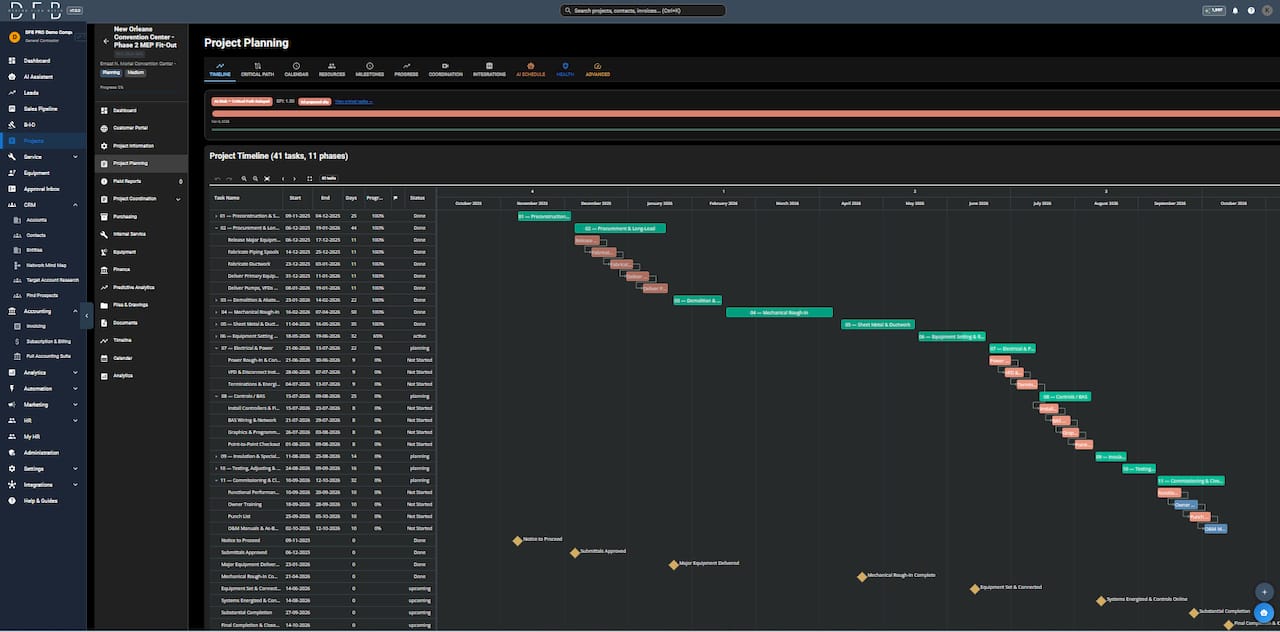
Designflow-build supports CPM scheduling and resource tracking with tools that connect your MEP project timeline directly to material delivery status and crew assignments. The platform reports a 70% reduction in manual data entry and monthly savings of up to $847K for construction teams. Implementation runs in 2–4 weeks with a 98% user adoption rate, so your team is working in the system before the next coordination cycle begins. You can review MEP scheduling terminology and explore how the platform fits your workflow before committing.
FAQ
What is an MEP project scheduling checklist?
An MEP project scheduling checklist is a phase-by-phase coordination tool that sequences mechanical, electrical, and plumbing work across a construction project timeline. It covers pre-construction planning, installation sequencing, BIM clash coordination, procurement tracking, and commissioning.
How many BIM coordination cycles does a typical MEP project need?
Most commercial MEP projects require 6–10 weekly BIM coordination cycles before installation begins. Each cycle includes model federation, automated clash detection, an OAC meeting, and assigned resolution tasks.
When should long-lead MEP equipment be ordered?
Order long-lead equipment as early as the schematic design phase for items like transformers, which carry lead times of 120–128 weeks. Medium-voltage switchgear requires ordering at design development, given 40–52 week lead times.
What is Functional Performance Testing in MEP commissioning?
Functional Performance Testing (FPT) verifies that MEP systems operate as designed under real conditions. FPT should begin only after 80%–90% of pre-functional checklists are complete, with DDC controllers programmed and point-to-point verification finished.
How does resource leveling improve MEP scheduling?
Resource leveling adjusts CPM schedule outputs to reflect actual crew capacity, preventing physically impossible concurrent trade assignments. It catches crew conflicts in the planning phase rather than on the job site, where delays are far more costly.
Recommended
-
Construction Software Glossary — ERP, Takeoff, Scheduling Terms | DesignFlow Build
-
Construction Scheduling Software | CPM, Monte Carlo, DCMA - DesignFlow Build
-
DesignFlow Build | AI Construction ERP Software & Project Management Platform
-
DesignFlow Build - AI-Powered Business Transformation Platform