Construction Bid Management Automation: 2026 Guide

Construction bid management automation is the use of software workflows and AI technologies to systematically manage the end-to-end bidding process in construction, eliminating repetitive manual tasks and improving bid accuracy and throughput. For construction professionals and project managers, this means replacing spreadsheets and email chains with integrated platforms that handle everything from bid discovery to final submission. Tools like Dodge Data, ProEst, Pivotly, and Building Connected now connect directly into automated workflows, giving your team the capacity to pursue more work without adding headcount. The core benefit is straightforward: automation reduces manual re-keying across every stage of the construction bidding process, freeing estimators to focus on pricing strategy instead of data entry.
What is construction bid management automation and how does it work?

Construction bid management automation connects external bid feeds directly into your internal workflows, covering estimating, proposal assembly, and subcontractor coordination without manual downloads or notifications. The industry term for this integrated approach is bid lifecycle automation, and it operates as an orchestration layer across specialized tools rather than replacing them.
The workflow typically runs through seven stages:
- Bid discovery. Platforms like Dodge Data push new project opportunities into your pipeline automatically. You set filters by trade, geography, and project size, and matching bids appear without manual searching.
- Invitation capture. Bid invitations from general contractors arrive through platforms like Building Connected and are logged directly into your pipeline. Invitation capture and scoring eliminate the need to manually track incoming opportunities across email inboxes.
- Opportunity qualification. Automated scoring ranks bids by fit based on your predefined criteria. Estimators receive only the opportunities worth pursuing, not every invitation that comes in.
- Estimating and takeoff. Structured data from RFPs and blueprints feeds into estimating tools like ProEst or Sage. Pivotly, for example, parses full bid packages and extracts quantities and material details automatically.
- Proposal assembly. Generative AI drafts proposal sections from structured project data, pulling scope descriptions, exclusions, and standard language from your template library.
- Submission and deadline management. Automated reminders track due dates across your entire bid pipeline. No bid misses a deadline because it was buried in someone’s inbox.
- Follow-up and win/loss tracking. Post-submission, the system logs outcomes and updates your pipeline, giving you clean data for win rate analysis.
Pro Tip: Set your bid discovery filters tightly at first. A wide filter floods your pipeline with low-fit opportunities and defeats the purpose of automated qualification.
How does AI improve the construction bidding process?
AI adds a layer of intelligence that basic workflow automation cannot provide. The most impactful applications are document parsing, compliance scanning, and proposal generation.
- RFP and blueprint parsing. AI reads bid documents and extracts structured data, including quantities, material specs, and scope requirements. Pivotly’s AI extracts key material counts and flags changes in addenda in real time, removing the manual counting that consumes estimator hours.
- Compliance scanning. Natural language processing (NLP) scans bid documents for regulatory requirements, bonding thresholds, insurance minimums, and prevailing wage clauses. AI bid management tools flag regulatory requirements before submission, reducing the risk of a disqualified bid.
- Proposal summarization and assembly. Generative AI drafts narrative sections of proposals, pulling from structured project data and your approved language library. ConstructionBids.ai uses this approach to accelerate proposal assembly while keeping estimators in control of final content.
- Scope drift prevention. Automation platforms maintain consistent project and trade codes through every stage of the bid lifecycle. This prevents the version control errors that cause pricing mismatches between your estimate and your submitted proposal.
Governance is non-negotiable when using AI in bid management. Humans must verify pricing and legal decisions before any submission goes out. AI handles organization and summarization well. It does not replace the judgment your estimator brings to a complex scope.
Pro Tip: Treat AI output as a first draft, not a final answer. Build a human checkpoint into your workflow specifically for scope review, pricing sign-off, and legal compliance before every submission.
The broader shift AI enables is moving estimators away from counting and toward strategy. The largest benefit in estimating comes from automating handoffs between document intake and pricing-ready data. That shift is where the real productivity gain lives.
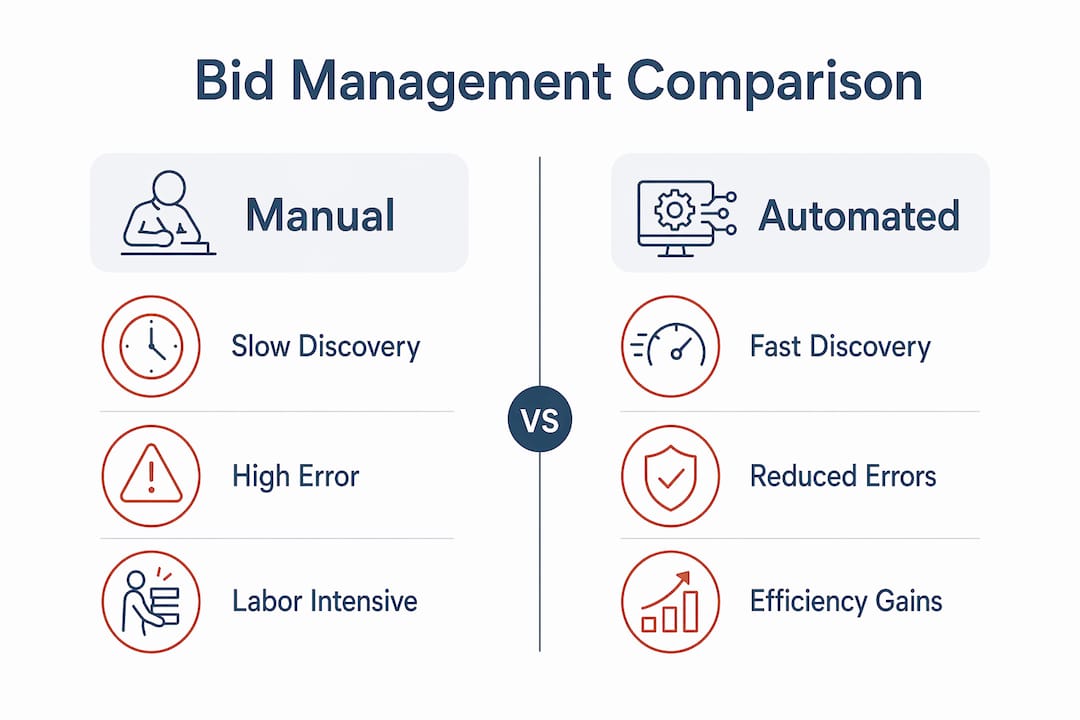
Manual vs. automated bid management: which delivers better results?
The gap between manual and automated bid management is measurable at every stage of the construction bidding process.
| Factor | Manual process | Automated process |
|---|---|---|
| Bid discovery | Manual searches across multiple portals | Automated feeds from Dodge Data and similar platforms |
| Invitation tracking | Email inbox and spreadsheet | Centralized pipeline with scoring and assignment |
| Estimating data entry | Manual re-keying from PDFs | Structured data extracted by AI tools like Pivotly |
| Deadline management | Calendar reminders, prone to gaps | Automated alerts across the full pipeline |
| Subcontractor coordination | Email chains, no audit trail | Building Connected integration with logged communications |
| Proposal assembly | Copy-paste from previous bids | Template-driven generation with version control |
| Bid volume capacity | Limited by estimator hours | Up to three times more bids submitted per period |
The manual approach works when you are submitting a handful of bids per month. It breaks down when you want to grow bid volume without growing your team. Spreadsheet-based workflows also create version control risks: two estimators working from different copies of a scope document is a common source of pricing errors on bid day.
Platforms like US Tech Automations act as an orchestration layer connecting Dodge Data, ProEst, and Building Connected into a single workflow. That integration is what separates a collection of software tools from a true bid management system.
Best practices for implementing bid automation in construction
Adopting bid management automation works best when you treat it as a process change, not just a software installation. These practices separate successful implementations from ones that stall after the first month.
- Start with the orchestration layer. Connect your bid discovery feed, estimating tool, and subcontractor platform before adding AI features. A clean data flow between systems is the foundation everything else depends on.
- Maintain audit trails. Every change to a scope document, estimate, or proposal draft should be logged with a timestamp and user ID. Audit trails and version control are governance requirements, not optional features.
- Build human checkpoints into the workflow. Automated workflows should pause at three points: scope finalization, pricing sign-off, and legal compliance review. Removing these checkpoints to save time is the most common failure mode in bid automation.
- Require structured outputs, not text summaries. Your estimating tool needs bid-ready structured data, not a paragraph describing the scope. Platforms that produce structured, bid-ready outputs prevent estimator rework and scope drift.
- Train your team on governance, not just the software. Estimators need to understand what the AI is doing and where it can be wrong. A team that trusts AI output blindly will eventually submit a bid with an error the system introduced.
- Align on consistent project and trade codes. Use the same codes from bid intake through proposal submission. Inconsistent coding is the leading cause of scope mismatches in automated workflows.
The AI governance guidance from the architecture and federal procurement space reinforces this point. Research on AI in procurement workflows consistently shows that human oversight at pricing and compliance stages is what separates successful automation from costly errors.
What is the ROI of bid management automation for contractors?
The financial case for bid automation is direct. Automation enables submitting three times more bids by replacing manual workflows, with the strongest gains reported for general contractors with $2 million to $20 million in revenue and 10 to 100 workers.
That productivity gain compounds quickly. If your team currently submits 10 bids per month and wins 20% of them, tripling bid volume to 30 submissions at the same win rate means six wins per month instead of two. The revenue impact depends on your average contract size, but the math is straightforward.
Beyond volume, automation delivers measurable cost reductions in administrative labor. Estimators spend less time on data entry and more time on the pricing decisions that actually win work. Designflow-build reports a 70% reduction in manual data entry for contractors using its AI-native ERP, which translates directly into estimator capacity. Tracking your win/loss ratio before and after implementation gives you the clearest picture of ROI. Pair that with a measure of administrative hours saved per bid, and you have the two metrics that justify the investment to any stakeholder.
Key Takeaways
Construction bid management automation delivers the highest ROI when it functions as an orchestration layer connecting specialized tools, with human oversight built into every critical decision point.
| Point | Details |
|---|---|
| Automation covers the full bid lifecycle | From bid discovery through submission and follow-up, software handles every repetitive stage. |
| AI extracts data, humans own decisions | AI parses RFPs and blueprints accurately, but estimators must verify pricing and legal compliance. |
| Tripling bid volume is achievable | Replacing manual workflows with automation can enable three times more bid submissions per period. |
| Governance prevents costly errors | Audit trails, version control, and human checkpoints are required features, not optional add-ons. |
| Structured outputs matter more than summaries | Estimating tools need bid-ready data, not text paragraphs, to avoid rework and scope drift. |
What I have learned watching contractors adopt bid automation
The contractors who get the most from bid automation are not the ones who buy the most software. They are the ones who fix their process first and then automate it.
I have watched teams implement platforms like Building Connected or ProEst and immediately hit a wall because their internal bid qualification criteria were never written down. The software cannot score opportunities if no one has defined what a good opportunity looks like. That is a process problem, not a technology problem.
The other failure mode I see consistently is over-trusting AI output on scope. Generative AI is genuinely useful for drafting proposal language and summarizing bid documents. It is not reliable for catching a buried alternates clause or a liquidated damages provision that changes your risk profile entirely. Those require an estimator who has read the full document.
The emerging trend worth watching is AI that flags compliance issues in real time as documents arrive, not just at submission. Research on AI in federal procurement shows this capability maturing fast, and it will move into commercial construction bid workflows within the next 18 months.
My practical recommendation: implement automation in stages. Start with bid discovery and deadline management. Add AI document parsing once your team trusts the data flow. Add generative proposal assembly last, after you have governance checkpoints in place. Rushing to full automation before your team understands the system is the fastest way to submit a bid you regret.
— Keith
How Designflow-build supports your bid management workflow
Designflow-build is built for contractors who want to cut manual work without rebuilding their entire operation from scratch.

The platform combines AI-driven project management, accounting, and field operations in one system, with a reported 70% reduction in manual data entry. For bid management specifically, Designflow-build’s AI takeoff tools connect blueprint data directly into your estimating workflow, removing the manual extraction step that slows most teams down. Implementation runs in 2–4 weeks with a 98% user adoption rate, so your team is productive fast. You can review the full construction software glossary to understand how ERP, takeoff, and scheduling terms connect to your bid workflow, or explore the full platform to see how it fits your operation.
FAQ
What is construction bid management automation?
Construction bid management automation is the use of software workflows to handle every stage of the bidding lifecycle, from bid discovery and document parsing to proposal assembly and submission tracking, without manual data re-entry.
How does AI help with the construction bidding process?
AI parses RFPs and blueprints to extract structured quantity and material data, scans documents for compliance requirements using NLP, and drafts proposal sections using generative AI. Human estimators must review and approve all pricing and legal decisions before submission.
Can automation really triple bid submission volume?
ROI studies show that replacing manual spreadsheet and email workflows with integrated automation platforms can enable contractors to submit three times more bids per period, with the strongest gains for contractors with $2 million to $20 million in annual revenue.
What tools are commonly used in bid management automation?
Common platforms include Dodge Data for bid discovery, ProEst and Sage for estimating, Building Connected for subcontractor coordination, and Pivotly for AI-powered RFP parsing. US Tech Automations connects these tools as an orchestration layer.
What governance rules apply to AI in bid management?
Safe AI use requires audit trails and human review at scope finalization, pricing sign-off, and legal compliance stages. AI should never submit a bid without explicit human approval of the final document.