Which Plumbing Franchise Is the Right Fit for You?
For investors with $150,000 or more in liquid capital, established national networks like Mr. Rooter or Roto-Rooter offer the fastest path to scale, thanks to territory protections and vendor buying power. Owner-operators working with a tighter budget do better with niche, drain-focused models such as Zoom Drain, which typically demand less staffing to open the doors. If you want a higher average ticket from day one, dual-service brands like 1-800-Plumber + Air let you cross-sell HVAC work alongside plumbing calls.
A plumbing franchise is a licensed business arrangement where you operate under an established brand’s systems, marketing, and vendor relationships in exchange for an upfront fee and ongoing royalties. Here’s the shortlist to start with:
- Mr. Rooter — best for investors wanting a recognizable national brand and mature systems
- Zoom Drain — best for entrepreneurs seeking a lower-capital, specialist entry point
- 1-800-Plumber + Air — best for investors chasing higher tickets through bundled services
- Benjamin Franklin Plumbing — best for owners building a recurring residential maintenance base
Expect a typical plumbing franchise cost to vary widely depending on brand and territory, with initial franchise fees commonly landing in the range of tens of thousands of dollars. Mr. Rooter, for instance, lists an initial franchise fee near $42,500 alongside its total investment band.
Key Takeaways
Choosing among plumbing franchise brands comes down to matching territory protection, franchise fee, and support depth to your available capital and operating goals.
| Point | Details |
|---|---|
| Match brand to profile | National brands like Mr. Rooter suit capital-heavy investors; niche brands like Zoom Drain suit lower-budget entrants. |
| Verify Item 7 costs | Always confirm marketing-page figures against the FDD’s Item 7 cost breakdown before budgeting. |
| Budget 18 months of runway | Plan working capital beyond startup costs to cover the ramp to profitability. |
| Escape the technician trap | Hire a lead tech and shift into management early to scale past one or two trucks. |
| Unify your back office | Designflow-build combines dispatch, accounting, and field data entry to cut manual admin as franchise territories grow. |
Where to Verify These Numbers Yourself
- Request the franchisor’s FDD, focusing on Item 7 (costs) and Item 19 (earnings, if disclosed)
- Review the FTC’s franchise buying guide for the full due-diligence checklist
- Cross-check figures against independent rankings like Franzy’s franchise guide
Table of Contents
- Comparing the Top Plumbing Franchise Opportunities
- What Each Top Plumbing Franchise Actually Offers
- How Do You Actually Choose Between Franchise Brands?
- What Will It Actually Cost to Open and Operate?
- The Path From Research to Grand Opening
- What Separates Franchisees Who Scale From Those Who Stall?
- Frequently Asked Questions
- Sources
Comparing the Top Plumbing Franchise Opportunities
The table below pulls together publicly disclosed figures from franchisor pages and third-party aggregators so you can compare candidates before requesting a Franchise Disclosure Document (FDD). Numbers vary by territory and disclosure year, so treat these as starting ranges, not quotes.
Rooter-Man, Z Plumberz, ACE DuraFlo Systems, and Order a Plumber don’t publish standardized investment figures across all territories, so you’ll need to request their FDDs directly to get exact numbers.
The Franzy franchise guide aggregates FDD-derived investment ranges and unit revenue estimates across multiple plumbing brands, and it’s a solid second opinion once you’ve pulled a franchisor’s own numbers.
Pro Tip: Always cross-check the marketing page figures against FDD Item 7, which itemizes the actual all-in startup cost range, including working capital and additional funds a franchisor requires you to hold in reserve.
Where public data goes quiet, that’s not a red flag by itself. Ask for current franchisee contact lists and bring your specific questions to discovery day.
What Each Top Plumbing Franchise Actually Offers
Mr. Rooter runs on decades of systemized operations, with national vendor programs and marketing support baked into the franchise agreement. Franchisor materials describe training, tech tools, and vendor discounts as core to the offering. It fits investors who want a mature playbook rather than one they build themselves.
Roto-Rooter operates through a network of largely independent franchises tied together by a well-known brand and centralized logistics for parts and training, according to the company’s own franchise description. If brand recognition alone drives calls in your target market, this weighs heavily in Roto-Rooter’s favor.
Benjamin Franklin Plumbing leans hard into residential maintenance agreements and structured service protocols, positioning itself for owners who want predictable, recurring revenue rather than one-off emergency jobs. The brand’s franchise page emphasizes training and field onboarding as differentiators.
bluefrog Plumbing + Drain targets a more modern brand image, with technician development programs and growth pathways into commercial work. Investors evaluating bluefrog’s franchise materials should note that territory availability is one of the biggest ROI variables, since protected territories can matter more than small differences in marketing spend.
Rooter-Man brings decades of regional market experience and an emergency-response focus, similar to positioning seen in other legacy drain and sewer specialists that emphasize urgent-call revenue and premium ticket sizes for after-hours work.
Z Plumberz centers its model on customer retention and service quality metrics, appealing to operators who’d rather compete on repeat business than volume.
1-800-Plumber + Air stands out for its dual-service structure. Bundling plumbing with HVAC gives franchisees a second revenue stream and a higher average ticket, which can offset a heavier buildout cost.
Zoom Drain keeps things narrow: drain and sewer work only, which usually means a leaner staffing model and lower initial complexity compared to full-service brands.
ACE DuraFlo Systems differentiates through technical or proprietary service lines rather than broad residential plumbing, making it a fit for investors who want a more specialized, product-linked business.
Order a Plumber focuses on inbound lead volume and dispatch efficiency, which suits owners who want a business built around call handling and scheduling rather than heavy marketing overhead.
Before you commit to any of these, the FTC’s consumer guide walks through exactly which FDD sections to scrutinize, especially Item 19 if the franchisor makes any earnings claims.
How Do You Actually Choose Between Franchise Brands?
Rank your evaluation in this order, because the first three items eliminate more bad fits than everything else combined:
- Territory exclusivity. Confirm whether your territory is protected or shared. A non-exclusive territory can quietly cap your revenue no matter how good the brand is.
- Item 7 costs. Pull the actual FDD, not the marketing page. Compare the low and high ends against your available capital plus a cash cushion.
- Net worth and liquidity requirements. Franchisors set minimums for a reason. If you’re stretching to meet them, you won’t have reserves for slow months.
- Training and field onboarding depth. Ask how many weeks of hands-on training you get and whether it covers dispatch, sales, and management, not just technical skills.
- National buying power and vendor discounts. Larger networks negotiate better parts pricing, which can materially improve margins compared to running independently.
- Marketing support and tech stack. Ask what’s centrally managed versus what you’re expected to fund and run yourself.
At discovery day, ask current franchisees about churn, average time to profitability, and how often the franchisor updates its tech tools. Walk away if Item 7 costs are vague, if unit economics aren’t disclosed anywhere, or if multiple franchisees mention high turnover among peers.
What Will It Actually Cost to Open and Operate?
Your plumbing franchise cost breaks into three buckets: the initial franchise fee, one-time startup costs, and ongoing operating fees.
- Initial franchise fee: typically $30,000 to $50,000, though niche or lower-capital brands can run lower.
- Startup costs: trucks, tools, vehicle wraps, office setup, and initial marketing, often pushing total investment into six figures.
- Working capital: budget for a 12 to 18 month runway beyond your startup spend. Most new franchisees underestimate this.
- Recurring fees: royalties usually range from mid single digits to around 7% of gross revenue, plus a separate national advertising fee.
Financing typically comes from three sources: SBA 7(a) loans, franchisor-arranged financing programs, and third-party lenders. Lenders will ask for your FDD and want to see validated revenue data before approving a service-business loan.
Pro Tip: Build your cash flow model around an 18-month runway, not 12. Plumbing franchises ramp faster than restaurants but slower than most new owners expect, especially while you’re still hiring your first lead technician.
The Path From Research to Grand Opening
- Shortlist 3 to 5 brands based on territory availability and investment fit.
- Request the FDD from each and read Item 7 and Item 19 closely.
- Call current franchisees, not just the ones the franchisor recommends.
- Attend discovery day to meet leadership and see the training operation firsthand.
- Secure financing, typically 4 to 8 weeks for SBA-backed loans.
- Sign the franchise agreement and begin territory setup.
- Complete training and launch, usually 8 to 12 weeks after signing.
What Separates Franchisees Who Scale From Those Who Stall?
The owners who grow past one or two trucks stop thinking like plumbers and start thinking like executives. Franchise development sources consistently point to the same pattern: successful owners focus on hiring, commercial contracts, and management instead of staying on the tools themselves.
The failure mode has a name in the industry: the technician trap, where an owner keeps doing field work instead of hiring a lead tech and building dispatch systems. Escaping it early is what determines whether you’re still running calls yourself in year three.
Pro Tip: In year one, prioritize three things: hire a lead technician as soon as revenue supports it, put dispatch and scheduling software in place before you add a second truck, and start selling recurring maintenance agreements immediately rather than waiting for slow season.
- Build emergency-response capacity early; urgent calls carry premium tickets.
- Sell maintenance agreements as your first recurring revenue play.
- Use your network’s vendor discounts aggressively from day one.
A Note on Operational Readiness
Buying into a strong plumbing franchise brand only gets you halfway there. What actually determines whether you scale past your first few trucks is whether your dispatch, billing, and job costing systems can keep pace once call volume climbs.
Scaling Past the First Few Trucks
Every plumbing franchise owner eventually hits the same wall: more trucks means more scheduling conflicts, slower invoicing, and messier job costing if you’re still running things on spreadsheets. Designflow-build was built for exactly this stage, combining dispatch, accounting, and field data entry into one system instead of the patchwork most franchisees inherit.
Where a franchisor gives you the brand and the playbook, Designflow-build gives you the operational backbone that the playbook depends on. Its AI-driven project management tools predict scheduling conflicts before they cost you a missed appointment, and the platform’s mobile field app lets technicians log job data by voice from the truck instead of paperwork at day’s end. Franchisees using disconnected tools for scheduling, accounting, and dispatch often lose hours a week to manual entry, hours that compound fast once you’re running three or four crews. If you’re evaluating how to run the back office behind a new franchise plumbing services territory, take a look at DesignFlow Build’s platform and see what a unified system looks like before you sign your first vendor contract.
Frequently Asked Questions
What is the typical plumbing franchise cost to get started? Most brands require a total investment between the mid five figures and $250,000 or more, with initial franchise fees commonly falling between $30,000 and $50,000. Exact figures depend on territory, buildout needs, and brand.
Which plumbing franchise is best for a first-time owner? It depends on your capital and risk tolerance. Investors wanting a proven system often start with established national brands, while those on a tighter budget look at specialist models with lower startup staffing needs.
Is a plumbing franchise business opportunity recession-resistant? Plumbing demand is largely driven by urgent repairs and infrastructure maintenance rather than discretionary spending, which industry analyses describe as a generally recession-resistant pattern compared to more discretionary service categories.
How long does it take to open a plumbing franchise? From initial FDD request to grand opening, most buyers spend 4 to 6 months on financing, agreement signing, and training before launch.
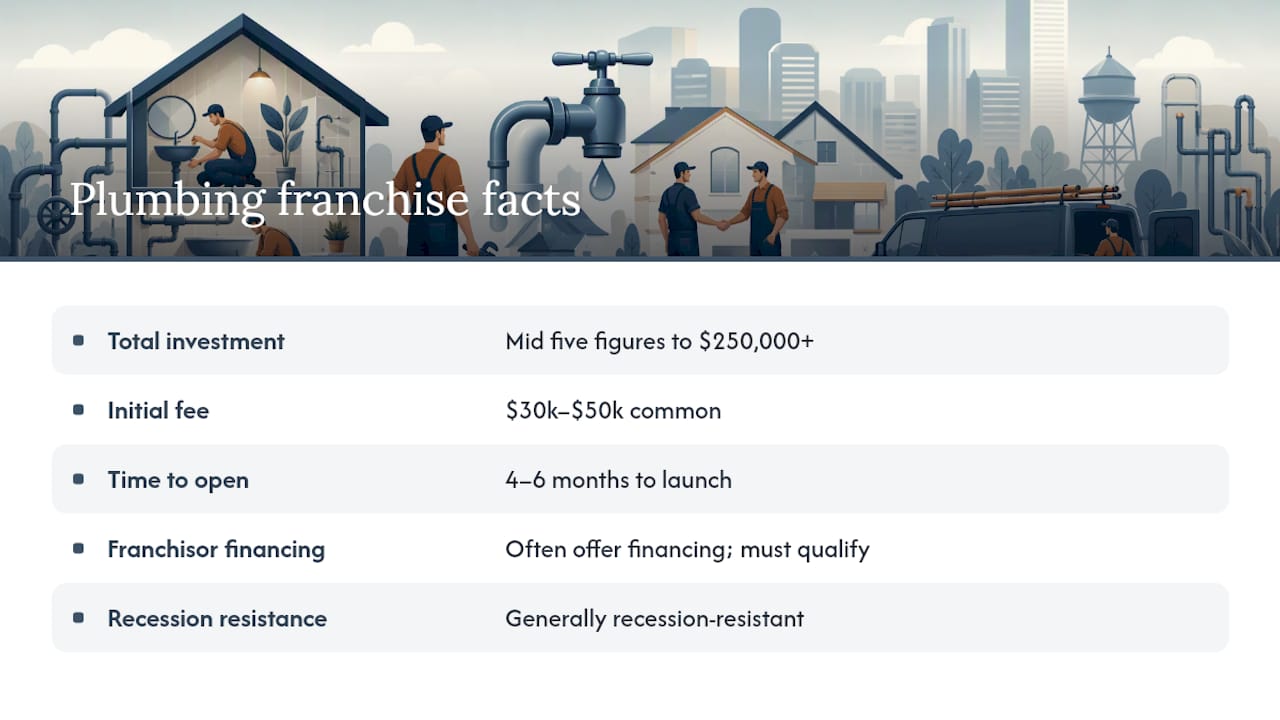
Do plumbing franchises offer financing help? Many franchisors offer their own financing programs or partnerships with SBA-approved lenders, though you’ll still need to qualify based on personal net worth and liquid capital requirements.
Sources
- Consumers’ Guide to Buying a Franchise — FTC
- Plumbing Franchise Business | Mr. Rooter Plumbing
- Best Plumbing Franchises of 2025: Complete Guide and Rankings - Franzy
- bluefrog franchise
- Benjamin Franklin Plumbing - Franchise