
Depreciating Asset: What Small Business Owners Need to Know

A depreciating asset is a tangible item your business owns that loses value over a predictable useful life, and you spread its cost across years for accounting and tax purposes rather than expensing it all at once. Think machinery, vehicles, or the laptop you bought for your crew lead. U.S. tax rules generally require the Modified Accelerated Cost Recovery System (MACRS) for property placed in service after 1986, according to the IRS.
Two things to do right now:
- Check IRS guidance to confirm your item qualifies before you write off a dime.
- Track the purchase cost, the date you placed it in service, and the percentage of business use, starting today.
Pro Tip: Getting the placed-in-service date wrong is the single most common depreciation mistake small business owners make. It determines your entire schedule.
Key Takeaways
A depreciating asset loses value on a predictable schedule, and choosing the right method plus keeping clean records determines whether you capture every deduction you’re entitled to.
| Point | Details |
|---|---|
| Know the five-part test | An asset must be owned, business-used, last over a year, have determinable life, and not be excepted property. |
| MACRS governs most tax filings | Property placed in service after 1986 generally uses MACRS class lives and IRS-set conventions. |
| Depreciation is non-cash | It lowers taxable income but gets added back on your cash-flow statement since no cash actually leaves. |
| Match method to asset behavior | Use units-of-production for wear-based equipment, accelerated methods for fast-obsolete tech, straight-line for steady reporting. |
| Records protect your deductions | Invoices, placed-in-service dates, and business-use logs make Section 179 claims and disposals defensible. |
Table of Contents
- What Qualifies as a Depreciating Asset
- Common Examples of a Depreciating Asset
- Why Depreciation Matters for Your Books and Your Tax Bill
- Depreciation Methods: Which One Fits Your Asset
- U.S. Tax Rules at a Glance: MACRS and Beyond
- Cost Basis, Salvage Value, and When Depreciation Starts
- Records to Keep for a Depreciating Asset
- Two Worked Examples: Straight-Line vs. Tax-Style Depreciation
- Quick Practical Guidance for Owners
- Sources
What Qualifies as a Depreciating Asset
The IRS applies five tests to decide whether something counts. You must own the property, use it in a business or income-producing activity, and expect it to last more than one year with a determinable useful life. It also can’t fall under “excepted property” (certain leased or inherited items), according to IRS Topic 704.
Depreciation is often confused with two cousins: amortization applies to intangible assets like patents and software licenses, while depletion applies to natural resources like timber or oil reserves. Each uses a different allocation method, but the goal is the same: spread cost over useful life.
- Land, no matter how much it appreciates, is never depreciable.
- Inventory held for sale doesn’t qualify either. It’s an expense when sold, not a fixed asset.
- Property held purely for personal use is off the table until it’s converted to business use.
Common Examples of a Depreciating Asset
Most small businesses carry a handful of textbook examples on their books:
- Computers and office equipment
- Manufacturing or shop machinery
- Office furniture
- Business vehicles
- Buildings (not the land beneath them)
- Specialized tools and equipment
What about a home office desk or a truck you also use on weekends? You prorate it. If you drive a pickup 60% for jobs and 40% for personal errands, you can only depreciate 60% of its cost, since the IRS doesn’t allow depreciation on the personal-use portion of any mixed-use asset. Land itself stays off your depreciation schedule permanently, but improvements you make to it, like paving a parking lot, usually qualify.
Why Depreciation Matters for Your Books and Your Tax Bill
Depreciation exists because of the matching principle: you record an asset’s cost in the same periods it helps generate revenue, rather than dumping the whole expense in month one. That’s the accounting rationale AccountingTools lays out clearly.
Here’s the part that surprises new business owners: depreciation lowers your taxable income without touching your actual cash. It’s a non-cash expense, which means it gets added back to net income on your cash-flow statement, according to FMX’s cash-flow training materials. That’s why a business can show strong cash reserves even while reporting a thinner profit on paper.
- It shapes when you owe tax, not just how much.
- It helps you budget for equipment replacement before the old unit dies on a job site.
- It keeps your balance sheet honest about what your assets are actually worth today.
Depreciation Methods: Which One Fits Your Asset
Four methods cover almost every situation you’ll run into:
- Straight-line: (Cost minus salvage value) divided by useful life. Same deduction every year, the simplest and most common method.
- Declining balance (including double-declining): Applies a fixed percentage to the asset’s remaining book value each year, front-loading larger deductions early.
- Sum-of-the-years’-digits (SYD): Weights early years more heavily than straight-line but less aggressively than declining balance.
- Units-of-production: Ties the deduction to actual usage, like machine hours or miles driven, instead of the calendar.
A quick example: a $10,000 machine with a $1,000 salvage value and 5-year life depreciates $1,800 per year under straight-line. Under double-declining balance, year one jumps to $4,000 (20% times 2, or 40%, applied to full cost), then shrinks each year after.
Pro Tip: If wear and tear tracks with how hard you run the equipment, like a concrete mixer or a fleet vehicle, units-of-production usually reflects reality better than a calendar-based method. For tech that goes obsolete fast, like computers, an accelerated method often makes more tax sense.
U.S. Tax Rules at a Glance: MACRS and Beyond
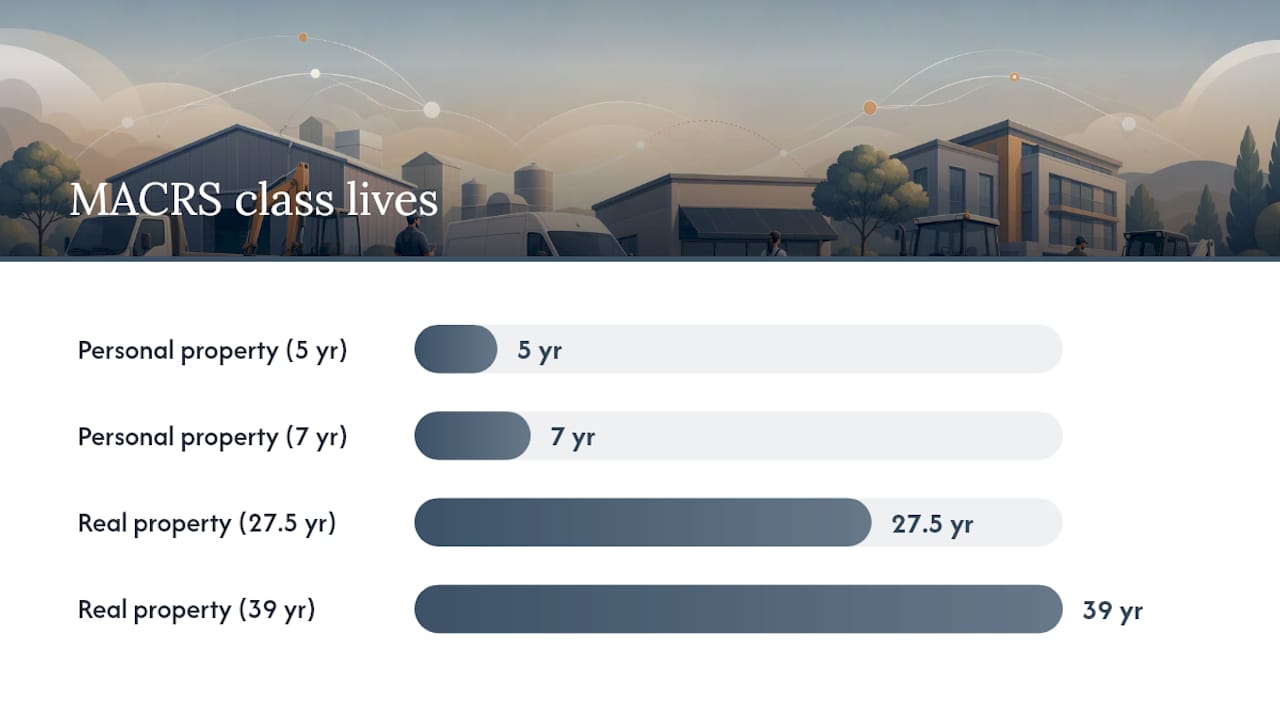
MACRS is the system the IRS generally requires for property placed in service after 1986, and it splits assets into personal property (like equipment, typically 5 or 7-year class lives) and real property (buildings, typically 27.5 or 39 years), according to IRS Topic 704. Publication 946 is where the actual class-life tables and depreciation percentages live.
Conventions determine how much you deduct in a partial year:
- Half-year convention: treats the asset as placed in service midyear, regardless of the actual date.
- Mid-quarter convention: applies when you place a large share of assets in service late in the year.
- Mid-month convention: used for real property.
Section 179 and bonus depreciation both let you accelerate deductions, sometimes writing off the full cost in year one, but eligibility rules and dollar caps shift and depend on current law. Confirm current limits directly with IRS guidance before you count on either one.
Cost Basis, Salvage Value, and When Depreciation Starts
Your depreciable base isn’t just the sticker price. It’s the purchase cost plus setup, shipping, and sales tax, minus the estimated salvage value at the end of its useful life. Buy a $50,000 excavator, pay $2,000 to ship and install it, and expect to sell it for $8,000 in ten years? Your depreciable base is $44,000.
Depreciation starts the day the asset is “placed in service,” meaning ready and available for use, not the day you ordered it. It stops when you’ve deducted down to salvage value, sold the asset, or pulled it from business use entirely.
- Buy equipment in October? A partial-year convention limits your first-year deduction, even though you own it for the full fourth quarter.
- Use a vehicle 70% for business? You depreciate 70% of the eligible base, not the full amount.
Records to Keep for a Depreciating Asset
Keep these on file for every asset you depreciate:
- Purchase invoices and proof of payment
- Date placed in service
- Serial numbers or asset tags
- Business-use percentage logs, especially for vehicles and mixed-use equipment
- Documentation distinguishing repairs (expensed immediately) from improvements (capitalized and depreciated)
- Disposal or sale records, including sale price and date
Good documentation makes Section 179 elections, bonus depreciation claims, and eventual disposals far easier to defend if the IRS ever asks. A simple asset schedule tracking cost, date, useful life, and accumulated depreciation speeds up your year-end close.
Pro Tip: Set up your asset register the day you buy the item, not at tax time. Retroactively hunting down a placed-in-service date from eight months ago wastes hours you don’t have.
Two Worked Examples: Straight-Line vs. Tax-Style Depreciation
Example 1, straight-line: You buy office furniture for $12,000, expect $2,000 salvage value, and assign a 5-year useful life.
- Depreciable base: $12,000 minus $2,000 equals $10,000.
- Annual depreciation: $10,000 divided by 5 equals $2,000 per year.
- Book value after year one: $10,000.
Example 2, MACRS-style: That same $12,000 furniture purchase falls into the 7-year class life under Publication 946’s tables. Using the half-year convention, your first-year MACRS deduction runs higher than straight-line’s $2,000, since MACRS front-loads deductions using declining-balance math before switching to straight-line partway through the schedule. For your actual dollar figures, run the numbers against the IRS Publication 946 tables or a depreciation schedule calculator, since percentages vary by asset class and convention.
Quick Practical Guidance for Owners
Many small businesses set a capitalization threshold within a typical financial range so that smaller purchases get expensed immediately, and larger ones get depreciated, based on common small-business practice. Accelerated methods help when you want tax relief now; straight-line helps when steady, predictable reporting matters more. A digital asset register built into your accounting system catches misclassified expenses before they become an audit headache.
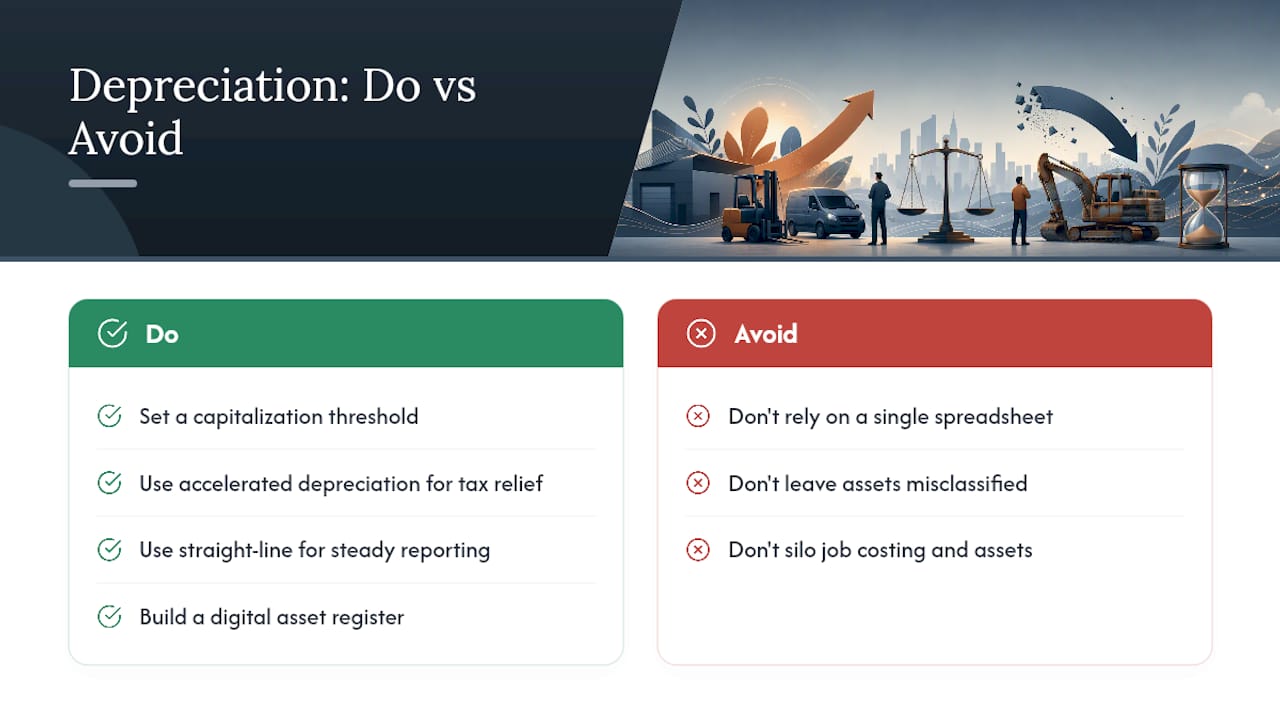
Depreciation decisions rarely stay simple once you’re running multiple job sites, tracking equipment across crews, and juggling both GAAP books and tax filings. DesignFlow Build’s construction ERP folds job costing, asset tracking, and general ledger entries into one system, so your depreciation schedules stay tied to the actual projects and cost codes your equipment supports. Contractors using the AI-driven project and accounting platform cut manual data entry significantly by eliminating the spreadsheet-to-QuickBooks handoff that trips up so many asset registers. If you’re still tracking depreciation in a spreadsheet that lives on one laptop, it is worth fixing before next tax season.
Sources
- Topic no. 704, Depreciation | Internal Revenue Service
- Depreciation definition and methods — Investopedia
- Cash-flow training — FMX / Texas
This article is general information, not a substitute for advice from a qualified financial advisor. Consult a qualified financial professional about your own circumstances before acting on anything here.