
Stop Premature Releases: Automate Lien Waivers for U.S. Contractors

Lien waiver management is the process of generating, signing, verifying, and storing the documents that release lien or bond claim rights on a construction project. The right approach for most contractors in 2026 is automation paired with a conditional-first policy: send conditional waivers by default, only convert them to unconditional once payment actually clears. Do that consistently, and you cut lien exposure, speed up closeout, and build an audit trail that holds up if a dispute ever lands in front of a lender or a court.
TL;DR:
- Automating lien waiver management reduces lien exposure, speeds project closeout, and creates a reliable audit trail when payment is confirmed before waiver conversion.
- Using state-specific statutory templates is essential, as generic forms can be invalid in about twelve U.S. states if they lack official language.
- Connecting payment confirmation data from accounting systems prevents converting waivers prematurely and safeguards legal rights.
- Assigning clear roles, setting triggers, and running weekly audits help prevent common errors like signing waivers too early or with incorrect information.
- Signing unconditional waivers before payment clearance risks losing lien rights and delaying payment, especially on jobs with extended settlement periods.
Table of Contents
- What Lien Waiver Management Actually Covers
- The Four Waiver Types and When to Use Each
- State Rules That Can Void Your Waiver Without You Knowing
- Where Integrations and Payment Confirmation Stop the Bleeding
- A Practical Rollout: Roles, Triggers, and Weekly Checks
- The Real Cost of Signing the Wrong Waiver Too Soon
- Verifying Waiver Authenticity and Catching Fraud Early
- How Waiver Management Shapes Cash Flow and Risk
- Common Waiver Disputes and How They Get Resolved
- What Improper Waiver Handling Actually Costs You Legally
- Training Your Team on Waiver Discipline
- Publisher Perspective: How DesignFlow Build Approaches This
- If You Want to Automate Lien Waiver Management, Start Here
- Sources
What Lien Waiver Management Actually Covers
Lien waiver management is not a single form. It’s a lifecycle that repeats every pay cycle, on every job, for every subcontractor and vendor on your payment schedule. The sequence looks the same whether you’re running three jobs or thirty: generate the waiver, send it for signature, get it signed, verify the payment behind it actually cleared, then store the signed document where you can find it in five seconds during an audit or a title search.
Platforms built for this handle the repetitive parts so your project accountant isn’t chasing PDFs by email:
- Pre-built templates matched to state statutory language
- Built-in e-signature with timestamped, ESIGN/UETA-compliant audit trails
- Automated reminders to subs who haven’t signed yet
- Dashboards showing waiver status by project, sub, and pay period
- One-click exports for lender draws, title companies, or litigation holds
The accounting or ERP integration matters more than most contractors realize. Without it, someone has to manually cross-reference which invoices got paid before deciding whether a waiver should convert from conditional to unconditional. Skip that step even once, and you’ve handed a subcontractor an unconditional release for money that never landed in their account. That’s a legal problem, not an administrative one.
The Four Waiver Types and When to Use Each
Every lien waiver splits along two axes: conditional versus unconditional, and progress versus final. A conditional waiver only takes effect once the referenced payment clears; an unconditional waiver takes effect the moment it’s signed, whether or not the check ever shows up. Progress waivers cover a single pay application; final waivers close out the full contract.
That gives you four combinations, and each one has a specific job in your payment cycle:
- Conditional progress waiver — sent with a pay application, before payment. Protects the sub if the payment falls through.
- Unconditional progress waiver — sent only after that specific progress payment has cleared and posted.
- Conditional final waiver — sent with the final pay application, still contingent on that final payment clearing.
- Unconditional final waiver — sent only after the final payment has cleared. This is the one that permanently closes lien rights on the job.
The distinction between the four types and how state forms present them varies, but the operating rule doesn’t change from state to state.
Pro Tip: Default every outgoing waiver request to conditional. Nobody has ever been sued for sending a conditional waiver too early. People get sued for sending unconditional waivers too soon, constantly.
State Rules That Can Void Your Waiver Without You Knowing
About twelve U.S. states require exact statutory language on lien waiver forms. Use a generic template instead of the state-mandated wording, and the waiver can be thrown out entirely, even if both parties signed it in good faith. That’s the trap: a signed document that everyone believed was binding turns out to be legally worthless the moment someone challenges it.
The pitfalls show up in predictable places:
- Downloading a “universal” waiver template off the internet and using it in a statutory state
- Using last year’s form after a state legislature updated the required language
- Assigning the wrong state’s template to a multi-state contractor’s project by mistake
- Missing a signature block or notarization requirement buried in the statute
The operational fix is straightforward: tie the waiver template to the project’s jurisdiction automatically, not to whatever form is sitting in a shared drive. A platform that auto-selects the statutory form based on project address, and flags a project as statutory-compliant only when the correct language is attached, removes the guesswork from a problem that has nothing to do with intent and everything to do with paperwork accuracy.
Where Integrations and Payment Confirmation Stop the Bleeding
The single most dangerous gap in lien waiver management is the space between “payment was sent” and “payment cleared.” Wire transfers bounce. ACH payments get reversed. Checks get stopped. If your waiver workflow doesn’t wait for confirmation before switching a waiver to unconditional, you’re exposed every single pay cycle.
Closing that gap requires syncing a specific set of data points between your accounting system and your waiver workflow:
- Invoice and pay application IDs, matched one-to-one with waiver records
- Payment amounts tied to the exact pay app they satisfy
- Payment clearing events (posted deposit, cleared ACH, cashed check), not just “payment initiated”
Most contractors connect this through QuickBooks Online, Sage, or ERP connectors using OAuth-based integrations, which sync payment status without manual re-entry. When that connection exists, automation can enforce the conditional-first policy structurally. The system simply won’t generate an unconditional waiver until the accounting record shows a cleared payment. Signed waivers attach directly to the accounting record they correspond to, so anyone pulling up an invoice six months later sees the waiver right next to it.
A Practical Rollout: Roles, Triggers, and Weekly Checks
Lien waiver management fails most often because nobody owns it clearly. Fix that first, before touching software.
- Assign three roles. One person (usually the project accountant or PM) sends waiver requests. One person confirms payment clearing in the accounting system. One person files and archives signed documents. On smaller teams, one person can hold two roles, but never let payment confirmation and waiver-sending sit with the same untracked step.
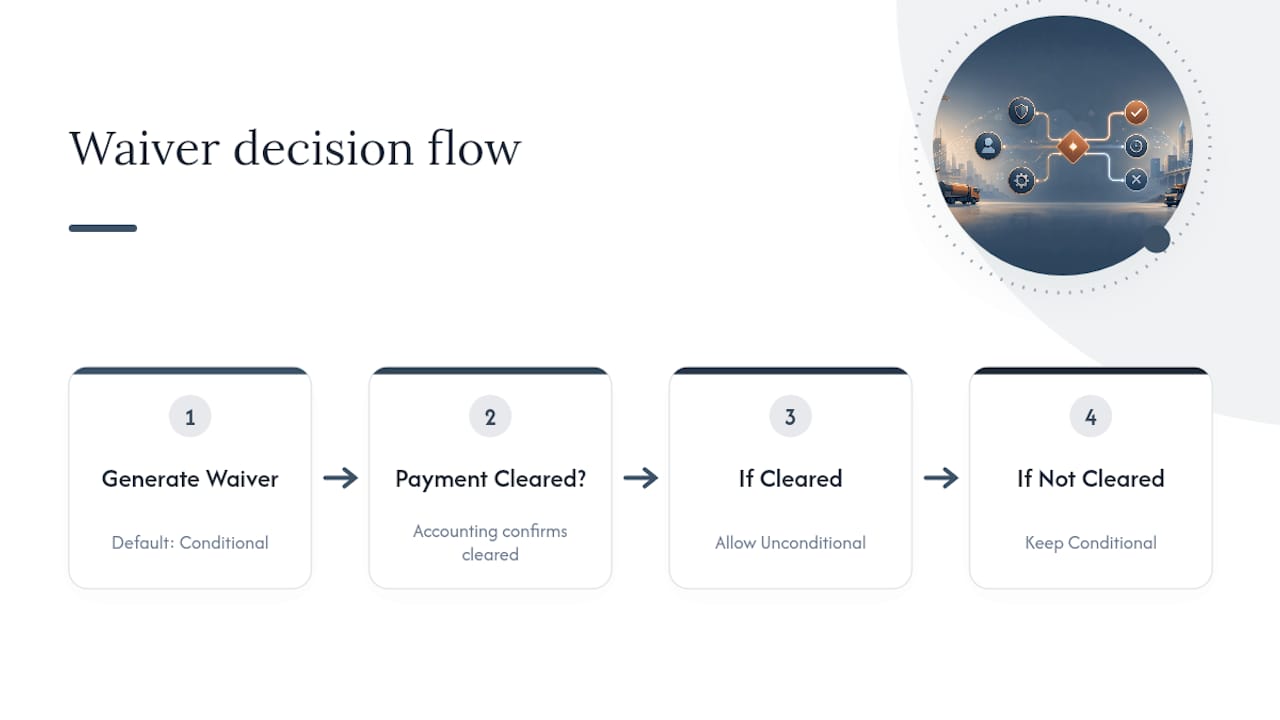
- Set your triggers. A conditional waiver goes out the moment a pay application is submitted. An unconditional waiver goes out only after accounting confirms the corresponding payment cleared. A final unconditional waiver goes out only after retainage releases and the last payment posts.
- Run a weekly waiver audit. Fifteen minutes, every Friday: which waivers are outstanding, which subs haven’t signed, which conditional waivers are overdue for conversion because payment cleared days ago.
- Watch for red flags. A sub who won’t sign a conditional waiver at all. A waiver signed but undated. A final waiver missing while retainage sits unreleased.
Pro Tip: Map every pay application number to its invoice ID before you automate anything. If accounting and project management are tracking payments under different reference numbers, no software can reconcile them for you. A vendor compliance pilot run over two to four weeks is usually enough to catch these mismatches before they become a habit.
The Real Cost of Signing the Wrong Waiver Too Soon
Signing an unconditional waiver before payment clears is the single most common and most expensive mistake in this entire process. Once you sign one, you’ve legally released your lien rights for that amount, whether the money shows up or not. If the check bounces or the wire gets clawed back, you have no lien remedy left for that portion of the payment. You’re now an unsecured creditor chasing a payment through a slower, weaker legal process than the one you just gave up.
Payment timing makes this worse than it sounds on paper. Construction invoices in the U.S. can take a typical period to settle from submission to final clearing, especially on jobs running through general contractor pay chains with retainage holds. A subcontractor who signs unconditional waivers on a fixed schedule, regardless of what accounting shows, is effectively gambling on 90 days of payment certainty every single cycle.
The wrong waiver type creates a different but related problem. Sending a final waiver when you meant to send a progress waiver can release lien rights on unpaid retainage you never intended to give up. Sending a progress waiver that accidentally uses final-waiver language does the same thing. These aren’t hypothetical clerical slips. They happen when waiver generation depends on someone remembering which template goes with which pay stage, instead of a system that ties waiver type to the specific triggering event automatically.
The fix isn’t complicated: never generate an unconditional waiver except as a direct response to a confirmed, cleared payment event in your accounting system. Every other waiver in your workflow should default to conditional.
Verifying Waiver Authenticity and Catching Fraud Early
Fraud in this space usually isn’t dramatic. It’s a subcontractor who backdates a waiver to cover a dispute, a forged signature on a document nobody double-checked, or a waiver that references a payment amount that doesn’t match what accounting actually sent. Catching it requires the same discipline you’d apply to any financial control, not a forensic investigation.
Start by verifying that every signed waiver matches an actual line-item payment in your accounting system, down to the dollar amount and invoice reference. A waiver referencing a payment that doesn’t exist in your ledger is a red flag that needs resolution before you file it, not after.
E-signature platforms with ESIGN and UETA-compliant audit trails timestamp who signed, when, and from what IP address or device, which makes backdating and disputed signatures far harder to pull off than with a scanned paper form. Look for platforms carrying independent security assurance, like an AICPA SOC report, when the tool will hold both signed legal documents and payment metadata. That’s a meaningful trust signal, not a checkbox.
Cross-check signatory authority, too. A waiver signed by someone without authorization to release lien rights on behalf of their company can be challenged later. Keep a simple record of who’s authorized to sign for each subcontractor on your project roster, and reject waivers that don’t match it. None of this requires exotic tools. It requires treating waiver verification with the same seriousness you’d apply to approving a wire transfer.
How Waiver Management Shapes Cash Flow and Risk
Lien waiver management sits directly on the critical path between finishing work and getting paid. Lenders and title companies routinely require current waivers before releasing a draw, which means a missing or improperly executed waiver can freeze funding for an entire project, not just one line item.
On a mid-size job with a general contractor managing multiple subcontractors through monthly draws, many waivers move through the system every month. Miss filing a single final waiver, and you can block retainage release for that sub, delay project closeout, and hold up the final draw the general contractor needs to close their own books. One overlooked document creates a bottleneck for everyone downstream.
The risk cuts both directions. Owners and lenders want unconditional waivers as proof that lien rights are actually gone before they release money. Subcontractors want to avoid signing those same waivers until they know the money is real. Whoever manages this process well, meaning fast, accurate, and properly sequenced, keeps cash moving on both sides. Whoever manages it poorly turns every draw request into a negotiation.
That’s why lien waiver management functions as a cash flow tool as much as a legal safeguard. A contractor who can produce a complete, current waiver package on demand closes draws faster and gets to final payment sooner. A contractor who’s chasing signatures or discovers a statutory form error mid-draw adds days, sometimes weeks, to a payment timeline that was already stretched.
Common Waiver Disputes and How They Get Resolved
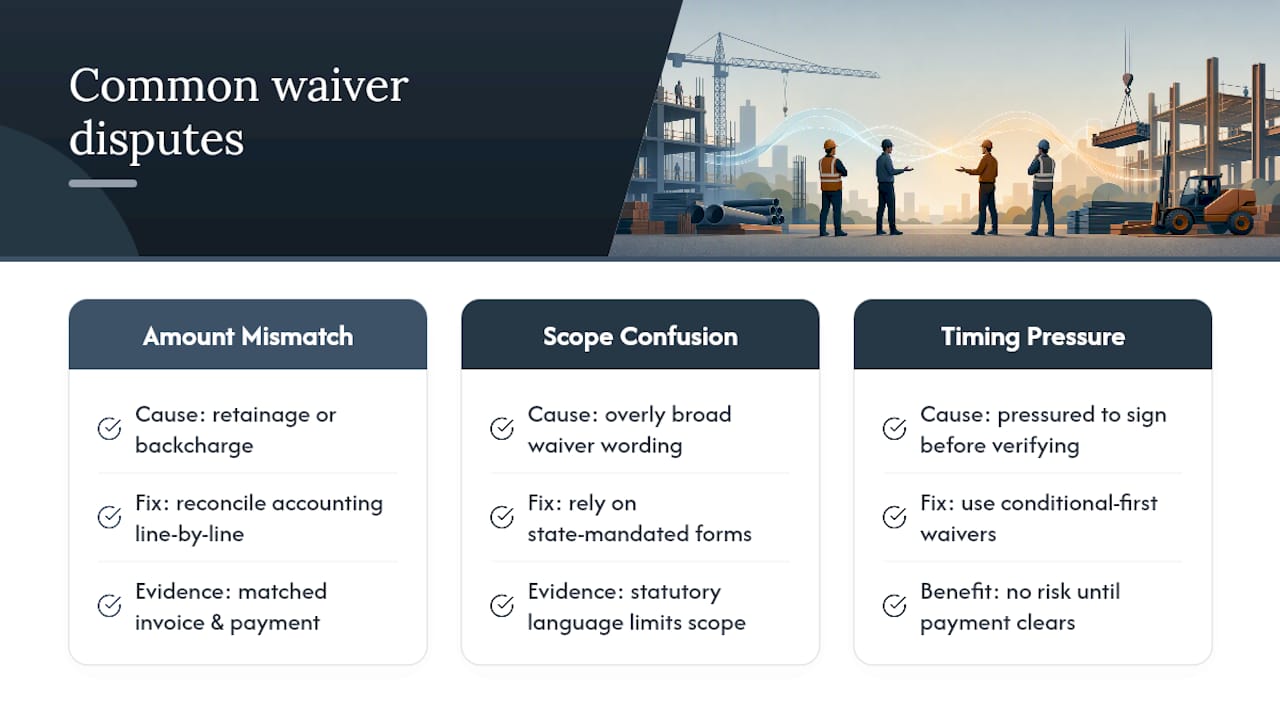
Most lien waiver disputes fall into a handful of recurring patterns, and recognizing which one you’re in usually points to the resolution.
The first is a dollar-amount mismatch: a waiver references a payment figure that doesn’t match what the sub says they received, often because of a retainage deduction or a backcharge nobody flagged clearly beforehand. Resolution starts with pulling the accounting record and reconciling the exact figures line by line before either party signs anything.
The second is scope confusion: a waiver worded broadly enough that it appears to release rights for work beyond the specific pay period it was meant to cover. This is where statutory language protections actually help subcontractors, since state-mandated forms are generally written to limit the waiver to the specific payment referenced, not the entire contract.
The third is timing disputes: a sub claims they signed a waiver under pressure to keep the payment moving, before they’d verified the amount was correct. This one is largely preventable. A conditional-first policy removes most of the pressure, since a conditional waiver carries no risk until payment clears, which gives everyone room to verify amounts calmly instead of rushing a signature to keep cash flowing.
When disputes do escalate, the paper trail decides the outcome. Whoever has the cleanest, most complete audit trail (signed dates, payment confirmations, matched invoice records) has the stronger position, whether that dispute stays informal or ends up in front of a judge.
What Improper Waiver Handling Actually Costs You Legally
Mishandled lien waivers create legal exposure on more than one front, and the consequences don’t stop at “the waiver was invalid.”
If you sign an unconditional waiver and payment never clears, you’ve likely forfeited your lien rights for that amount in most states, regardless of intent. You can still sue for breach of contract, but you’ve lost the faster, more secure remedy that a mechanic’s lien provides. That’s a meaningfully weaker legal position, especially against a general contractor or owner with more resources to draw out a dispute.
If you use a noncompliant form in a statutory state, the waiver itself may be unenforceable, which sounds protective until you realize it cuts both ways. An owner or lender who relied on that waiver to release funds can come back and argue lien rights never actually transferred, reopening a closed draw and creating liability for everyone who signed off on it.
There’s also the audit and lender relationship risk. Title companies and lenders that discover sloppy waiver practices, missing documents, mismatched signatures, or waivers issued before payment, tend to tighten their draw requirements on future projects. That shows up as slower funding and more documentation demands industry-wide, not just on the project where the problem occurred. Good waiver hygiene protects more than the current job. It protects your standing with everyone who reviews your paperwork on the next one.
Training Your Team on Waiver Discipline
Lien waiver management fails most often at the human layer, not the software layer, which makes staff training the highest-leverage fix available to most companies.
Project accountants and PMs need to understand the conditional/unconditional distinction cold, not as a vague concept but as an operating rule they apply without thinking twice: nothing goes out unconditional until accounting confirms the payment cleared. That single rule, drilled consistently, prevents the majority of costly mistakes covered here.
Field supervisors and project managers who collect waivers from subs need a basic literacy in what they’re looking at. They should be able to spot an undated signature, recognize when a waiver references the wrong pay period, and know to escalate a form that doesn’t match the state’s statutory template instead of filing it and moving on.
New hires should go through waiver handling as part of onboarding, not as an afterthought discovered during their first live dispute. A short internal reference sheet mapping each project’s state requirements, plus a walkthrough of the conditional-to-unconditional conversion trigger, takes an afternoon to build and prevents months of cleanup later. Revisit that training annually, since statutory language changes state by state, and a form that was compliant last year isn’t guaranteed to be compliant this one.
Publisher Perspective: How DesignFlow Build Approaches This
Most lien waiver tools solve one piece of this problem and leave the rest to spreadsheets. DesignFlow Build ties compliance automation directly into the same system holding job costing and payment records, so a waiver’s conditional-to-unconditional conversion is triggered by an actual cleared payment in accounting, not a calendar reminder. That structural link is what actually stops premature unconditional waivers, not better intentions. Full ERP automation makes the most sense once you’re juggling waivers across multiple states and subs; a smaller job with one or two subs may not need it yet.
— Keith
If You Want to Automate Lien Waiver Management, Start Here
If you’re running waiver tracking through email threads and shared spreadsheets, the fix isn’t more discipline. It’s a system that enforces the conditional-first policy structurally, so nobody has to remember to check accounting before releasing an unconditional waiver. DesignFlow Build connects lien waiver automation directly to job costing and payment records, so waivers convert only when a payment actually clears, and every signed document lands attached to its invoice automatically.

Before you commit to any waiver tool, ask these questions in a demo: Does it auto-select statutory templates by project state? Does it sync payment clearing events from your accounting system, not just payment initiation? How long does implementation actually take, and what does the audit trail look like six months in? Some construction ERP platforms combine those answers into one workflow instead of three disconnected tools, with implementation typically running a few weeks. See how the AI-native ERP platform handles compliance automation alongside job costing, and book a walkthrough to see your own state’s statutory forms mapped into the workflow.
Sources
Claims on waiver types and statutory language draw from the AIA Contract Documents guide, Corpay’s lien waiver overview, and the ABA’s guide to lien waivers.
- Construction lien waiver — Corpay
- Types of Lien Waivers: Conditional, Unconditional, Progress & Final | AIA Contract Documents