
General Contractor Workforce Management: 2026 Guide

General contractor workforce management is the operational discipline that aligns labor resources with construction project demands to maximize efficiency, profitability, and compliance throughout the project lifecycle. Known in the industry as construction labor resource management, this practice covers everything from scheduling superintendents and estimators months in advance to deploying hourly trade crews on active job sites. Understanding what is general contractor workforce management means recognizing its two distinct operational layers, each requiring different tools, data, and planning horizons. Get this right, and your projects run on time and on budget. Get it wrong, and labor costs erode your margins before the first wall goes up.

What is general contractor workforce management?
General contractor workforce management is the strategic process of planning, deploying, and optimizing labor to meet project objectives across two operational layers. The first layer is strategic capacity planning for salaried staff, covering a 3–9 month horizon. The second is tactical scheduling for hourly trade crews on active sites, which operates day to day. These two layers require fundamentally different approaches, data sets, and decision cycles.
Strategic capacity planning answers the question: do you have enough project managers, superintendents, and estimators to handle the work in your pipeline? Tactical scheduling answers a different question entirely: which crew goes to which site tomorrow, and do they have the right certifications? Conflating the two is one of the most common mistakes general contractors make. The result is either overstaffed offices or understaffed job sites, both of which cost money.
Workforce management is also distinct from HR. Workforce management focuses on operational execution, including scheduling, time tracking, and task assignment, while HR handles hiring, benefits, and compliance administration. This distinction matters because it defines who owns the problem. On most GC firms, that responsibility falls to the operations director, not the HR manager.
What are the two main operational layers in GC workforce management?
The two layers operate on different clocks and require different data. Salaried staff capacity planning runs on a 3–9 month horizon tied directly to your bid pipeline. Hourly trade crew scheduling runs on a 24–72 hour cycle tied to daily site conditions.
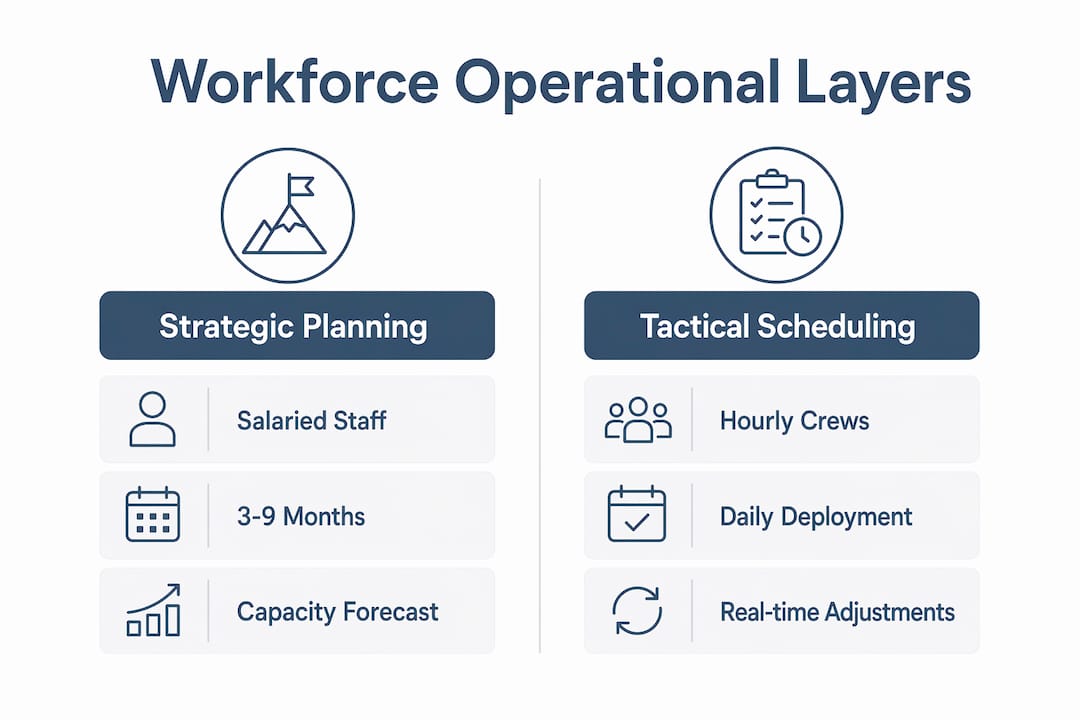
Strategic capacity planning for salaried staff
Salaried staff capacity planning requires long-term modeling tied to bid pipeline probabilities. If you have $40 million in bids outstanding at a 60% weighted probability, you need to plan for roughly $24 million in workload. That means knowing whether your current project managers and superintendents can absorb that load, and when you need to hire or reassign.
Key inputs for this layer include:
- Bid pipeline value and probability weights to forecast expected workload
- Current staff utilization rates to identify capacity gaps before they become crises
- Project start dates and durations to model mobilization timing
- Skill profiles for each salaried employee to match them to project type and complexity
This layer is where most GC firms underinvest. They track bids carefully but fail to connect bid data to staffing capacity. The result is a project manager assigned to three jobs at once, or a superintendent mobilized two weeks late because no one planned ahead.
Tactical scheduling for hourly trade crews
Tactical scheduling covers the daily deployment of hourly workers and subcontracted trade crews. This layer depends on real-time site conditions, weather, material delivery schedules, and inspection timelines. Foremen and superintendents own most of this work, but they need reliable systems to track crew hours and communicate changes across sites.
Pro Tip: Set a daily cutoff time, such as 3:00 PM, for crew assignment changes. Last-minute reassignments after that window create payroll errors and site confusion. Discipline in the scheduling process pays off in cleaner timesheets and fewer disputes.
How do data-driven strategies improve workforce management efficiency?
Data-driven workforce management replaces guesswork with measurable inputs. The four strategies below produce the highest return for general contractors.
-
Demand forecasting with weighted pipeline probability. Assign a probability percentage to each bid in your pipeline, then multiply by contract value to get expected workload. This gives you a rolling forecast of labor demand 3–6 months out. Demand forecasting using weighted pipeline probability improves planning accuracy and labor cost control. It turns your bid log into a staffing plan.
-
Skills and certification tracking. Every salaried employee and key trade worker should have a digital skills profile that includes OSHA certifications, equipment licenses, and project type experience. When a new project requires a certified safety officer or a superintendent with healthcare construction experience, you can search your roster in minutes instead of days. This reduces mobilization delays and keeps you compliant with site-specific requirements.
-
Real-time assignment systems. Paper schedules and shared spreadsheets fail at scale. Real-time assignment systems give every stakeholder, from the estimator to the foreman, a single source of truth for who is assigned where. Real-time assignment systems replace manual methods and increase project resilience. They also create an audit trail that protects you in disputes.
-
Performance analytics tied to profitability. Track labor cost per project and utilization rates in real time. Compare budgeted labor hours to actual hours weekly, not at project closeout. This catches margin erosion early, when you can still act on it.
| Strategy | Primary benefit | Planning horizon |
|---|---|---|
| Weighted pipeline forecasting | Predicts staffing demand before gaps appear | 3–9 months |
| Skills and certification tracking | Reduces mobilization delays and compliance risk | Ongoing |
| Real-time assignment systems | Eliminates scheduling conflicts and data errors | 24–72 hours |
| Performance analytics | Catches labor cost overruns before closeout | Weekly |
Pro Tip: Review your forecasting accuracy monthly by comparing predicted workforce demand to actual resources deployed. Higher accuracy correlates directly with better labor cost control. Even a rough monthly review beats no review at all.
What legal and compliance considerations must general contractors manage?
Worker classification is the highest-stakes compliance issue in construction labor management. Misclassifying an employee as an independent contractor exposes your firm to back taxes, unpaid workers’ compensation premiums, wage violations, and potential litigation.
The IRS applies a 20-factor behavioral and financial control test to determine worker status. The Department of Labor uses an “economic reality” test that examines whether a worker is economically dependent on your firm. Both tests look at factors like who controls the work schedule, who supplies tools, and whether the worker can profit or lose money independently.
State-level rules are often stricter. Many states apply an ABC test, which presumes a worker is an employee unless you can prove all three of the following:
- The worker is free from your control in performing the work
- The work falls outside your usual course of business
- The worker is independently established in that trade or occupation
Failing any one of the three automatically classifies the worker as an employee under state law. Worker classification involves overlapping IRS and Department of Labor standards, with stricter state tests increasing compliance risk. This means a worker you treat as a subcontractor under federal rules may still be an employee under your state’s ABC test.
Misclassification consequences include penalties on workers’ compensation coverage, insurance audits, back wage payments, and potential criminal liability in repeat cases. The safest practice is to document the classification decision for every worker at the start of each engagement, not after an audit begins.
Maintain a classification log for every trade worker and subcontractor. Review it annually and whenever your working relationship with a contractor changes significantly.
How can modern technology and software integrate to support workforce management?
The most effective general contractor management tools connect directly to your bid pipeline. Pipeline-connected capacity planning software automates demand forecasting tied to bid probability, avoiding manual sync errors and outdated data. These tools combine project pipeline, active assignments, and capacity per person into one unified view.
The difference between a connected system and a disconnected one is significant. Entry-level field apps handle crew scheduling well but have no visibility into your bid pipeline or salaried staff capacity. Enterprise platforms built for construction connect bid management, project scheduling, and workforce capacity in a single system.
| Capability | Entry-level field apps | Integrated enterprise platforms |
|---|---|---|
| Crew scheduling | Yes | Yes |
| Salaried staff capacity planning | No | Yes |
| Bid pipeline integration | No | Yes |
| Certification and skills tracking | Limited | Full |
| Labor cost analytics | Basic | Real-time |
AI-powered tools add another layer of efficiency in preconstruction. AI takeoff tools complete automated measurements in under one minute per page, freeing estimators to focus on scope review and labor cost analysis rather than manual quantity calculations. That speed directly improves the accuracy of your labor estimates, which feeds back into your workforce capacity plan.
Designflow-build combines project management, accounting, and field operations into one AI-native ERP system. It reports a 70% reduction in manual data entry and monthly savings of up to $847,000 for contractors. Implementation takes 2–4 weeks, with a 98% user adoption rate. For GC firms tired of juggling disconnected tools, that kind of integrated construction scheduling is a practical step forward.
Pro Tip: Before evaluating any software, map your current workflow gaps. Identify whether your biggest pain point is salaried staff capacity planning, field crew scheduling, or bid pipeline visibility. The answer determines which type of platform you actually need.
Key takeaways
Effective general contractor workforce management requires two distinct operational layers, data-driven forecasting, strict compliance practices, and software that connects your bid pipeline to your staffing capacity.
| Point | Details |
|---|---|
| Two operational layers | Manage salaried staff on a 3–9 month horizon and trade crews on a 24–72 hour cycle separately. |
| Pipeline-driven forecasting | Use weighted bid probability to predict staffing demand before gaps become project delays. |
| Skills and certification tracking | Maintain digital profiles for every key worker to reduce mobilization delays and stay compliant. |
| Worker classification risk | Document every contractor classification decision at engagement start to avoid IRS and state penalties. |
| Integrated software wins | Pipeline-connected platforms outperform disconnected field apps by linking capacity planning to bid data. |
Workforce management is not a one-time task
Most general contractors I talk to treat workforce management as a scheduling problem. They think if the crew shows up on time and the project manager has a calendar, the job is done. That framing misses the point entirely.
Workforce management is a continuous operational process, not a setup task. Treating it as an agile iterative process means reviewing your capacity, skill gaps, and pipeline alignment on a regular cycle, not just when a project starts or a key person quits. The firms that do this well review their staffing model monthly and adjust before problems surface.
The other mistake I see constantly is treating workforce management as an HR function. HR owns hiring and compliance administration. Workforce management owns execution. When an operations director delegates workforce planning to HR, the result is staffing decisions made without project context. That disconnect costs money.
The firms winning on labor efficiency right now are the ones using real-time data to make daily decisions, not monthly reports to explain what went wrong. If you are still reconciling timesheets in a spreadsheet at the end of the week, you are already behind. The data you need to act on is 48 hours old by the time you see it.
Start with the two-layer framework. Separate your salaried capacity planning from your field crew scheduling. Build a simple pipeline-weighted forecast. Then layer in skills tracking and performance analytics as your process matures. Workforce management done right is not complicated. It is just disciplined.
— Keith
Workforce planning tools built for general contractors
General contractors need software that connects bid pipelines to staffing capacity, not just a scheduling app that tracks who showed up. Designflow-build is an AI-native ERP built specifically for construction firms, combining project management, field operations, and accounting in one system.
The platform’s AI-powered takeoff speeds up preconstruction labor estimates, while its integrated scheduling and capacity planning tools give operations directors a real-time view of who is assigned where. If you want to understand the full range of construction software terms before you evaluate platforms, the construction software glossary is a practical starting point. Designflow-build implements in 2–4 weeks with no army of consultants required.
FAQ
What is general contractor workforce management?
General contractor workforce management is the process of planning, deploying, and tracking labor across two layers: strategic capacity planning for salaried staff and tactical scheduling for hourly trade crews. The goal is to match the right people to the right projects at the right time.
How is workforce management different from HR?
Workforce management covers operational execution, including scheduling, time tracking, and task assignment. HR handles hiring, benefits, and administrative compliance. The two functions overlap but are not the same.
What is the biggest legal risk in construction labor management?
Worker misclassification is the highest-stakes risk. Misclassifying an employee as an independent contractor can trigger IRS penalties, workers’ compensation audits, and back wage liability under both federal and state law.
Why does workforce planning need to connect to the bid pipeline?
Bid pipeline data tells you how much work is likely to start in the next 3–9 months. Without that connection, capacity planning is based on guesswork rather than weighted probability, which leads to overstaffing or understaffing at project start.
What does effective contractor supervision require on active sites?
Effective contractor supervision requires real-time crew assignment systems, daily schedule discipline, and certification tracking to keep the right workers on the right tasks. Foremen need reliable tools to log hours and communicate changes without delays.