
SMB Construction Project Management Explained: 2026 Guide

Construction project management for SMBs is the organized process of coordinating people, materials, schedules, and finances to deliver construction projects on time, within budget, and at the quality your clients expect. It covers six core functions: scope definition, scheduling, budgeting, resource coordination, risk management, and quality control. On a small or medium-sized job, one person often handles all six, which is exactly why having a clear framework matters more, not less.
The construction project life cycle gives you that framework. It breaks every job into defined phases so nothing falls through the cracks, whether you’re running a $50,000 bathroom renovation or a $400,000 commercial fit-out.
Core components of SMB construction project management:
- Scope control: Written documentation of what is included, excluded, and assumed before work begins
- Scheduling: Task decomposition, sequencing, and realistic timeline with built-in contingency
- Budget management: Direct costs, subcontractors, permits, equipment, and a contingency reserve
- Resource coordination: Labor, materials, and equipment aligned to the schedule
- Risk management: Early identification of financial, schedule, safety, and compliance risks
- Communication: Structured updates, change order documentation, and client records
- Quality assurance: Defined standards, inspections, and sign-off procedures at each phase
Key fact: Effective project management acts as the “glue” that maintains SMB profitability by preventing small mistakes from cascading into large losses.
The roles on an SMB project are typically lean. A site supervisor or lead contractor usually owns the management function, covering scope control, schedule tracking, budget monitoring, and client communication simultaneously. What matters is that every responsibility is explicitly assigned, not assumed.

What are the six phases of construction project management for SMBs?
Every construction project, regardless of size, follows a six-phase life cycle that applies equally to a small residential renovation and a large commercial build. SMBs often condense or overlap phases, but skipping the discipline of each one is where projects start to drift.
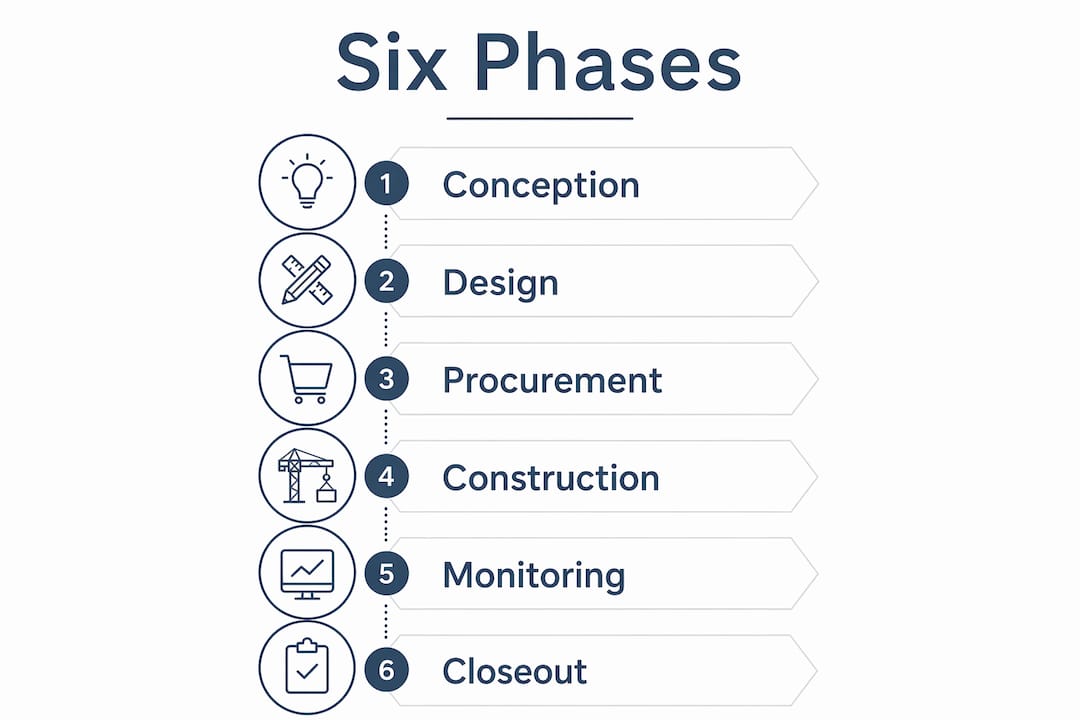
Phase 1: Conception and design
This is where you define what is being built and whether it is viable. Key activities include:
- Establishing project objectives, budget parameters, and site constraints
- Conducting a feasibility assessment covering technical, financial, and regulatory factors
- Developing initial design documents, from conceptual sketches to detailed blueprints
- Aligning all stakeholders on scope before any procurement begins
For SMBs, the most common mistake here is moving to procurement before the scope is fully documented. A one-page scope document that specifies inclusions, exclusions, and client-supplied items prevents disputes that are far more expensive to resolve later.
Phase 2: Procurement and sourcing
Procurement secures the materials, equipment, subcontractors, and labor the project needs. On an SMB job, this phase often runs faster than on large programs, but cutting corners here creates downstream problems.
- Build a complete materials list from design documents
- Solicit bids from subcontractors and evaluate on expertise, cost, and reliability
- Negotiate and execute contracts with clear scope, payment terms, and change order provisions
- Confirm lead times for long-delivery materials before locking the schedule
Phase 3: Pre-construction
Pre-construction bridges planning and breaking ground. Nothing moves forward legally until permits and approvals are in place.
- Submit permit applications and track approval timelines
- Conduct a thorough site analysis to identify conditions that could affect cost or schedule
- Finalize the construction schedule with all dependencies mapped
- Hold a pre-construction meeting with the full team to align on roles, safety protocols, and communication expectations
Phase 4: Construction and execution
This is when the budget gets spent and progress becomes visible. Effective management here means coordinating multiple trades without conflicts and keeping quality standards consistent.
- Orchestrate subcontractor sequencing to avoid idle time and rework
- Track daily progress against the schedule
- Manage material deliveries to match installation sequences
- Enforce safety standards on site every day, not just during inspections
Phase 5: Monitoring and control
This phase runs concurrently with execution. Its job is to catch problems before they become expensive.
- Compare actual costs to budget weekly, not monthly
- Track schedule variance and implement recovery actions early
- Log all change orders immediately with cost and schedule impact documented
- Conduct regular site inspections to verify quality against specifications
Change orders are the most common source of profit loss on small projects. Capturing them immediately, with written approval before work proceeds, is the single most effective protection you have.
Phase 6: Closeout and handover
Project closeout is the phase most frequently compressed or skipped on SMB jobs. That habit leaves money on the table and creates warranty risks.
- Conduct a joint walkthrough with the client before declaring practical completion
- Document any outstanding items with agreed resolution timelines
- Obtain written confirmation of practical completion from the client
- Compile and hand over all warranties, as-built drawings, and maintenance documentation
Written confirmation of completion establishes the point at which the project is accepted, which matters for final payment and any future defect claims.

How do you build and control a budget for an SMB construction project?
A complete SMB construction project budget includes more than the quote number. Every budget should cover direct costs, subcontractor costs, materials, permits and inspections, equipment hire, and a contingency reserve. On small projects, a 10–20% contingency is standard. For renovations or jobs with significant unknowns, that figure should sit at the higher end or above it.
Key budgeting practices for SMBs:
- Break the budget into line items, not a single lump sum, so variances are visible early
- Track actual spend against each line item weekly during execution
- Present the contingency reserve transparently to the client at the outset
- Freeze the scope in writing before finalizing the budget to prevent immediate variance
- Log every change order with its cost impact before authorizing the work
- Review budget-versus-actual at every project status meeting, not just at month end
Common pitfalls that erode margins:
- Compressing the budget conversation into a single quote number without line-item detail
- Adjusting the budget late in the project when overruns are already locked in
- Treating contingency as a buffer for scope additions rather than genuine unknowns
- Failing to price change orders before proceeding, then absorbing the cost
Pro Tip: Set up a simple change order log on day one of every project. Record the description, cost impact, schedule impact, and client approval date for every change, no matter how small. Contractors who apply this discipline consistently report far fewer end-of-project margin disputes.
Schedule realism ties directly to budget accuracy. Realistic scheduling starts with decomposing tasks, estimating each one honestly, sequencing them correctly, and including schedule contingency. For projects involving permits or specialist subcontractors, the buffer should be higher. A timeline built to win the commercial conversation but not to survive delivery reality is one of the fastest ways to turn a profitable job into a loss.
What risks do SMBs face in construction project management?
Small construction projects carry every risk of a major build, compressed into a tighter timeline and a smaller team. The margin for error is thin, and problems hit faster.
Types of risks SMBs commonly face:
- Financial risk: Cost overruns from unpriced change orders, material price increases, or underestimated labor
- Schedule risk: Subcontractor delays, permit hold-ups, or site conditions that were not identified in pre-construction
- Compliance risk: Missing permits, failing inspections, or not meeting local building codes
- Safety risk: Inadequate site controls, insufficient toolbox talks, or poor incident documentation
- Scope risk: Scope creep driven by informal client requests that never get priced or documented
Practical risk mitigation actions:
- Maintain a short risk log from project kickoff, updated weekly
- Identify the top three risks at each phase transition and assign a mitigation owner
- Use a written change control process for every scope addition, regardless of size
- Conduct pre-pour and pre-close inspections before covering work that cannot be easily revisited
- Keep communication records, including texts and emails, organized by project
Communication is often informal on SMB jobs, and that informality becomes a liability when disputes arise. Structured communication with explicit client updates and organized record keeping prevents scope creep and protects you in disputes. A weekly written update, even a brief one, creates a paper trail that informal phone calls never do.
One of the most overlooked risk factors is the calibration of management process to project size. Too much process burdens a small team. Too little invites uncontrolled risk. A $20,000 project needs a one-page scope document, a simple task list, a budget spreadsheet, and a weekly client update. A $200,000 project needs more of each. The discipline is the same; the weight of the documentation scales with the job.
Which software features matter most for SMB construction project management?
Most SMB owners assume project management software is built for large firms. That assumption costs them money. Effective PM software prevents the small mistakes that cascade into large losses, and the right tool does not require an enterprise budget or a consultant to implement.
The four core capabilities every SMB needs in a construction PM platform:
- Budget tracking: Real-time cost versus budget visibility, not end-of-month spreadsheet reconciliation
- Scheduling: Task sequencing, milestone tracking, and schedule variance alerts
- Document management: Centralized storage for contracts, permits, RFIs, and change orders
- Communication logging: A record of client updates, approvals, and field observations
Beyond those four, additional features add value when they integrate rather than fragment your data.
| Capability | What it does for your SMB |
|---|---|
| Live cost dashboard | Spots overruns during execution, not at closeout |
| AI-assisted data capture | Reduces manual entry on contracts and change orders |
| Client-ready report generation | Produces professional updates without rebuilding from scratch |
| Risk log and issue tracking | Builds an audit trail for every project decision |
| Field daily reports | Captures photos, time, and materials from the jobsite in real time |
| Schedule milestone tracking | Keeps the full team and client aligned on key dates |
| Document version control | Prevents crews from working off outdated drawings |
Platforms like Smartsheet offer flexible grid-based project tracking that SMBs can configure without IT support. monday.com provides visual workflow boards that work well for teams managing multiple active jobs simultaneously. CMiC is an enterprise-grade platform that integrates financials, field operations, and project controls in a single system, typically suited to SMBs that are scaling toward mid-market volume.
Field-focused tools like Raken serve SMBs with as few as 1–50 employees, offering daily report capture, time and material tracking, safety checklists, and document management with integrations to accounting platforms like QuickBooks and Sage.
Pro Tip: Before evaluating any platform, list the four core capabilities above and ask each vendor to show you exactly where each one lives in their interface. If a demo cannot answer that in ten minutes, the tool is probably not built for your team size.
How can SMBs achieve consistency across every project?
Consistency in construction project management comes from three disciplines applied on every job, not just the complex ones: constant job status awareness, budget-versus-spent tracking, and rigorous communication and change order documentation.
Integrated platforms that connect project data with financial and resource tracking give you real-time profitability visibility during execution, not after the fact. When your PM data and your accounting data live in separate tools, cost overruns surface at closeout, when it is too late to recover margin. An integrated dashboard lets you intervene early.
Practical strategies for consistent SMB project management:
- Run a weekly status check covering schedule, budget, open risks, and pending change orders
- Use a single platform for both project tracking and cost data to eliminate reconciliation gaps
- Standardize your scope document, change order form, and client update template across all jobs
- Capture field data daily, including photos, time, and material use, rather than reconstructing it at week end
- Assign every management responsibility explicitly at project kickoff, not by assumption
Integrated construction management enables SMBs to reduce manual admin by up to 70% and generate monthly savings of up to $847K by automating risk prediction and resource allocation.
The firms that deliver consistently profitable projects are not necessarily the ones with the most sophisticated tools. They are the ones who apply simple disciplines without exception. Status awareness, budget tracking, and change order capture are not complex processes. They are habits, and habits built on the right platform become automatic.
How should SMBs manage stakeholder communication on construction projects?
Clear, documented communication is one of the highest-leverage practices in small business construction management. When it breaks down, scope creep follows, disputes escalate, and client relationships suffer.
Effective stakeholder communication strategies for SMBs:
- Establish a single point of contact on both the contractor and client side at project kickoff
- Send a written project update to the client at least once a week, covering progress, upcoming work, and any open decisions required
- Document every client decision in writing, even if the conversation happened by phone or on site
- Use a structured meeting agenda for site meetings so nothing critical gets missed
- Log all subcontractor communications related to scope, schedule changes, or safety incidents
The temptation on small jobs is to manage everything informally through calls and texts. That works until a dispute arises, and then the absence of documentation becomes your liability. A brief weekly written update, a signed change order, and a record of client approvals cost almost no time and protect you completely.
For construction cleaning crew supervision and other subcontractor coordination, the same principle applies. Clear written instructions, documented scope, and a record of site conditions at handover prevent the most common disputes between general contractors and specialty crews.
How do you plan resources and manage your workforce on SMB construction jobs?
Resource planning on a small construction project means matching the right people, materials, and equipment to the right tasks at the right time. When that alignment breaks down, you pay for idle labor, rushed deliveries, or rework.
Workforce and resource management practices:
- Build a resource-loaded schedule that assigns labor and equipment to each task, not just dates
- Confirm subcontractor availability before locking the project schedule
- Track actual hours against estimated hours weekly to catch productivity gaps early
- Maintain a materials procurement log with delivery dates tied to installation sequences
- Cross-train key team members where possible so a single absence does not stall a phase
Equipment scheduling deserves the same attention as labor. Renting equipment for a window that is too wide adds cost. Renting for a window that is too narrow creates delays. Tie equipment hire dates directly to the task sequence in your schedule, and build a one-day buffer on either side for delivery and return logistics.
Workforce management on SMB jobs also means being honest about capacity before committing to a timeline. Contractors who win work by promising fast delivery and then overload their crews end up with quality problems, safety incidents, and client disputes. A realistic capacity assessment at the bid stage protects both the project and your reputation.
What quality assurance procedures should SMBs follow on construction projects?
Quality assurance on a construction project is not a final inspection. It is a series of checkpoints built into the schedule so defects are caught before they are buried in the next phase of work.
Core QA and QC procedures for SMBs:
- Define quality standards for each trade in the scope document before work begins
- Schedule pre-pour, pre-close, and pre-finish inspections as formal milestones in the project schedule
- Use managed checklists for each inspection, not informal walkthroughs
- Photograph completed work at each phase before it is covered by subsequent trades
- Document any defects found, assign a responsible party, and set a resolution deadline
- Conduct a joint client walkthrough before declaring practical completion
Photographic documentation serves two purposes. It creates a quality record that protects you in warranty disputes, and it gives the client visible evidence of workmanship at each stage. Both outcomes build trust and reduce end-of-project friction.
Field management tools like Raken include safety and quality checklists designed for SMB crews, covering observations, incident capture, and toolbox talks that improve compliance and reduce the risk of costly disputes. Digital checklists also create a timestamped audit trail that paper forms cannot replicate.
What legal and compliance requirements do SMBs need to manage on construction projects?
Legal and compliance obligations on a construction project are not optional, and the consequences of missing them range from stop-work orders to personal liability. SMBs need a clear checklist for every job.
Key legal and compliance areas for SMB construction projects:
- Permits and approvals: Confirm all required building, electrical, plumbing, and mechanical permits are obtained before work begins. Permit requirements vary by municipality, so verify locally.
- Licensing: Verify that your business license and all subcontractor licenses are current and cover the work being performed.
- Insurance: Carry general liability, workers’ compensation, and builder’s risk coverage appropriate to the project value. Require certificates of insurance from every subcontractor before they set foot on site.
- Contracts: Use written contracts for every engagement, including subcontractors and suppliers. Verbal agreements are unenforceable in most disputes.
- Lien rights: Understand your state’s mechanics lien laws. File preliminary notices where required to preserve your right to payment.
- OSHA compliance: Maintain a site safety plan, conduct regular toolbox talks, and document all safety incidents. OSHA inspections can occur without notice.
- Building codes: Ensure all work meets current International Building Code standards as adopted by your jurisdiction.
For bid preparation and subcontractor compliance, tracking certificate of insurance expiration dates and license renewals for every subcontractor is a practical necessity. A compliance dashboard that flags expiring documents before they lapse keeps your project legally protected without manual calendar tracking.
Contracts deserve particular attention. A contract that specifies scope, payment milestones, change order procedures, and dispute resolution terms is your primary legal protection on every job. The time spent getting it right before work starts is a fraction of the time spent resolving disputes without one.
How do you manage schedules and deadlines on SMB construction projects?
Schedule management is where most SMB construction projects either hold together or fall apart. The problem is rarely the schedule itself. It is the gap between the timeline that won the work and the timeline that can actually deliver it.
Scheduling techniques that work for SMBs:
- Task decomposition: Break the project into discrete work packages before estimating any durations. Estimating at the task level is far more accurate than estimating at the phase level.
- Dependency mapping: Identify which tasks cannot start until others are complete. Sequencing errors cause more delays than bad estimates.
- Critical path identification: Know which tasks have zero float. A delay on the critical path is a delay to the project end date.
- Schedule contingency: Add 10–15% contingency to the overall schedule for small projects. For jobs involving permits, inspections, or specialist subcontractors, that buffer should be higher.
- Milestone tracking: Set formal milestones at phase transitions and review them weekly, not just at the end of a phase.
- Recovery planning: When a task slips, update the schedule immediately and identify a recovery action. Letting slippage accumulate without a response plan is how small delays become project-ending delays.
Construction scheduling software that supports Critical Path Method (CPM) scheduling gives SMBs a structured way to model task dependencies, identify the critical path, and run schedule scenarios before committing to a client deadline. CPM is the industry standard for schedule analysis and is worth understanding even on smaller jobs.
The discipline of schedule management also means communicating changes to the client promptly. When a delay is identified, the client should hear about it from you, with a recovery plan, before they notice it themselves. That transparency builds the kind of trust that generates repeat business and referrals.
Designflow-build makes SMB construction project management simpler
Managing a construction project across six phases, with a lean team and tight margins, is genuinely hard. Designflow-build is built specifically for that challenge. Its AI-native ERP platform combines project management, accounting, and field operations in one system, so your PM data and your financial data are always in sync.
Contractors using Designflow-build report a 70% reduction in manual data entry and monthly savings of up to $847K through automated risk prediction and resource allocation. Implementation takes 2–4 weeks, and the platform achieves a 98% user adoption rate because it is designed for construction teams, not generic project managers.
You do not need an army of consultants to get started. Designflow-build’s AI construction ERP is ready to use from day one, with guided onboarding and no per-seat fees that penalize you for growing your team.
Key Takeaways
Effective SMB construction project management requires consistent application of six core disciplines across every phase, from scope definition through closeout, supported by integrated tools that connect project and financial data in real time.
| Point | Details |
|---|---|
| Six-phase life cycle | Every SMB project follows conception, procurement, pre-construction, execution, monitoring, and closeout phases. |
| Budget contingency | Include a contingency reserve in every project budget, typically ranging from 10–20%, with higher buffers for renovations or jobs with significant unknowns. |
| Change order discipline | Capture every change order in writing with cost and schedule impact before authorizing the work. |
| Integrated data visibility | Connecting PM and financial data in one platform lets you spot cost overruns during execution, not at closeout. |
| Schedule contingency | Add schedule contingency to small projects, generally around 10–15%, with larger buffers for jobs involving permits or specialist subcontractors. |