
Why Manual Processes Cut Your Construction Profits
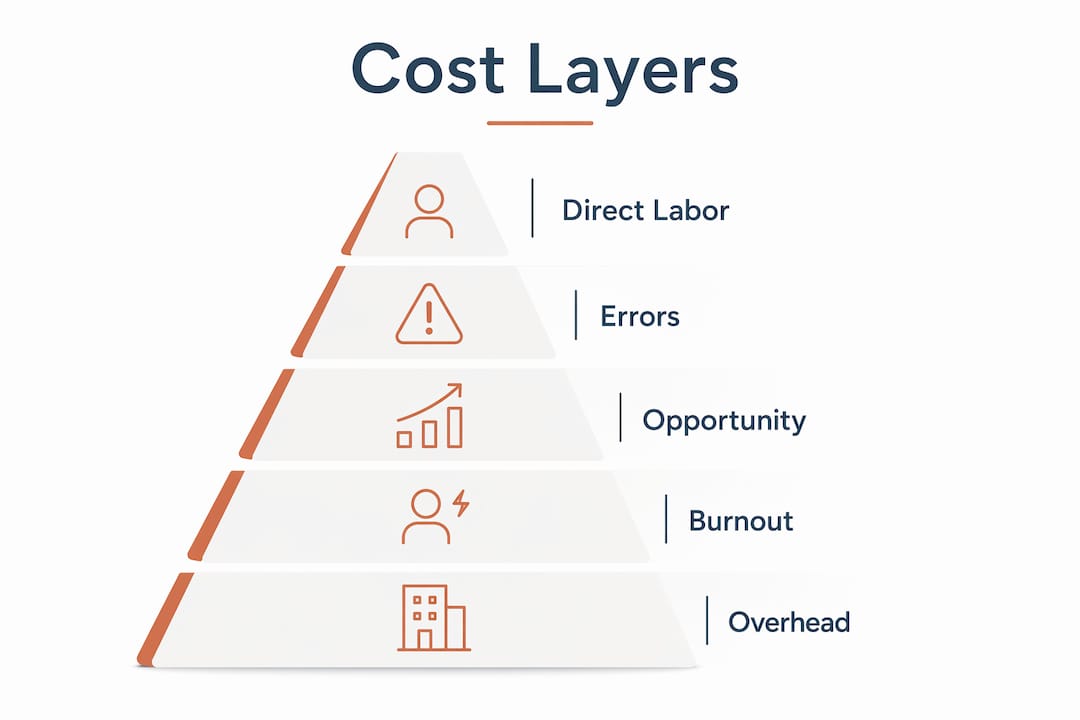
Manual processes reduce construction profits by stacking five distinct cost layers that most managers never see on a P&L: direct labor waste, error correction, opportunity cost, burnout-driven turnover, and customer churn. A typical 5-person construction team loses over $250,000 annually to manual processing across labor, error correction, opportunity cost, burnout, and customer impact. The core problem is not inefficiency in isolation. It is that manual workflows hide their damage inside salaries, project delays, and missed bids until the margin is already gone.
Here is where the profit drain actually comes from:
- Wasted skilled labor: Your best people spend hours on data entry, approval chasing, and reconciliation instead of work that moves projects forward.
- Compounding errors: Manual data entry carries a 1–4% error rate, and each mistake triggers detection, correction, client credits, and trust damage.
- Invisible opportunity cost: Revenue your team cannot pursue because they are buried in admin is the largest hidden layer, and it never appears on any report.
- Burnout and turnover: Repetitive manual tasks push people out, and replacing one employee costs roughly $36,000 in recruitment and lost productivity.
- Customer churn: Slow responses and inconsistent service drive clients to competitors before you even realize there is a problem.
Operators typically see only the payroll line. The other four layers compound silently until a project ends in the red.
Why manual processes reduce construction profits through errors and wasted time
The operational math is straightforward. Employees spend a significant portion of their working hours on manual data entry and transfer tasks, according to relevant industry studies. For a five-person team, that translates to roughly $82,500 in annual labor spent on work that adds no value to the project.

Manual data entry carries a measurable error rate in most studies. The cost is not just the mistake itself. It is the time to detect it, fix it, communicate the correction, and rebuild client confidence. That sequence repeats across every invoice, timesheet, change order, and cost code entry your team touches.
Delayed approvals compound the problem further. When change orders circulate by email and commitments live in separate spreadsheets, project managers lose visibility into real costs until month-end reconciliation. By then, an overrun that could have been caught in week two has grown into a margin-killing problem. Poor data design and disconnected systems make forecasting unreliable and executive decisions reactive rather than proactive.
Pro Tip: Track error correction time weekly, not monthly. The hours your team spends fixing mistakes is a leading indicator of margin erosion, and catching the trend early gives you time to act before it hits the income statement.
Rework is where errors become truly expensive. According to insurer Axa XL, rework alone often accounts for roughly 4%–6% of contract value on many projects. On a $2 million job, that is $80,000–$120,000 gone before you account for any other inefficiency.
The hidden cost layers that go far beyond payroll
Direct labor is only the first layer, and it is the smallest one most managers measure. Manual process costs break into five distinct layers, and together they are typically 3–5 times larger than the payroll hours alone.
| Cost layer | What it measures | Typical annual impact |
|---|---|---|
| Direct labor | Hours on repeatable manual tasks | — |
| Error correction | Rework, refunds, client credits | 5–15% of labor costs |
| Opportunity cost | Revenue you cannot pursue | Often the largest layer |
| Morale and burnout | Turnover, sick days, disengagement | roughly $36,000 per lost hire |
| Customer impact | Slow response, churn, lost referrals | Varies by project volume |
The hidden costs do not appear as a line item. They show up as falling margins, lost bids, and another back-office job posting. Most executives attribute these symptoms to staffing shortages or market conditions rather than process fragmentation, which means the root cause goes unfixed.
Opportunity cost deserves special attention. When your project engineers spend their afternoons reconciling spreadsheets, they are not reviewing subcontractor bids, catching scope creep early, or building client relationships. That lost capacity is revenue you never earned, and it is invisible on every financial report you run.
How construction’s complexity makes manual workflows worse
Construction is not a single workflow. It is a chain of fragmented subprocesses: estimating, scheduling, procurement, subcontract administration, billing, and financial close. Each handoff is a point where manual processes introduce delay, error, or lost data.
The industry’s productivity record reflects this. Construction productivity has remained stagnant since 1948 and has actually declined since the 1970s, according to the Federal Reserve Bank of Richmond. Every other major sector more than tripled labor productivity over that same period. The gap traces directly to bespoke project designs, lack of standardization, and manual, complex workflows that resist industrialization.
Lean construction research identifies eight categories of waste embedded in manual workflows:
- Defects: Poor workmanship and design errors requiring rework, rated the highest-severity NVAA by more than 80% of industry respondents.
- Waiting time: Delayed approvals, material shortages, and slow payment processing that leave crews idle.
- Overproduction: Misaligned planning that generates unnecessary work, storage costs, and rework.
- Unused talent: Skilled workers assigned to administrative tasks instead of value-creating work.
- Transportation and motion: Inefficient material movement and repetitive worker movements from poor site organization.
- Excess inventory: Materials and work-in-progress that tie up cash and space.
- Extra processing: Redundant approvals and overengineered documentation that add time without adding value.
The waste in manual workflows is often hidden in plain sight. Reactive management rarely captures these margin drains until project closeout, when it is too late to recover the cost.
Manual documentation creates a specific risk that compounds over time. When change orders live in email threads and daily logs arrive as handwritten notes, disputes become inevitable. Without a timestamped audit trail, you are negotiating from memory against a client with a contract. That is a losing position on any project.
Digital tools that actually fix the manual process problem
Construction ERP systems address the core issue by unifying project management, accounting, and field operations in a single data model. When estimators, project managers, site supervisors, and finance teams all work from the same system, the rekeying stops. Cost visibility shifts from monthly reconciliation to near real-time, which means overruns get caught in week two instead of week ten.
The operational improvements that follow from that unification are concrete:
- Faster invoicing: Automated billing workflows cut the gap between work completion and owner billing, reducing Days Sales Outstanding and improving cash flow.
- Controlled change orders: A single workflow with an audit trail replaces email threads, eliminating revenue leakage from unsigned or disputed changes.
- Mobile field capture: Digital timesheets and daily logs eliminate the multi-day lag between site activity and office processing, reducing payroll errors and accelerating job costing.
- Standardized approvals: Workflow automation enforces consistent approval routing, cutting the approval delays that cause idle labor and missed discount windows.
- Reliable WIP reporting: Integrated project accounting removes the manual reconciliation that currently consumes 10–12 business days at month-end for many contractors.
Firms that move away from paper-based field operations see an average annual time savings of $52,000 in administrative costs, along with a 34% average increase in overall productivity and an average 7x ROI on the transition. For cost-saving strategies that complement digital adoption, the principle is the same: eliminate the manual handoffs first, then measure what you recover.
What the research says about ROI from automating construction workflows
The financial case for automation in construction is well documented. Lean construction implementations deliver cost savings of roughly 10%–15% for many activities by eliminating time spent on non-value-added tasks and reducing project delays. BCG’s analysis of large contractors shows those savings come through both direct cost reductions in labor and materials and the avoidance of costs from waste elimination.
The five-layer cost model makes the ROI calculation straightforward. A 5-person team losing $250,000 annually to manual processes needs to recover only 30% of that figure to justify a meaningful automation investment in year one. Automation typically cuts manual data entry by over 70%, which directly attacks Layer 1 while reducing the error rate that drives Layer 2.
Real-world outcomes from ERP adoption in construction include:
- Earlier detection of cost code overruns, allowing project managers to intervene before margin deterioration becomes unrecoverable.
- Shorter invoice approval cycles, which reduce payment delays and the cash flow pressure that forces contractors into unfavorable financing.
- Improved schedule adherence through reliable committed cost tracking and subcontractor compliance visibility.
- Reduced rework from cleaner change order governance, directly recovering the 4%–6% of contract value that rework typically consumes.
Manual takeoff processes also miss hidden line items like dump fees, waste factors, and permit costs, causing margin erosion before a project even starts. Automated takeoff catches those items systematically. Without real-time job costing, contractors discover overruns too late to act, often facing liquidated damages on top of the original loss.
The pattern across every case study is consistent: the real cost of manual processes is 3–5 times what the owner expected. The managers who close that gap fastest are the ones who measure all five layers before choosing a solution, then implement a system that addresses the root cause rather than adding another reporting layer on top of a broken process.
Key Takeaways
Manual processes reduce construction profits by hiding costs across five layers that together far exceed what shows up on any P&L.
| Point | Details |
|---|---|
| Five cost layers compound silently | Direct labor, errors, opportunity cost, burnout, and churn together cost a 5-person team over $250,000 annually. |
| Rework is a measurable margin killer | Rework consumes roughly 4%–6% of contract value, a direct and recoverable loss on every project. |
| Productivity has stagnated for decades | Construction productivity has not grown since 1948, driven by bespoke designs and manual, fragmented workflows. |
| ERP unification stops the rekeying cycle | Connecting project management, accounting, and field data in one system cuts overrun detection time from months to days. |
| Automation delivers measurable field savings | Firms transitioning to digital field capture report average annual savings of $52,000 and a 34% productivity increase. |
Designflow-build helps you stop the profit drain

Designflow-build is built specifically for contractors who are done watching margin disappear into spreadsheets and email threads. The AI-native ERP platform connects project management, accounting, and field operations in one system, with no army of consultants required to get started.
The results are direct: a reported 70% reduction in manual data entry, and a 98% user adoption rate. Implementation takes 2–4 weeks. You start recovering margin almost immediately. Implementation takes 2–4 weeks. You start recovering margin almost immediately.
Ready to see what your manual process costs are actually adding up to? Explore Designflow-build’s AI ERP platform or check the construction scheduling software built to replace the manual timeline management that delays your projects and your billings.