
Fixed Asset Accounting: A Practical Guide to Getting It Right

Fixed asset accounting is the process of recording, capitalizing, depreciating, and eventually derecognizing long-lived tangible assets like buildings, equipment, and vehicles. If you want to be audit-ready, three things matter more than anything else: adopt a written capitalization policy, record precise available-for-use dates for every asset, and reconcile a fixed asset roll-forward to the general ledger every period. Skip any of these and you’re setting up a scramble at year-end close.
Under U.S. GAAP guidance in ASC 360, fixed assets get capitalized at cost, depreciated across their useful life, tested for impairment when circumstances warrant it, and removed from the books at disposal. That’s the whole lifecycle in one sentence. The mechanics behind each step, though, are where most finance teams either build real control or quietly accumulate audit risk.
Before diving into methods and journal entries, here’s what you need in place immediately:
- A documented capitalization threshold and policy, approved and applied consistently
- Available-for-use dates captured at the moment an asset enters service, not when the purchase order closes
- A fixed asset register reconciled to the GL, with a roll-forward summary produced every reporting period
Worked examples, depreciation formulas, and journal entries follow below.
Key Takeaways
Fixed asset accounting requires a written capitalization policy, an available-for-use date captured at the right moment, and a reconciled asset register to hold up under audit.
| Point | Details |
|---|---|
| Capitalize by the rules | Apply the cost, useful-life, and business-use tests consistently, and include freight and installation in the capitalized basis. |
| Get the available-for-use date right | Depreciation starts when an asset is ready for use, not when construction or the purchase order formally closes. |
| Match the method to the asset | Straight-line, DDB, SYD, and units-of-production all produce the same total depreciation but shift timing and tax impact differently. |
| Reconcile the register regularly | Tie your roll-forward to the general ledger at least quarterly, and verify assets physically at least once a year. |
| Automate the CWIP-to-PP&E handoff | Designflow-build connects project and job costing data directly to asset creation, significantly reducing manual data entry for construction teams. |
Table of Contents
- What Counts as a Fixed Asset Under Fixed Asset Accounting Rules?
- How Does an Asset Move Through the Fixed-Asset Lifecycle?
- What Are the Main Depreciation Methods and Journal Entries?
- How Do You Set a Capitalization Threshold and Policy?
- When Do You Test Fixed Assets for Impairment?
- How Do You Maintain an Accurate Fixed Asset Register?
- Where Do Fixed Assets Appear in Financial Statements?
- What Do Fixed Asset Journal Entries Look Like in Practice?
- What Should You Look for in Fixed Asset Software?
- A Construction Industry View on Fixed Asset Accounting
- How DesignFlow Build Turns Fixed Asset Accounting Into Fewer Manual Steps
- Sources
What Counts as a Fixed Asset Under Fixed Asset Accounting Rules?
Not every purchase belongs on the balance sheet as a fixed asset, and getting this wrong in either direction creates problems. Expense something that should be capitalized and you understate assets while overstating current-period costs. Capitalize something trivial and you’re stuck tracking a $200 item for years.
Three tests generally determine whether a purchase qualifies:
- Cost exceeds your capitalization threshold. Most mid-size companies set the capitalization threshold at a moderate dollar amount per unit appropriate to their revenue and transaction volume.
- Useful life extends beyond one year. A laptop that gets replaced every 18 months clears this bar; office supplies don’t.
- The asset is used in business operations, not held for resale as inventory.
Classic depreciable fixed assets include manufacturing equipment, commercial vehicles, buildings, furniture, and computer hardware. Land is the notable exception. It’s capitalized as property, plant, and equipment but never depreciated because it doesn’t wear out or become obsolete the way a building does. Most intangible assets, like patents or trademarks, follow amortization rules under separate guidance rather than the fixed asset depreciation rules covered here.
The capitalized cost of an asset isn’t just the invoice price; consider using the best software for managing renovation invoices to accurately support invoice and asset workflow in renovation projects. It includes freight, installation, testing, and any costs required to get the asset ready for its intended use. Buy a piece of manufacturing equipment with delivery and installation charges, and your capitalized basis includes all costs needed to get it ready, not just the purchase price. Costs that don’t belong in that number: routine maintenance, minor repairs, and training costs for staff who’ll operate the new equipment. Those get expensed as incurred.
Pro Tip: Build your capitalize-versus-expense decision into your chart of accounts and coding instructions, not into a policy document nobody reads at transaction time. If the person entering the invoice has to stop and think about GAAP, you’ll get inconsistent coding no matter how good your written policy is.
How Does an Asset Move Through the Fixed-Asset Lifecycle?
Every fixed asset moves through predictable stages, and the accounting treatment changes at each one. Missing a transition point, especially the shift from construction to service, is one of the most common sources of depreciation errors.
- Acquisition and capitalization. When you purchase an asset outright, you capitalize its full cost the moment it’s ready for use. Self-constructed assets work differently: costs accumulate in a Construction Work in Progress (CWIP) account as the project proceeds, including materials, labor, and, in many cases, capitalized interest on construction financing.
- CWIP to PP&E transfer. Once construction finishes and the asset is available for use, you transfer the accumulated CWIP balance into the appropriate property, plant, and equipment account. This transfer date is the trigger for depreciation to begin, not the date the invoice gets paid or the project gets formally closed out.
- Available-for-use determination. This is arguably the single most consequential field in your entire fixed asset register. Depreciation starts on the date an asset is ready and available for its intended use, regardless of whether you’ve actually started using it yet. A complete lifecycle guide from CPCON Group outlines this as one of eight core steps in a defensible asset accounting process, and getting the date wrong by even a month can distort depreciation expense and net income for the entire remaining useful life.
- Transfers between locations or cost centers. When equipment moves between job sites, departments, or subsidiaries, you update the custodian and location fields in the register without changing the depreciation schedule. The asset’s basis and remaining life stay the same. What changes is who’s accountable for it and where it physically sits.
- Disposal and derecognition. When you sell, scrap, or retire an asset, you remove both the original cost and its accumulated depreciation from the books. Compare the proceeds received against the asset’s remaining book value to calculate a gain or loss on disposal.
The disposal entry looks like this: debit Accumulated Depreciation for the full amount accrued, debit Cash for any sale proceeds, credit the Fixed Asset account for the original cost, and plug the difference to a gain or loss on disposal account. If proceeds exceed book value, you record a gain. If book value exceeds proceeds, you record a loss.
Construction firms and companies managing capital projects run into the CWIP-to-PP&E transfer more than most, because a single facility might combine dozens of purchase orders, change orders, and contractor invoices before it’s ready for use. Tracking those costs against a job costing structure as the project unfolds makes the eventual transfer far cleaner than trying to reconstruct total project cost after the fact.
What Are the Main Depreciation Methods and Journal Entries?
Depreciation allocates an asset’s cost over its useful life, and the method you choose affects reported earnings, tax timing, and how your balance sheet looks year to year. Every method starts from the same depreciable base: cost minus estimated salvage value. From there, the four common approaches diverge in how quickly they recognize expense.
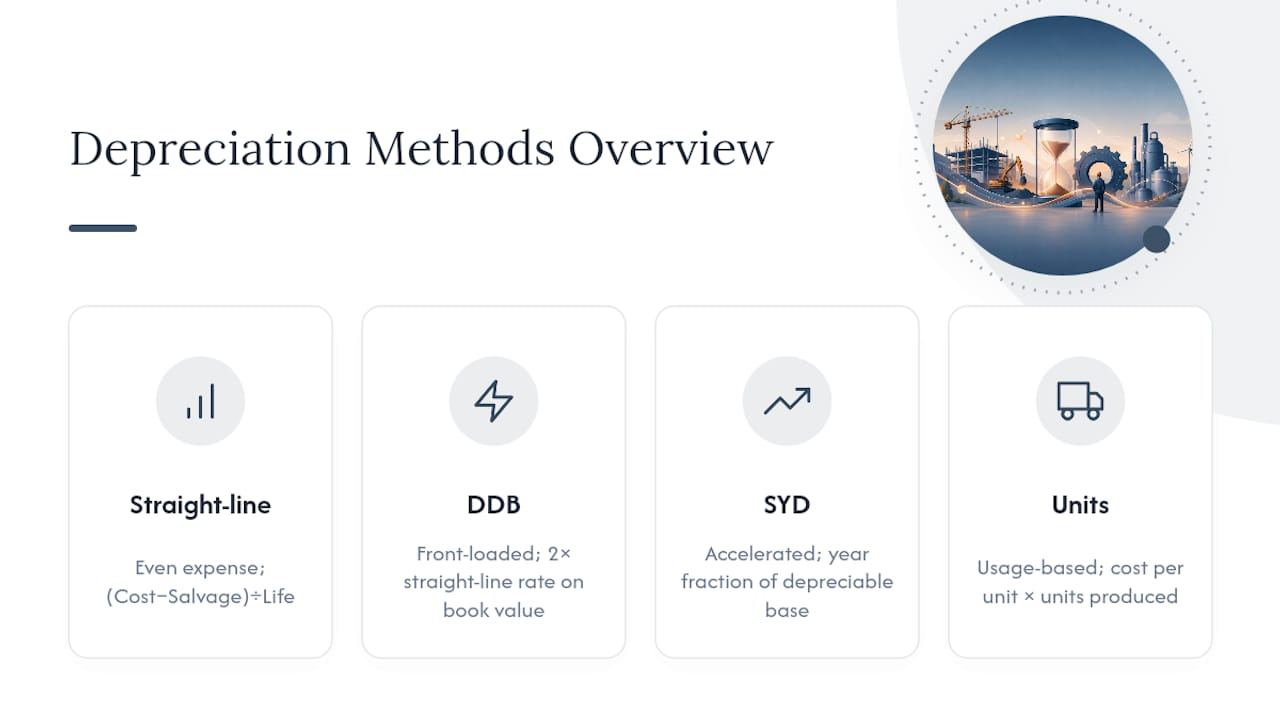
Straight-line depreciation spreads cost evenly across useful life. The formula is (Cost − Salvage Value) ÷ Useful Life. A $50,000 machine with a $5,000 salvage value and a 10-year life depreciates at $4,500 per year, every year, until it’s fully depreciated.
Double-declining balance (DDB) front-loads expense by applying twice the straight-line rate to the asset’s declining book value each year, ignoring salvage value in the calculation itself (though you stop depreciating once book value hits salvage).
Sum-of-the-years’-digits (SYD) also accelerates depreciation but less aggressively than DDB. You add up the digits of the useful life (for 10 years, that’s 1 through 10, summing to 55), then apply a descending fraction of the depreciable base each year: 10/55 in year one, 9/55 in year two.
Units-of-production ties depreciation to actual usage rather than time, which fits equipment where wear correlates with output. You calculate cost per unit (depreciable base ÷ total expected units) and multiply by units produced each period.
AccountingTools’ overview of depreciation methods confirms that useful life, salvage value, and method selection are the three inputs driving every calculation, and Investopedia’s breakdown of depreciation methods illustrates how accelerated methods shift more expense (and more tax benefit) into early years compared to straight-line.
The core journal entry is identical no matter which method you pick: debit Depreciation Expense, credit Accumulated Depreciation, for the period’s calculated amount. AccountingTools confirms this entry structure and notes that Accumulated Depreciation is a contra-asset account, meaning it reduces gross fixed assets on the balance sheet rather than sitting as a separate liability.
Most companies record depreciation monthly to keep interim financial statements accurate, though smaller organizations with fewer assets sometimes post it quarterly. Once you select a useful life, changes should be applied prospectively only. If you discover an asset will last longer or shorter than originally estimated, you adjust the remaining depreciable base over the remaining life going forward. You never restate prior periods for a useful-life revision.
One detail that trips up otherwise careful teams: book depreciation and tax depreciation frequently use different methods and lives. Many organizations run separate book and tax depreciation schedules, which creates deferred tax assets or liabilities that need periodic reconciliation between the two sets of numbers.
How Do You Set a Capitalization Threshold and Policy?
A capitalization policy is the single document that keeps your fixed asset accounting consistent across departments, locations, and years of staff turnover. Without one, you’ll find that one project manager capitalizes $1,500 laptops while another expenses $8,000 tools, and neither is technically wrong until you write the rule down.
Setting the right threshold balances two competing forces: materiality and processing cost. A $500 threshold means you’re maintaining depreciation schedules for staplers and monitors, which adds administrative burden without meaningfully changing your financial statements. A $25,000 threshold at a mid-size contractor might capitalize equipment that genuinely should be tracked and depreciated. Most companies set their capitalization thresholds at amounts informed by tax safe-harbor guidance, which is advisory rather than mandatory, allowing flexibility in policy setting.
The harder judgment call is usually repair versus improvement. Wipfli’s guidance on fixed asset accounting frames this as one of the most consistently misapplied areas in practice:
- Repairs restore an asset to its original condition and get expensed immediately. Replacing a broken window or patching a roof leak falls here.
- Improvements extend useful life, increase capacity, or improve efficiency, and those get capitalized. A full roof replacement or an engine overhaul that extends equipment life by five years qualifies.
For large assets built from distinct parts, componentization changes the calculus further. When a building’s roof, HVAC system, and structural shell have meaningfully different useful lives, capitalizing them as separate components with their own depreciation schedules gives a more accurate picture than one blended life for the whole structure.
Pro Tip: Embed the repair-versus-improvement decision into your accounts payable coding process rather than reviewing it at period close. Catching the classification when the invoice is entered prevents the scramble of reclassifying dozens of transactions during audit prep.
When Do You Test Fixed Assets for Impairment?
Impairment testing addresses a specific question: has an asset’s carrying value on the books outpaced what it’s actually worth or capable of generating? Unlike depreciation, which follows a predictable schedule, impairment gets triggered by events.
Common triggers include a significant drop in an asset’s market value, physical damage, a change in how the asset is used, obsolescence from new technology, or a business unit’s poor operating performance that suggests its assets won’t generate the cash flows originally projected.
- Under U.S. GAAP (ASC 360), the test is a two-step recoverability approach: first compare the asset’s carrying value to the undiscounted future cash flows it’s expected to generate, and only measure and record an impairment loss if that carrying value exceeds those cash flows.
- Under IFRS, the comparison runs against “recoverable amount,” defined as the higher of fair value less costs to sell or value in use, without the same undiscounted-cash-flow screening step.
The two frameworks differ in mechanics, and companies reporting under IFRS should follow their own standard’s specific measurement guidance rather than assuming U.S. GAAP steps apply directly.
When an impairment is confirmed, the entry is straightforward: debit Impairment Loss (or Loss on Impairment) for the amount by which carrying value exceeds recoverable value, and credit the Fixed Asset account (or an Accumulated Impairment contra-account) for the same amount. That loss flows through the income statement in the period it’s recognized, reducing net income and lowering the asset’s carrying value on the balance sheet going forward. Depreciation then continues on the new, lower carrying value over the remaining useful life.
How Do You Maintain an Accurate Fixed Asset Register?
A fixed asset register is the operational backbone of everything covered so far. It’s the detailed record that supports your balance sheet number, and it’s usually the first thing an auditor asks to see.
At minimum, your register needs these fields for every asset:
- Original cost and acquisition date
- Available-for-use date (the depreciation start trigger)
- Physical location and assigned custodian
- Depreciation method, useful life, and salvage value
- Accumulated depreciation to date and current carrying value
- Supporting documentation, including invoices and capitalization approvals
SUNY’s fixed asset register guidance treats these fields as the baseline for supporting an accurate roll-forward, and neglecting reconciliation is one of the fastest routes to a material misstatement finding.
A roll-forward reconciliation tracks the beginning balance, adds acquisitions, subtracts disposals, and applies the period’s depreciation to arrive at an ending balance that should tie exactly to your general ledger. Run this reconciliation at least quarterly, and always at year-end before your books close for audit. Monthly is better if your asset volume is high enough to justify it.
Physical verification, meaning someone actually walks the floor and confirms assets exist where the register says they do, should happen at least annually. Pair that with segregation of duties: the person approving capital purchases shouldn’t be the same person maintaining the register or performing the reconciliation.

Pro Tip: Photograph and tag high-value assets at the point of capitalization, not during your next physical count. Attaching that documentation directly to the register entry saves hours during audit fieldwork and eliminates disputes about what an asset actually is.
Where Do Fixed Assets Appear in Financial Statements?
Fixed assets show up on the balance sheet in three connected lines: gross property, plant, and equipment (the original capitalized cost), accumulated depreciation (a contra-asset that reduces the gross figure), and net PP&E (the resulting carrying value). Depreciation expense for the period flows through the income statement, typically embedded in cost of goods sold or operating expenses depending on how the asset is used.
Fixed assets also affect the cash flow statement in a distinctive way. Depreciation is a non-cash expense, so it gets added back to net income in the operating activities section. Actual asset purchases show up as cash outflows under investing activities, and proceeds from disposals appear as inflows in the same section.
A handful of ratios help managers and analysts read what’s happening with a company’s capital base:
- Fixed-asset turnover = Net Sales ÷ Net Fixed Assets, showing how efficiently a company generates revenue from its asset base.
- Capital expenditure ratio = Capex ÷ Depreciation, where a ratio consistently above 1 suggests a company is investing in growth rather than just replacing worn-out assets.
- Average age of assets = Accumulated Depreciation ÷ Depreciation Expense, giving a rough sense of your fleet or equipment base’s age relative to useful life.
The depreciation method you choose has a direct effect on these numbers and on tax timing. Accelerated methods like DDB push more expense into early years, which lowers taxable income sooner and can improve near-term cash flow through reduced tax payments, even though total depreciation over the asset’s life is identical no matter which method you use. Straight-line produces smoother, more predictable earnings, which some companies prefer for financial statement presentation even while using an accelerated method for tax purposes.
What Do Fixed Asset Journal Entries Look Like in Practice?
Numbers make this concrete faster than formulas alone. Here’s how the three most common fixed asset transactions actually get posted.
1. Capitalization entry. Say you purchase manufacturing equipment for $200,000, pay $10,000 in freight, and spend $5,000 on installation.
2. Depreciation schedule. Using that same $50,000 asset from earlier (salvage value $5,000, 10-year useful life), here’s how the first three years compare under straight-line versus double-declining balance:
Each year’s entry is identical in structure regardless of method: debit Depreciation Expense, credit Accumulated Depreciation, for that year’s calculated amount.
3. Disposal entry. Suppose you sell that asset at the end of year three for $30,000 cash. Under straight-line, accumulated depreciation would total $13,500 after three years, giving a book value of $36,500. Selling for $30,000 produces a $6,500 loss.
If the asset had instead sold for $40,000, you’d record a gain of $3,500 rather than a loss, with Cash debited for $40,000 and the gain credited instead of debited. The mechanical structure never changes: remove the original cost and its accumulated depreciation, record whatever cash actually changed hands, and let the difference fall to gain or loss.
What Should You Look for in Fixed Asset Software?
Manual spreadsheets can track a handful of assets reasonably well. Once you’re managing hundreds of pieces of equipment across multiple job sites or locations, spreadsheet-based tracking becomes the weak link in your control environment, not because the math is hard, but because updates get missed, versions get out of sync, and reconciliation becomes a manual hunt.
Effective fixed asset software should include:
- An asset master file that centralizes cost, location, custodian, and documentation in one system of record
- A depreciation engine that calculates multiple methods automatically and posts entries without manual recalculation each period
- Roll-forward reporting built in, rather than reconstructed in a spreadsheet at quarter-end
- Transfer workflows that update location and custodian fields without disturbing the depreciation schedule
- An audit trail showing who approved each capitalization, transfer, and disposal, with timestamps
The operational payoff shows up in reduced manual data entry, faster period-end reconciliations, and audit evidence that’s already organized rather than assembled under deadline pressure. When evaluating tools, prioritize general ledger integration, support for component-level depreciation, and a built-in physical-verification workflow rather than a bolt-on spreadsheet export.
A Construction Industry View on Fixed Asset Accounting
Construction and capital-project companies mishandle capitalization more than almost any other industry, and it’s rarely due to a lack of accounting knowledge. It’s a data problem. A single facility build might touch a dozen vendors, change orders, and cost codes before it’s ready for use, and if that spend isn’t tracked against a coherent project structure from day one, someone is reconstructing total project cost from memory during audit season.
The real fix isn’t a better spreadsheet. It’s shortening the distance between when a cost hits a project and when it lands correctly in the asset register. When project management, job costing, and accounting live in separate systems, that CWIP-to-PP&E transfer becomes a manual reconciliation exercise every single time. When they’re connected, the transfer becomes a natural extension of project close-out instead of a separate accounting project.
That’s the gap Designflow-build was built to close in construction finance operations, connecting project data directly to the accounting entries it eventually produces. DesignFlow Build reports a significant reduction in manual data entry for teams that adopt integrated workflows, which is exactly the kind of manual work that turns CWIP transfers and asset capitalization into error-prone, deadline-driven scrambles.
— Keith
How DesignFlow Build Turns Fixed Asset Accounting Into Fewer Manual Steps
If you’ve read this far, you already know the hard part of fixed asset accounting isn’t the depreciation formula. It’s keeping capitalization timing, roll-forward reconciliations, and physical verification consistent across every project and job site without a spreadsheet army. Designflow-build was built specifically to close that gap for contractors and construction managers.
The platform creates asset records directly from project and job costing data, so a completed project’s capitalized costs flow into the fixed asset register without a manual re-entry step. Its depreciation engine calculates and posts entries automatically, roll-forward reconciliation reports generate on demand instead of at quarter-end scramble, and built-in physical-verification workflows keep your register tied to what’s actually in the field.
If your fixed asset process still depends on year-end reconciliation projects, explore the AI-native construction ERP platform and see how project-to-asset automation fits your close process.
Sources
For deeper technical guidance beyond this overview, these resources cover the standards and mechanics referenced throughout:
- Overview of depreciation — AccountingTools
- Understanding Depreciation: Methods and Examples for Businesses — Investopedia
- Fixed asset accounting: Dos, don’ts and details — Wipfli