
Construction Project Automation Explained for Project Managers

Construction project automation is the use of technology and automated workflows to replace repetitive manual tasks, reduce scheduling errors, and improve real-time visibility across every phase of a project. The industry term for the broader practice is construction workflow automation, and it spans everything from AI-powered takeoff tools to automated pay application processing. Construction companies that automate core operations report 18–35% higher project margins and 25–40% lower administrative overhead. That gap between automated and manual firms is widening fast, and project managers who understand where automation delivers the most value will hold a clear competitive edge.
What is construction project automation?
Construction project automation is the systematic replacement of manual, paper-based, or spreadsheet-driven tasks with software-driven processes that run with minimal human input. The goal is not to remove people from construction. The goal is to remove the low-value, repetitive work that slows people down and creates errors. Think of it as giving your project team back the hours they currently spend chasing approvals, re-entering data, and manually tracking subcontractor credentials.
The practice covers preconstruction through closeout. Bid management, lien waiver collection, RFI routing, pay application processing, and safety documentation are all candidates for automation. When these workflows run automatically, your team focuses on decisions that actually require judgment.

What technologies and processes make up construction automation?
The core components of construction workflow automation fall into five categories. Understanding each one helps you prioritize where to start.
- AI-powered takeoff and estimating. AI tools process architectural drawings and generate quantity takeoffs in minutes. AI-driven preconstruction automation reduces takeoff time from 40–80 hours to under 15 minutes. That time savings alone changes how many bids a firm can pursue each month.
- Workflow automation platforms. These platforms handle bid management, lien waiver collection, and safety documentation without manual follow-up. Contractors using automated bid management cut bid preparation time by 60–75%.
- Robotic and autonomous equipment. Drones survey sites and generate progress reports. Autonomous equipment handles grading and compaction on repetitive terrain. These tools reduce labor hours on predictable, physical tasks.
- IoT sensors and site cameras. Internet of Things devices track material deliveries, equipment location, and site conditions in real time. The data feeds directly into project management dashboards, eliminating manual site logs.
- Integrated project management software. Platforms that connect scheduling, accounting, and field operations in one system remove the data gaps that cause delays. Designflow-build, for example, combines project management, accounting, and field operations into a single AI-native ERP, reporting a 70% reduction in manual data entry for its users.
Pro Tip: Start your automation assessment by listing every task your team performs more than three times per week. Those high-frequency, low-complexity tasks are your best automation targets.
What measurable ROI do construction automation examples show?
The financial case for construction project automation is specific and well-documented. Project managers need numbers, not promises.
Labor hour recovery
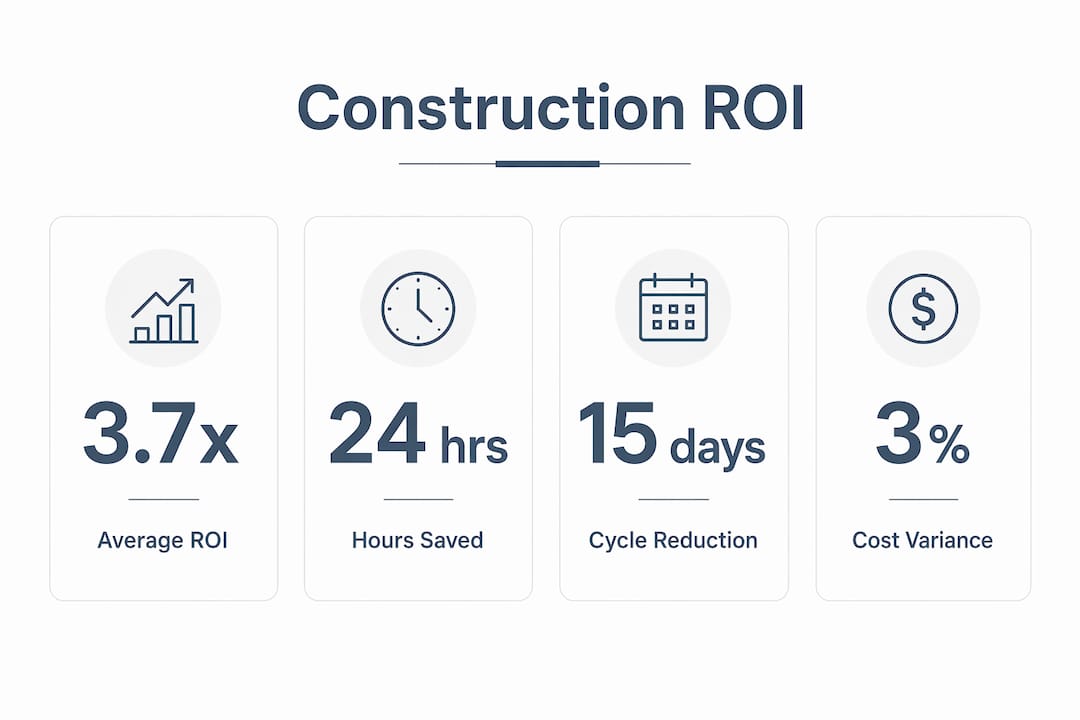
Contractors automating bid management, lien waivers, and safety documentation recover 18–24 admin hours weekly per employee. Multiply that across a five-person office team and you recover 90–120 hours per week. Those hours can go toward estimating more work or managing existing projects more carefully. Labor costs rose 8.3% in 2025, which makes every recovered hour worth more than it was the year before.
Change order cost control
Reducing change order cost variance by 3% recovers hundreds of thousands of dollars on large projects. AI-assisted document review catches scope gaps and pricing errors before they become approved change orders. On a $50M project, a 3% variance reduction is a $1.5M swing in profitability.
Working capital from faster pay applications
Automating pay application cycles by 15 days can unlock millions in cash flow. On an $80M project, shortening the cycle reduces interest expense by $60,000 to $80,000. That saving alone can pay for a software subscription within months.
Overall return on investment
Early adopters of AI-driven automation see an average ROI of 3.7x on their AI investments. That figure accounts for implementation costs, training time, and the learning curve. A 3.7x return is not a marginal improvement. It represents a fundamental shift in how profitable a construction firm can be.
| Automation Area | Measurable Impact |
|---|---|
| AI takeoff and estimating | Reduces takeoff time from 40–80 hours to under 15 minutes |
| Bid management automation | Cuts bid preparation time by 60–75% |
| Admin workflow automation | Recovers 18–24 hours per employee per week |
| Pay application processing | Shortens cycle by 15 days, saving $60K–$80K on $80M projects |
| AI investment overall | Delivers average 3.7x ROI for early adopters |
What are the best practices for implementing construction automation?
Implementation is where most automation programs succeed or fail. The technology is rarely the problem. The process and the people are.
Start with high-volume, low-risk workflows
Successful firms pilot automation on high-volume, low-risk workflows first before scaling to complex tasks. Bid management, lien waiver collection, and subcontractor onboarding are ideal starting points. These workflows are repetitive, well-defined, and easy to measure. A successful pilot builds team confidence and gives you a clear baseline for ROI.
Fix your data before you automate
30% of automation projects fail due to poor data quality. Automation amplifies whatever is already in your system. If your project data is inconsistent or incomplete, automated workflows will produce inconsistent and incomplete outputs. Audit your data before you deploy any new platform.
Address the people side directly
46% of automation initiatives are hampered by lack of skilled personnel managing new workflows. Training is not optional. Your team needs to understand why the new process exists, how it works, and what success looks like. Change management is as important as the software itself.
Follow this sequence when rolling out automation:
- Identify the three to five workflows with the highest manual time cost.
- Audit the data quality feeding those workflows.
- Select one workflow for a 30-day pilot.
- Define success metrics before the pilot starts, not after.
- Train the team on the new process, not just the software.
- Measure results, document lessons, and scale to the next workflow.
Pro Tip: Define your success metric before the pilot begins. “We will reduce bid preparation time by 50% in 30 days” is a measurable goal. “We want to be more efficient” is not.
How does automation improve project visibility and control?
Project visibility is the ability to know the current status of every active workflow without asking anyone. Automation creates that visibility by generating real-time data as a byproduct of normal operations.
AI is most effective in early phases like preconstruction, where document processing bottlenecks create the biggest competitive disadvantage. Automated bid tracking shows you exactly which bids are in progress, which are awaiting subcontractor quotes, and which are overdue. You stop managing by memory and start managing by data.
The visibility benefits extend through the full project lifecycle:
- Subcontractor credential tracking. Automated systems flag expired insurance certificates and missing compliance documents before they delay a project start.
- RFI and submittal routing. Automated routing sends documents to the right reviewer, tracks response times, and escalates overdue items without manual follow-up.
- Pay application status. Real-time dashboards show which applications are submitted, under review, or approved, giving you accurate cash flow forecasts.
- Field-to-office data flow. IoT devices and mobile field apps push site data directly into project management systems, eliminating the lag between what happens on site and what the office sees.
Automation functions best as a unified intelligence layer across business outcomes, not as a collection of isolated tools. When your bid management, scheduling, accounting, and field operations share the same data, every decision is based on current information. That connection between systems is what separates firms with genuine project control from firms that are always catching up.
Key Takeaways
Construction project automation delivers the highest ROI when deployed as a unified system across preconstruction, field operations, and accounting, starting with high-volume administrative workflows and scaling from there.
| Point | Details |
|---|---|
| Start with admin workflows | Bid management and lien waivers deliver fast, measurable wins with low implementation risk. |
| Fix data quality first | 30% of automation projects fail because of poor data, not poor technology. |
| Measure labor hour recovery | Automating admin tasks recovers 18–24 hours per employee per week. |
| Accelerate pay applications | Shortening the pay cycle by 15 days reduces interest costs and improves cash flow. |
| Connect systems, not just tasks | A unified platform delivers more value than multiple disconnected automation tools. |
Why most construction firms are still leaving money on the table
I have watched construction firms invest in automation tools and still struggle to see results. The pattern is almost always the same. They buy a point solution for estimating, another for scheduling, and a third for document management. Each tool works in isolation. None of them talk to each other. The project manager still spends Friday afternoon manually reconciling data from three different systems.
The firms that actually improve their margins treat automation as an infrastructure decision, not a software purchase. They ask: “What does our data flow look like from bid to closeout?” Then they build automation around that flow. The technology choice comes second.
The other mistake I see is automating the wrong things first. Firms try to automate complex, judgment-heavy tasks before they have mastered the simple, repetitive ones. That creates frustration and kills adoption. The firms with the best results start with bid management or lien waivers, prove the concept in 30 days, and then scale. They build confidence before they build complexity.
The competitive reality is this: firms that automate well will bid more work, win more contracts, and close projects with better margins. Firms that do not will face rising labor costs and shrinking margins with no structural way to respond. The gap between those two groups will be visible in financial statements within three years.
— Keith
How Designflow-build puts construction automation to work
Designflow-build is built specifically for contractors who want to replace disconnected tools with a single AI-native platform. It combines project management, accounting, and field operations in one system, so your data flows from bid to closeout without manual re-entry.

The platform’s AI takeoff tools process blueprints in minutes, and its workflow automation handles bid management, pay applications, and compliance tracking without manual follow-up. Designflow-build reports a 70% reduction in manual data entry and monthly savings of up to $847K for its users. Implementation takes 2–4 weeks with a 98% user adoption rate. If you want to understand the full range of construction software terms before you commit, the construction software glossary is a practical starting point.
FAQ
What is construction project automation?
Construction project automation is the use of software and AI-driven workflows to replace repetitive manual tasks in construction management, including bid processing, document routing, and pay application tracking. The goal is to reduce errors, recover labor hours, and give project managers real-time visibility into project status.
How much ROI can construction automation deliver?
Early adopters of AI-driven automation report an average ROI of 3.7x on their investments. Specific gains include recovering 18–24 admin hours per employee per week and reducing pay application cycles by 15 days.
Where should a construction firm start with automation?
Start with high-volume, low-risk administrative workflows like bid management and lien waiver collection. These workflows are well-defined, easy to measure, and deliver fast results that build team confidence for broader rollout.
Why do construction automation projects fail?
30% of automation projects fail due to poor data quality, and 46% are hampered by lack of skilled personnel managing new workflows. Fixing data quality and investing in team training before deployment are the two most important steps a firm can take.
Does automation work for small and mid-size contractors?
Automation delivers measurable results at any firm size. The key is starting with one workflow, proving the ROI, and scaling from there rather than attempting a full-firm transformation at once.