
Bid/No-Bid Criteria for MEP and Data Center Pursuits

A bid/no-bid decision is a documented go or no-go on a pursuit, made before your estimators spend hours on takeoff, vendor quotes and a proposal. The criteria that matter most are the same across the research: can the owner pay, is the scope clear, can you staff and cash-flow the job, and does the margin survive your own downside case. For a chilled water plant or a data center electrical package, you also need to know whether the equipment lead times and the design basis fit your capacity. Score those factors against numbers you agreed on before the RFP arrived, not against how much you want the work.
TL;DR
- Screen in order: eligibility gates first (license, bonding, due date), then ability to perform, project and owner risk, margin, and only then odds of winning.
- The factors that ranked highest in a 2024 contractor survey were owner ability to pay, clarity of scope, project cash flow, need for work and qualified labor availability.
- Use a weighted scorecard with hard stops, so a high fit score cannot hide a capacity or payment-risk problem.
- Decide more than once: at the early notice, at the final RFP, and again when an addendum changes scope or dates.
- Archive every decision, win or no-bid, so the next scorecard is calibrated against real outcomes.
Table of Contents
- Why a formal bid/no-bid pays off
- The five criteria groups, in screening order
- Build a weighted scorecard with hard stops
- Warning signs that justify a no-bid
- Who decides, and when
- Close the loop with lessons learned
- Perspective
- Put the scorecard on one platform
- FAQ
- Sources
Why a formal bid/no-bid pays off
Estimating a mission-critical package is expensive. A single data center bid can pull in takeoff for piping, electrical gear and controls, quotes from several equipment vendors, a schedule and a risk register. ProposalWorkspace reports that contractors spend an average of 84 hours on one proposal, and a design-build plant bid usually costs more than that.
The AIA’s best-practices guidance makes the other half of the point: when a team is focused on winning, it is hard to step back and ask whether it wants the job at all. The same piece notes that selective firms are more profitable and have a higher proposal success rate.
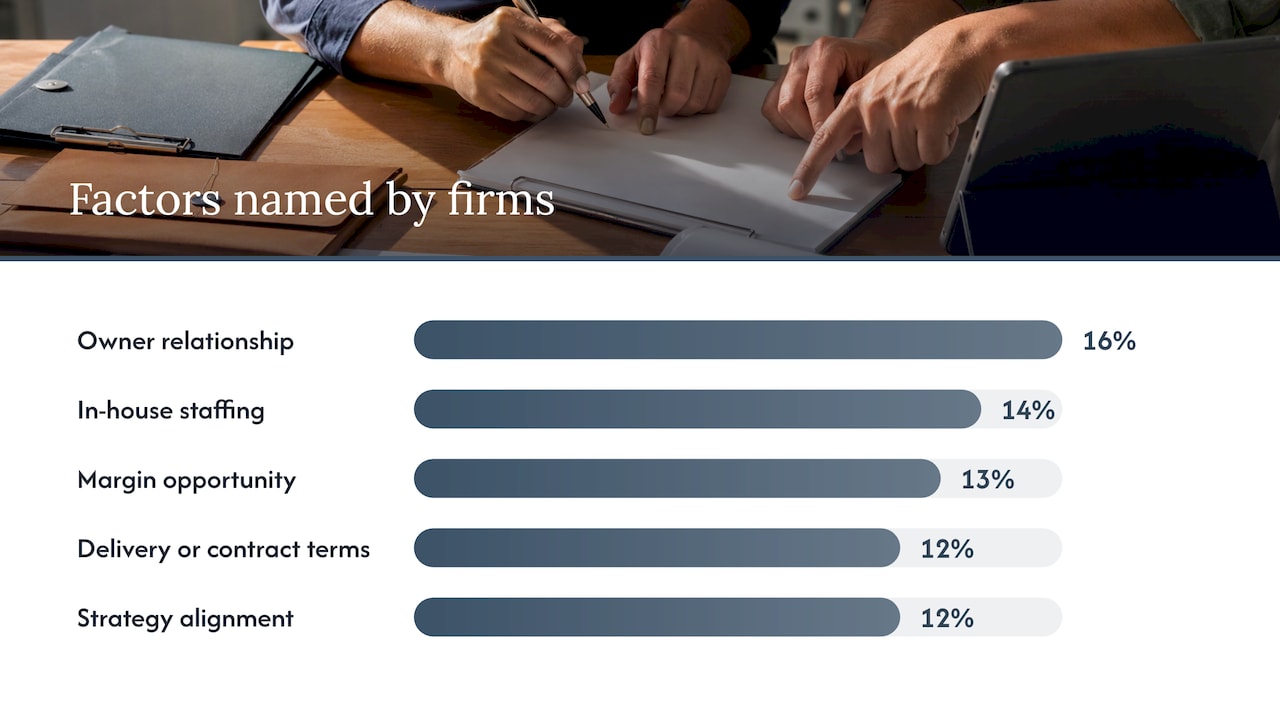
The habit is spreading. In the AGC/FMI white paper, 84% of firms already using a formal go/no-go process increased their reliance on it. The top factors those firms named were owner relationship, reputation and financial stability (16%), in-house staffing (14%), margin opportunity (13%), delivery method or contract terms (12%) and strategy alignment (12%).
The five criteria groups, in screening order
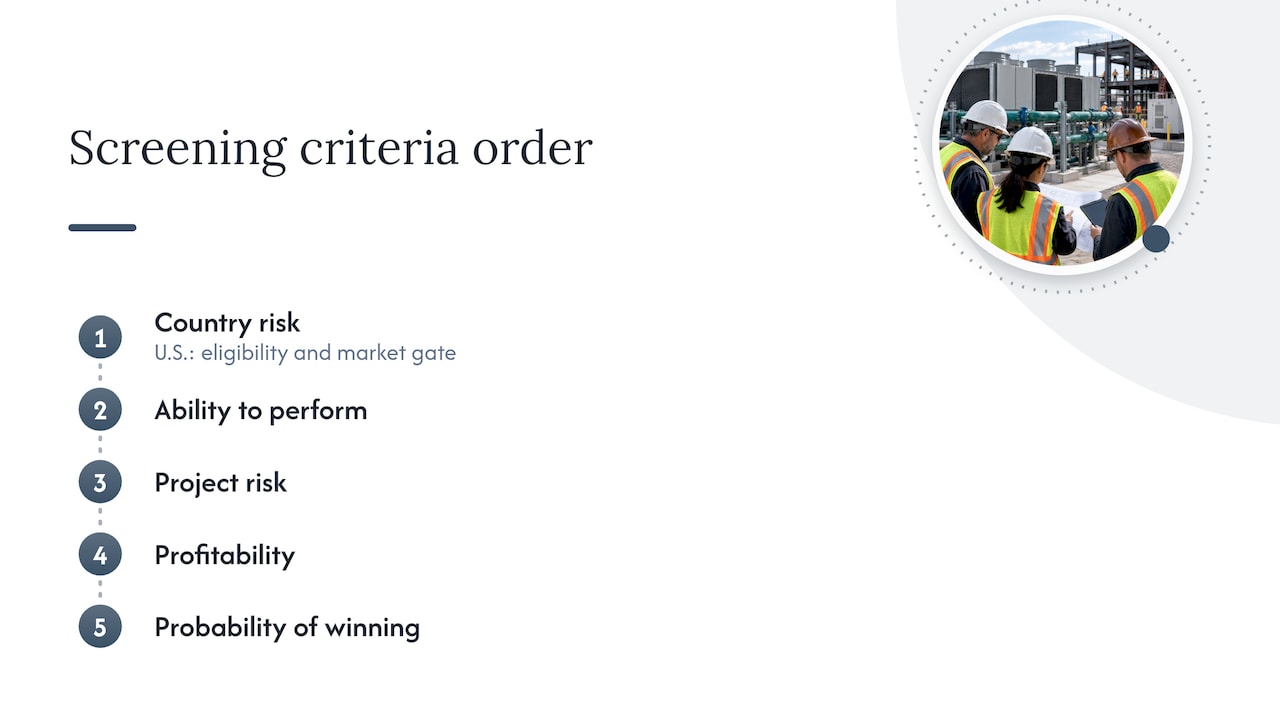
A 2020 study in the Journal of Construction Engineering and Management found that contractors screen in stages rather than making one judgment. The sequence it validated was country risk, ability to perform, project risk, profitability, then probability of winning. It identified 41 factors across five criteria. For a U.S. domestic contractor, “country risk” becomes the eligibility and market gate. The order still holds: cheap, binary questions first, expensive judgment calls last.
1. Eligibility gates
These are yes/no. One “no” ends the pursuit, and no score averages it away.
- Required state contractor license, and a PE or EOR relationship where the delivery method needs one.
- Bonding capacity and insurance limits that satisfy the bid documents.
- Prequalification requirements the owner sets, including safety record (EMR) thresholds.
- A due date you can meet with a priced, reviewed estimate, not a rushed one.
- Any mandatory certification, clearance or owner-approved vendor list that you are not on.
ProposalWorkspace also frames the decision as starting with eligibility gates such as set-aside qualification, mandatory licenses and the due date. Gating first means you never score a job you cannot legally or contractually perform.
2. Ability to perform
This is where mission-critical work differs from ordinary commercial work. Ask:
- Staffing: Do you have a project manager, superintendent and BIM or detailing lead free during the window the job needs them? Foremen who can run piping and electrical in a live white space are scarce.
- Technical fit: Have you built this system type? A 4,000-ton chilled water plant with N+1 chillers and a closed-loop cooling tower arrangement is a different risk from a 200-ton rooftop replacement. The same goes for 2N medium-voltage distribution against a standard 480V panel upgrade.
- Supply chain: Are chiller, switchgear and generator lead times compatible with the owner’s energization date? A schedule that assumes equipment you cannot get is a no-bid signal, not an estimating problem.
- Self-perform vs. subcontract mix: Can you cover the work you plan to self-perform?
Capacity is the factor teams most often overrule with enthusiasm. A forward view of who is available helps, and team capacity forecasting that runs weeks ahead turns “we think we can staff it” into a number you can score.
3. Project and owner risk
The 2024 Buildings survey of 112 respondents rated 22 factors. It found that the client’s ability to pay, clarity of scope, project cash flow, the need for work and availability of qualified labor were the most critical. Three of those five are owner or scope questions, which is why this group deserves real work:
- Owner payment record. Ask for the owner’s financing status. For developer-backed data center campuses, find out whether the project has committed capital or is speculative, and whether a lender is reviewing pay apps.
- Scope clarity. Is the design at 30% with an unresolved load schedule, or released for construction? An unclear basis of design on a 20 MW hall is where change orders and claims start.
- Contract terms. Look for pay-when-paid language, liquidated damages tied to energization, uncapped consequential damages, and retainage above what your cash flow can carry.
- Delivery method. Design-build, CM at risk and bid-spec each shift risk differently. FMI’s list above includes delivery method and contract terms among the top factors.
- Owner history. A 2021 study in the Journal of Civil Engineering and Management tested a client-record method on 40 university construction projects. It found cost and schedule overrun probabilities of 49% and 35%. Its argument is that quantifying an owner’s payment record, change-order frequency and contract administration lets a contractor avoid bidding for clients whose record shows high overrun rates. You can apply the same idea with your own job history.
Cash flow deserves its own line. A job that is profitable on paper can still strain payroll if billing lags. Run the project through a 13-week cash forecast before you commit.
4. Profitability
Do not score margin on the estimate you hope to build. Score it on a downside case:
- Your minimum acceptable gross margin for this work type, set in advance.
- Margin after a realistic escalation hit on copper, steel pipe and switchgear.
- Margin after the owner’s retainage and payment terms are priced in.
- Cost to pursue, including estimator hours, vendor engineering and any required design-assist.
The AIA checklist includes cost to pursue and acceptance risk as explicit categories, alongside client, project viability, profit potential, skills and experience, competition, selection process and an odds calculation. Include them.
5. Probability of winning
This comes last because it is the softest. Ask who wrote the spec, who the incumbent is, whether you have a prior relationship with the owner or the engineer of record, and whether your price position is realistic. Relationship is the single largest factor in the AGC/FMI list, so an owner who has never heard of you deserves a lower score here.
Build a weighted scorecard with hard stops
The AIA checklist uses 28 yes/no questions and calculates a score as yes responses divided by applicable questions. That is a good base. Add weights, because not every question carries the same consequence. Here is a scorecard for a mission-critical MEP pursuit. The weights are illustrative; set yours from your own history.
| Criterion group | Example question | Weight | Hard stop? |
|---|---|---|---|
| Eligibility | License, bonding and prequal requirements met | Gate | Yes |
| Ability to perform | PM, super and detailer free for the build window | 20% | Yes, if unstaffed |
| Technical fit | Built this plant or distribution topology before | 15% | No |
| Owner and payment risk | Funded project, clean pay history | 20% | Yes, if unfunded |
| Scope clarity | Basis of design and load schedule defined | 10% | No |
| Profitability | Downside-case margin above your minimum | 20% | Yes, if below minimum |
| Probability of winning | Prior relationship, realistic price position | 15% | No |
Two rules keep this honest. First, set thresholds before you read the RFP: minimum margin, maximum concurrent project load, acceptable contract risk and who must approve. Second, never let the weighted total override a hard stop. A 78% score with no available superintendent is a no-bid or a hold, not a bid.
When a drawing, a contract clause or an estimate assumption is missing, mark the gap, name who closes it and by when. Hold the decision if the missing fact could change it. Schedule pressure is the usual reason teams skip this.
Warning signs that justify a no-bid
These are red flags, not scores. Any one of them should trigger a review and often a pass:
- A spec tailored to someone else. Proprietary equipment, a sole-source chiller or a vendor-specific controls platform written into the documents suggests the winner is chosen. SiftHub lists requirements tailored to a competitor, no prior buyer relationship and an unrealistic timeline among its automatic no-bid signals.
- Energization date that ignores lead times. If the schedule needs generators or medium-voltage gear faster than the market delivers, you are pricing liquidated damages.
- Unfunded or speculative owner. No evidence of capital, or a pay-when-paid clause on a developer with no track record.
- Incomplete design on a firm-price contract. A lump-sum bid against a 30% design transfers the engineer’s gaps to you.
- Bid window too short. If you cannot take off the piping and electrical, get vendor quotes and review them, you would be guessing.
- Uncapped liability or one-sided termination terms your attorney and surety will not accept.
- Your best people already committed. If the key positions are booked on another job, the new one inherits a weaker team.
Prequalify the vendors and subs you would rely on at this stage too. If your key trade partners cannot meet the owner’s insurance and compliance terms, the pursuit weakens. Our guides on vendor prequalification and subcontractor prequalification gates cover those checks.
Who decides, and when
The decision belongs to someone accountable for the people and money the pursuit will use, usually a business development lead working with an executive and informed by the people who read the documents. ProposalWorkspace recommends an initial decision at the sources-sought or draft RFP stage, a firmer one on the final RFP, and a reopened decision when an amendment changes scope or dates.
FMI, in the AGC white paper, encourages firms to build their own selectivity factors, aligned with strategy and past experience, with multiple points of signoff. It also describes Gilbane assigning opportunities to levels 1 to 3 by size and complexity, with all business units convening for level 3. For a mid-size MEP contractor, a practical version is:
- Under a set dollar threshold: the estimating manager and a principal decide in one meeting.
- Above it, or any new owner: add operations, finance and your surety contact.
- Any design-build plant or campus work: include the lead engineer, because technical risk sits in the design basis.
Close the loop with lessons learned
A CIB study proposes four phases: set the criteria list with directors, managers and estimators; evaluate previous similar projects against it; decide using both criteria and lessons learned; and record lessons from the executed project and archive them for future decisions.
In practice, keep a one-page record per pursuit: score, hard stops, who approved, dissent, and the outcome. After the job closes, compare the bid margin to the actual job-cost result. If jobs scored 70% finish below your minimum margin, your weights are wrong. Log no-bids too, with the reason, and send a brief, positive decline to the owner so the relationship stays open. Vendors you leave hanging remember it, so a clear bid reminder cadence and a prompt “we are not pursuing” notice protect your quote relationships.
Perspective
Most bid/no-bid failures are data failures. The scorecard is fine. The inputs are late, scattered or optimistic. Takeoff lives in one file, vendor quotes in an inbox, job history in accounting, and capacity in someone’s head. So the decision gets made on instinct, the day before the due date.
We built DesignFlow Build as one system for takeoff, estimating, scheduling, project management, accounting and field operations. The decision can then use what your own jobs cost, not what you remember. When estimating, scheduling and job costing sit together, the downside case is a number you can pull up, not a guess. Teams go live in 2-4 weeks and cut manual data entry by about 70%, which means estimators spend hours on the decision instead of re-keying data.
For data center and central plant work, the same logic applies earlier in the pursuit. Plant Designer sizes and selects chillers, cooling towers, pumps and generators, routes and spools the piping, and designs the electrical from one 3D model, then produces a priced proposal. Its drawings, calculations and submittals are preliminary design-assist documents for the engineer of record to review and seal. That gives you a defensible cost basis for the margin line on a scorecard before you commit estimator hours to a full bid.
Our advice: write your thresholds down, keep the scorecard to one page, and make every hard stop non-negotiable.
Keith
Put the scorecard on one platform
If your takeoff, estimates, schedules and job costs are spread across spreadsheets and separate tools, the scorecard inherits the gaps. DesignFlow Build’s AI blueprint takeoff and construction estimating software put quantities and pricing in the same system as scheduling and job costing, so the margin line on your scorecard reflects your own cost history.
Pro seats are $100 per month per office user and field seats are $25 per month per user; see the pricing page for the plans. Plant Designer is set up by DesignFlow Build for enterprise customers and is not part of the free trial. See the Plant Designer page for the central plant design workflow.
FAQ
What does a no-bid mean?
A no-bid is a deliberate decision not to submit a proposal because fit, profit, risk or capacity is wrong. It is a normal business decision, not a failure. Send the owner a short, positive decline with your contact information so you remain on the invite list.
What are the criteria for bid evaluation?
Owners evaluate on price, qualifications, schedule, safety record and approach. Contractors evaluate their own side: owner ability to pay, scope clarity, cash flow, need for work, labor availability, margin and probability of winning. Your internal criteria should mirror what you know about your own capacity and past results.
How long should the bid/no-bid decision take?
The first screen should take minutes: eligibility gates and red flags. A full scorecard for a larger pursuit is typically one meeting with the right people present. Reopen it whenever an addendum changes scope, schedule or contract terms.
Should every contractor use the same criteria?
No. FMI encourages firms to develop criteria specific to their strategy and past experience. Start from the standard groups (client, project, contractor, market, contract) and adjust the weights against your own job history.
Sources
- AIA Best Practices: Reality check, assess whether a project is right for your firm
- AGC/FMI, Building Amid Uncertainty (2022)
- Empirical Bid or No Bid Decision Process in International Construction Projects, Journal of Construction Engineering and Management (2020)
- Exploring Bid/No-Bid Decision Factors of Construction Contractors, Buildings (2024)
- Enhancement of Bid Decision-Making in Construction, Journal of Civil Engineering and Management (2021)
- An integrated bid/no bid decision process for construction, CIB (2010)
- What Is a Bid/No-Bid Decision? ProposalWorkspace
- Master the bid no-bid process before your next RFP lands, SiftHub