
Weather Delay Risk: How to Schedule and Price It
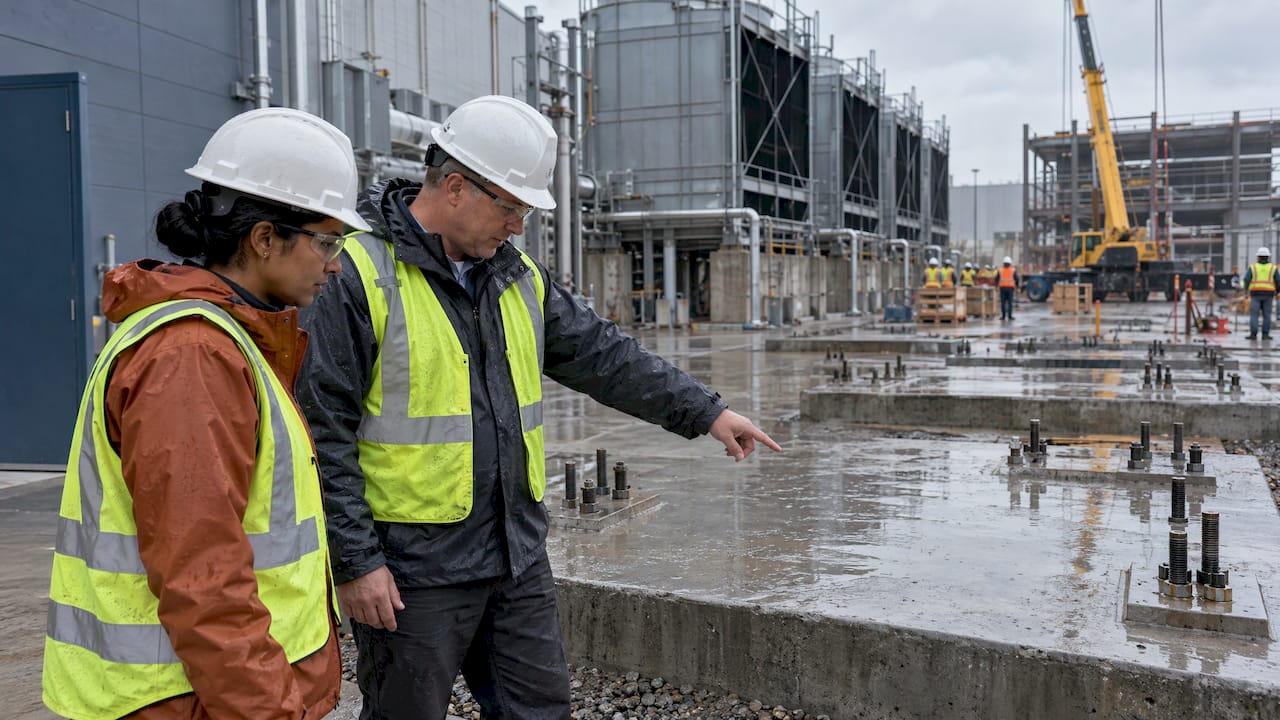
Weather delay risk is the probability that rain, wind, lightning, heat or freezing temperatures cost your project working days, multiplied by what each lost day costs. On a data center or central plant job, that cost is rarely just the crew. A missed crane window delays chiller and cooling tower setting, which pushes piping, electrical termination, flushing and commissioning. The teams that handle this well stop treating weather as an excuse and start treating it as a number in the schedule and the budget. DesignFlow Build runs scheduling, estimating, accounting and field operations in one system, so that number lives in one place instead of three spreadsheets.
TL;DR
- Weather risk is a distribution, not a single allowance. Model it per activity (exterior concrete, steel, crane lifts, roofing, underground, outdoor equipment setting), not as one flat percentage on the whole job.
- Use probabilistic forecasts and two time horizons: a short tactical window for daily crew and lift decisions, and a longer strategic window for procurement and sequencing.
- Price the risk twice: schedule float for time, contingency for money. Keep the two tied to the same activities so a lost day shows up in both.
- Document every weather day the same day it happens. Contract notice requirements and back charge disputes are won on daily records.
- A Monte Carlo schedule run shows which weather-exposed activities sit on the critical path and how many days of float actually protect your completion date.
Table of Contents
- Why weather delay risk is a different problem on mission-critical work
- Sort activities by weather exposure
- Forecast horizons: what to use for which decision
- Why capacity matters more than the weather event itself
- Worked example: a 20-MW chilled water plant expansion
- Run it as a probability, not a guess
- Price it: schedule float and contingency are two halves of one number
- Contract language and daily records
- Weather delay and equipment lead time
- Perspective
- Put weather risk in the same system as your schedule and budget
- FAQ
- Sources
Why weather delay risk is a different problem on mission-critical work
On a warehouse, a rained-out slab pour costs a day or two. On a hyperscale or enterprise data center, the same lost day can sit ahead of an energization date that carries liquidated damages or a tenant’s go-live commitment. Three features make weather risk sharper in this sector:
- Heavy, scheduled lifts. Chillers, cooling towers, generators, switchgear and transformers are set by crane in booked windows. Wind limits on the crane and the rigging plan decide whether the lift happens, and rebooking a large crane is rarely a one-day fix.
- Long-lead equipment with fixed delivery slots. If the pad, housekeeping slab or underground duct bank is not ready because of a wet week, the equipment arrives anyway and needs laydown, protection and storage.
- Back-end compression. Weather loses days early, in sitework and structure. Commissioning dates rarely move, so the loss is absorbed by the trades at the end: piping, electrical termination, controls, startup and integrated systems testing.
The first step is to be precise about which activities are weather-exposed. Not every task on the schedule is.
Sort activities by weather exposure
Build an exposure list from the schedule. Each activity gets one of three tags.
| Exposure | Typical activities | What weather does |
|---|---|---|
| High | Mass excavation, underground utilities, duct banks, exterior slabs, tilt-up or steel erection, crane lifts, roofing, exterior piping and insulation | Stops work outright: precipitation, standing water, high wind, lightning, freezing temperatures |
| Moderate | Cooling tower and chiller pad work, generator yard, exterior conduit, site electrical, paving | Slows production or forces rework: saturated subgrade, cold-weather concrete protection, heat limits on crew hours |
| Low | Interior MEP rough-in after dry-in, controls, commissioning in conditioned space | Indirect only: delivery access, material staging, labor availability |
Two cautions apply. First, exposure changes when the building is dried in, so the tag should be tied to a milestone, not a fixed date. Second, outdoor commissioning tasks, such as running chillers and towers under load, depend on ambient conditions and can be rescheduled by weather even though they come at the end.
The Pipe X page on concrete and storm structures in Denver is a useful illustration of how site conditions and task type change how much a given weather event matters on civil and underground work.
Forecast horizons: what to use for which decision
Aviation has spent decades managing weather as a quantified risk, and its planning practice maps well onto construction. The FAA’s Weather-ATM Integration Working Group found that forecasts are more accurate in the zero-to-two-hour tactical period than in the two-to-ten-hour strategic period, and named forecast uncertainty as a core planning challenge. The same report found that as much as two-thirds of weather-related delay in its analyzed convective events might have been avoidable, and it recommended risk-based, incremental decisions rather than all-or-nothing calls.
The National Weather Service’s Aviation Weather Center shows what a probabilistic product looks like. Its terminal forecasts carry probability groups, where PROB30 marks a forecaster’s 30% assessment of a thunderstorm or precipitation event. You do not need aviation products to run a jobsite, but the habit transfers: read the probability, not just the icon.
For a construction team, that translates into three decision layers:
- Tactical (same day to next morning). Go or no-go on a pour, a lift or a trench opening. Superintendents make these calls with the freshest forecast and site conditions: wind speed against crane limits, lightning, ground saturation.
- Short strategic (two to ten days). Crane and concrete bookings, trucking, crew allocation, protection materials. Hold options open and decide incrementally as the forecast firms up.
- Long strategic (project start). Which season each exposed activity falls in, how much float to carry, how much contingency to price. This is where historical weather data for the site governs, not a forecast.
A useful rule: do not make a long-lead commitment based on a forecast beyond the range where forecasts hold up, and do not cancel a booked lift on a low-probability call without a defined trigger. Write the triggers into the lift plan, for example a sustained wind limit from the crane chart and a lightning stand-down rule, so the decision is made before the morning pressure starts.
Why capacity matters more than the weather event itself
The FAA makes a point in its weather delay FAQ that applies directly to jobsites: weather does not automatically produce a major delay. The effect depends on capacity and demand, and busy airports operating near capacity face the longest delays when weather constrains operations.
Construction works the same way. A rain day on a job with flexible crews and loose sequencing costs one day. The same rain day on a job with every crew, crane and inspection booked back to back cascades. The risk is a function of how tightly the schedule is packed around the exposed activity.
That gives you three levers:
- Sequencing. Put weather-exposed work early and interior work behind dry-in, so crews can be redirected on a bad day.
- Resource slack. Know which crews can move to interior work. Track skills and availability, not just headcount. Our guide to commercial construction workforce planning covers how to keep that visible.
- Buffer placement. Put float directly behind exposed activities, not as one lump at the end of the schedule, where it is invisible to the people who need it.
Worked example: a 20-MW chilled water plant expansion
The numbers below are illustrative, not data from a real project.
A contractor is building a chilled water plant expansion at an existing campus: foundations and pads for three cooling towers, a chiller room, underground chilled water piping, and a generator yard. The schedule has 140 working days from notice to proceed to mechanical completion. Exterior work runs for the first 60 days.
Step 1. Tag exposure. Excavation, underground piping, pads, tower setting and the generator yard are high or moderate exposure. Chiller room interior work is low exposure after the roof is on.
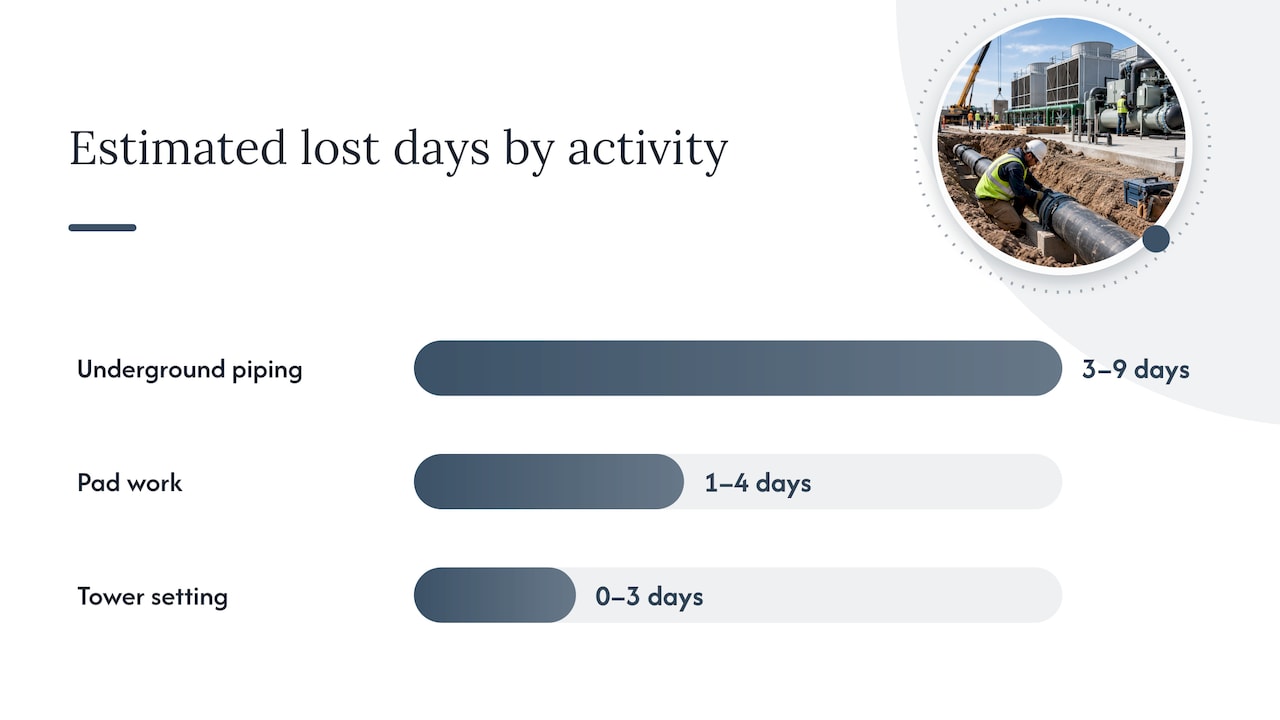
Step 2. Estimate lost days by activity. Using historical weather records for the site and the contract’s definition of adverse weather, the team estimates lost days per activity as a range, not a point: for example 3 to 9 days on underground piping, 1 to 4 on pad work, 0 to 3 on tower setting depending on wind.
Step 3. Find where float absorbs it. Underground piping has 5 days of total float. Tower setting is critical, with zero float, because commissioning is fixed by the owner’s schedule. So any loss in the tower setting window moves the end date day for day, while a 3-day loss in underground piping is absorbed.
Step 4. Price the result. For the critical activity, each lost day carries general conditions, crane standby, and idle crew cost. For the non-critical one, the cost is mostly rework and protection. The contingency is built from these activity-level figures, rather than a flat percentage of contract value.
Step 5. Re-run when conditions change. After a wet October, update actual lost days, re-forecast the remaining exposed activities and re-check which ones are now critical.
The outcome is a defensible statement for the owner: not “we added 10 days for weather,” but “tower setting is the weather-critical activity, and here is the probability we hold the commissioning date and what it costs to improve it.”
Run it as a probability, not a guess
A single-point schedule with a weather allowance hides the real question: what is the chance of finishing on time? A Monte Carlo schedule analysis answers it. It reruns the schedule thousands of times with each uncertain duration drawn from a range, and reports the spread of finish dates and which activities drive it most often. For weather, you feed it the lost-day ranges from the exposure list above.
Two outputs matter most:
- Criticality index. The share of runs in which an activity lands on the critical path. A weather-exposed activity that is critical in 60% of runs deserves protection; one that is critical in 3% does not.
- Confidence-level finish date. The date you hit in, say, 80% of runs, which you can compare with the contractual date to size the buffer or decide on acceleration.
Our construction scheduling software covers CPM, Monte Carlo and DCMA schedule checks in the same platform as estimating and job cost, so lost-day ranges and their dollar impact come from the same activity list.
Price it: schedule float and contingency are two halves of one number
Float protects the date. Contingency protects the margin. If they are set independently, they drift apart: a schedule with generous float and a budget with no weather line, or the reverse.
A workable approach:
- Use the activity-level lost-day ranges to set float on exposed work.
- Convert expected lost days on critical activities to dollars using daily general conditions, equipment standby and crew idle cost.
- Hold the result as a named contingency line, not buried in labor or equipment rates, so it can be tracked and released as risk passes.
- Release contingency as exposed activities finish. When the underground piping is backfilled, its weather reserve is no longer needed.
Our article on construction contingency goes through how to size and release reserves. For the facilities-owner side of the same discipline, this piece on planning reserves to limit repair disruption shows why reserves are decided before work starts, not during the disruption.
Contract language and daily records
Most weather disputes come down to two questions: did the weather exceed what the contract treats as normal, and was notice given on time. Read your contract for four things:
- The definition of adverse weather. Some contracts define it against a threshold such as inches of rain or wind speed, others against a historical average for the month. Know which applies.
- Notice deadlines. Time-extension claims usually require written notice within a stated number of days of the event. Missing it can forfeit the claim.
- Time versus money. Many contracts grant time for adverse weather but no added compensation. Price your own risk accordingly.
- Who owns protection. Temporary heat, dewatering and protection of installed equipment need a named owner of the cost.
Record, every weather day: date, hours lost, activities affected, crews sent home, equipment on standby, conditions observed (rain, wind, ground), and photos. Field entries made on the day carry far more weight than a reconstruction at month end. The DesignFlow Build mobile field app is live for field crews, and field seats are $25 per user per month.
Weather also feeds disputes between trades. When one subcontractor’s lost day becomes another’s, clean records decide who is responsible. See our guide to back charges in construction and the one on change orders that stop three-week delays for handling the paperwork.
Weather delay and equipment lead time
Weather risk is not only on your site. Fabrication, freight and vendor schedules carry their own exposure, and a late chiller or generator turns a manageable site delay into a long one. For manufacturers’ reps and equipment vendors, the same logic applies: map the weather-exposed legs of delivery and carry buffer there. For a plain explanation of the components of lead time, see this overview of manufacturing lead time. Then tie confirmed delivery dates to the activity they feed, so a slip at the vendor shows up in the schedule immediately.
Perspective
Weather is the delay risk everyone admits and almost nobody prices properly. We see the same pattern in how mission-critical work gets planned: a flat weather allowance in the schedule, a flat percentage in the budget, and no link between them.
Our view is that weather belongs in the same model as everything else. Lost-day ranges per activity, float placed behind exposed work, contingency released as exposure passes, and daily field records that support a time-extension claim. When scheduling, estimating, job cost and field logs sit in separate tools, each of those steps is a manual re-entry, and the weather picture is stale by the time it reaches the budget.
That is why DesignFlow Build puts CPM scheduling with Monte Carlo analysis, estimating, accounting and field operations on one platform, and why our AI project management is built around risk prediction and resource allocation. Teams go live in 2-4 weeks and cut manual data entry by about 70%. For central plant work, Plant Designer produces preliminary design-assist drawings, calculations and submittals from one 3D model, for the engineer of record to review and seal, so equipment selection and the schedule it drives start from the same source.
Keith
Put weather risk in the same system as your schedule and budget
DesignFlow Build is an AI-native construction ERP built for MEP contractors, data center builders, engineering firms and owners. Scheduling, estimating, job costing, compliance and field operations share one data set, so a lost day in the field updates the schedule and the cost picture without re-keying. Pro is $100 per month per office user and field seats are $25 per month per user, with a free tier available. See plans and pricing, or read how our construction risk prediction flags problems early.
Plant Designer is set up by DesignFlow Build for enterprise customers and is not part of the free trial. To see how the wider platform ties into your jobs, start with the Construction ERP.
FAQ
How many weather days should I put in a construction schedule?
There is no universal number. Estimate lost days per weather-exposed activity as a range from historical records for the site and the season, then place float behind the critical ones. A single project-wide allowance hides which activities actually threaten the end date.
What is the difference between tactical and strategic weather planning?
Tactical planning covers the next hours to a day or two: go or no-go on a lift or a pour. Strategic planning covers days to weeks and the whole project: bookings, sequencing, float and contingency. The FAA’s working group found forecasts are more accurate in the zero-to-two-hour window than the two-to-ten-hour window, so keep longer-range commitments flexible.
Is weather delay a compensable event?
It depends on the contract. Many agreements grant a time extension for adverse weather beyond what is normal for the location and season, but not additional compensation. Check the definition of adverse weather and the notice deadline, and have counsel review any claim that involves liquidated damages.
Why does the same storm cause bigger delays on some projects?
Capacity and demand decide it. The FAA notes that the effect of weather depends on how close operations run to capacity. A jobsite with every crew, crane and inspection booked back to back has no room to absorb a lost day.
Sources
- FAA Report of the Weather-ATM Integration Working Group
- FAA FAQ: Weather Delay
- NWS Aviation Weather Center product information