
WIP Schedule Errors: How to Find and Fix Them

Most WIP schedule errors are not math errors. They are input errors: a stale estimated cost to complete, a change order in revenue but not in cost, retainage left out of billings, job cost that does not tie to the general ledger. The formula is simple. The inputs are the problem, and they live in different places: the estimate, the field, the pay app log and the ledger. When those sit in separate spreadsheets and accounting tools, errors get in. DesignFlow Build runs job costing by cost code, WIP, billing and field data in one system, so the inputs are not re-keyed between tools.
This guide covers what goes wrong, how to spot it on the schedule, and how to correct it. It is written for MEP and general contractors, engineering firms, and owners and developers who review pay apps and contractor WIPs on data centers and other mission-critical work.
TL;DR
- The estimated cost to complete drives percent complete, earned revenue and gross profit. A stale estimate is the most damaging WIP error.
- Billing is not revenue. Revenue comes from percent complete, so a job cannot be “fine” just because the pay app went out.
- Change orders, retainage, cost cutoff and unallocated overhead are the other recurring sources of error.
- Reconcile the WIP to the general ledger every month, with no plugs. A schedule that does not tie signals an unreliable accounting system to sureties.
- Put the project manager’s sign-off on the estimate to complete in the monthly close.
Table of Contents
- What the schedule has to get right
- Estimate errors: the ones that cost the most
- Contract value and billing errors
- Cost errors
- Structural errors
- A monthly review that catches errors
- How to correct errors
- What errors cost you
- Why one system removes most of these errors
- Put the monthly WIP on one platform
- FAQ
- Sources
What the schedule has to get right
A WIP schedule compares, for each open contract, the contract price, estimated total cost, cost to date, billings to date and the revenue earned. AICPA & CIMA describes an effective schedule as one that carries the contract price, the estimated total project cost, and costs and requisitions to date. For fixed-price work, that lets the CPA calculate revenue earned through the reporting date.
Most contractors use the cost-to-cost method: costs to date divided by total estimated cost gives percent complete, and percent complete times contract price gives earned revenue. Katz & Bosch names four inputs that drive every calculation: contract value, costs to date, total estimated costs, and billings to date including retainage. If one is wrong, every downstream figure is wrong. Earned revenue less billings gives over/underbilling: overbilled means you billed ahead of the work, underbilled means you did work you have not billed.
Estimate errors: the ones that cost the most
Stale estimated cost to complete
FinTruction calls a stale estimated cost to complete the most common reason a schedule fails lender or surety review. If the PM carries the original budget while the field knows the job will overrun, percent complete and earned revenue are overstated and the profit shows up on paper and fades later. BuilderLedger’s checklist puts stale percent-complete figures at the top of its error list.
On mission-critical work this happens easily. A chilled water plant job carries long-lead items such as chillers, switchgear and generators. When a delivery slips or a vendor reprices, the cost to complete moves, but the WIP often waits for the next quarterly review.
A worked example
Take a $4,000,000 fixed-price central plant contract with a $3,200,000 original estimate. This is an illustration, not a customer case.
| Input | Carried forward estimate | Corrected estimate |
|---|---|---|
| Contract price | $4,000,000 | $4,000,000 |
| Estimated total cost | $3,200,000 | $3,700,000 |
| Cost to date | $1,600,000 | $1,600,000 |
| Percent complete | 50.0% | 43.2% |
| Earned revenue | $2,000,000 | $1,729,730 |
| Gross profit to date | $400,000 | $129,730 |
| Billed to date | $2,300,000 | $2,300,000 |
| Overbilling | $300,000 | $570,270 |
The same $1,600,000 of cost produces $270,270 less revenue once the estimate is honest. The job’s expected margin falls from $800,000 to $300,000. A schedule that carried the old estimate would show a healthy overbilling and a profitable job. Chau Tran CPA makes the same point: an optimistic estimate overstates every downstream figure, and the correction arrives later, all at once.
The fix is a monthly process, not a better formula. StrategX Advisory recommends that the project manager sign off on estimated cost to complete each month, with a closed-job report comparing final margin against bid margin.
Loss jobs
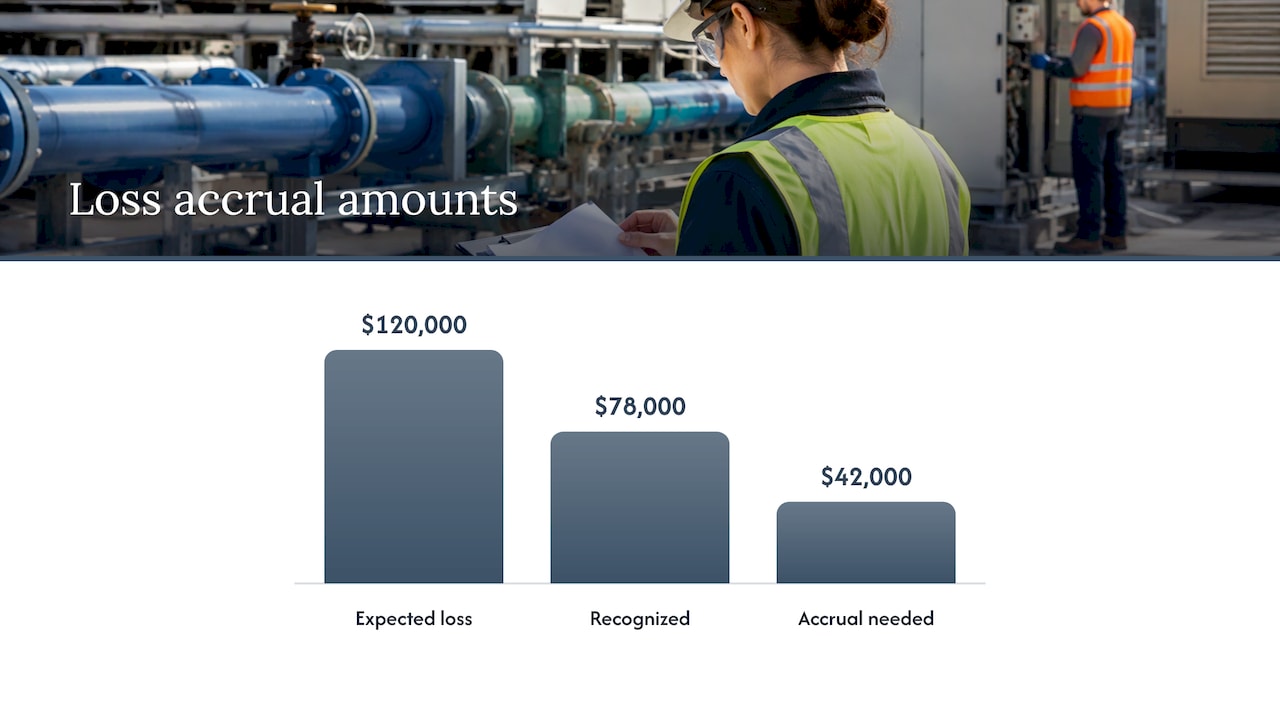
When a contract is expected to lose money, the full loss is recognized as soon as it is determinable, not ratably. Castro CPA gives an example: a job with a $120,000 expected loss at 65% complete that has recognized only $78,000 needs an additional $42,000 accrual, so cumulative gross profit equals the full negative $120,000. Missing loss accruals are among the most common defects in contractor-prepared schedules, and they err toward flattering the current period.
Contract value and billing errors
Change orders
Two mistakes show up repeatedly. The first is adding a change order to contract value without adding its cost to the budget. Dean Dorton lists this as improper change order management. The second is the reverse: the work is done and costs are in the cost column, but the change order is unsigned, so there is no revenue. That produces a paper underbilling. FinTruction’s template guide lists change orders performed but not approved as a recurring error found in contractor books.
A practical rule: pending change orders stay out of contract value unless approval is probable and you can support it. Modus says probable-of-approval changes can be included in contract value, while disputed ones should not. Keep field records and owner correspondence with the change order either way. On a data center build, scope changes from owner-furnished equipment or revised load assumptions arrive constantly, so the change order log needs to feed the WIP directly.
Retainage
Retainage is held back by the owner but is still billed. Leaving it out of billings to date understates billings and throws off over/underbilling. Cornerstone CPA lists it among common WIP mistakes, as does Stancil CPA, which also flags omitting retainage from collection forecasts. Retainage should be tracked on its own line so billings tie to the pay app register and AR.
Treating billing as revenue
AICPA & CIMA quotes Rob Mercado, CPA, CCIFP, making the point plainly: requisitioning for money is not revenue, because costs have to be incurred to create it. A schedule that uses billings as a stand-in for percent complete will look fine until the job closes.
Cost errors
Cost cutoff
Costs incurred but not recorded at period end understate percent complete, revenue and gross profit. Castro CPA lists unposted subcontractor invoices, uninvoiced sub work, materials delivered with invoices in transit, unposted equipment burden and payroll accruals. The result is paper underbillings that vanish the next month.
Burdened and unburdened mismatch
Mixing a burdened cost numerator with an unburdened estimated-total-cost denominator produces a percentage that means nothing. FinTruction also reports labor booked without burden, which it says understates cost by 20-35%. For electrical and mechanical crews, payroll taxes, insurance and benefits have to be consistently included on both sides of the fraction.
Unallocated or misclassified costs
Bilotta & Company CPAs points out that unallocated job costs make affected jobs look more profitable than they are. Management then underprices similar work, pays incentives on overstated margins and misjudges PM performance. The same pattern shows up when costs are coded to the wrong job or left in SG&A. If you price field labor by the hour, knowing what contractors charge per hour is only useful when the cost side of the job carries the matching burden. Our guide to overhead allocation in construction covers methods and examples, and a clean job-costing-first chart of accounts makes the tie-out easier.
Committed versus incurred
A purchase order for a generator is a commitment, not a cost. Counting committed costs as incurred pushes percent complete ahead of the work. The related problem is uninstalled materials: stored equipment inflates percent complete under cost-to-cost unless you treat it deliberately. Castro CPA lists uninstalled materials among the signs to flag.
Structural errors
- Netting jobs. HSM University notes that netting underbillings against overbillings across jobs hides the individual job position. Assess each job separately.
- Missing jobs. BerryDunn lists not including all contracts, open and closed, on the schedule.
- Year-end only. A WIP prepared once a year surfaces every problem at once. StrategX Advisory flags this too.
- Prior-period inconsistency. EisnerAmper says auditors see cumulative revenue that differs between the prior and current schedule, jobs that disappear, and percentages over 100% or negative.
A monthly review that catches errors
Run these checks on every close. They draw on the red flags listed by Castro CPA and Modus.
| Check | What it usually means |
|---|---|
| Job over 100% complete, or near 100% with large cost to complete | Data entry error or stale estimate |
| Material cost activity but estimated cost to complete unchanged | Estimate not reviewed |
| Identical gross profit percentages on unrelated jobs | Margin being plugged |
| Large underbilling late in the job | Dispute, unbilled retainage, unapproved change orders or hidden overrun |
| Billings above contract price | Change order invoiced but not added to contract value, or a billing error |
| Job showing both over- and under-billing | Calculation error |
| Closed job with a remaining over/underbilling | Incomplete closeout entry |
| Overbillings growing faster than revenue | Front-loaded billing or slipping progress |
| Loss job with no loss accrual | Missing provision |
| Cost transfers between jobs | Possible margin shifting |
Compare this month with last month job by job. Chau Tran CPA notes that a job whose estimated total cost keeps climbing while percent complete barely moves is visible on the schedule months before it shows up in the bank account. Our six-step monthly checklist for over and under billing turns this into a routine.
How to correct errors
The correction depends on the cause. Modus describes three underbilling causes that need three different actions:
- Timing. A pay app submitted after month-end resolves itself when the invoice is processed.
- Unapproved change orders. Gather field records and owner correspondence, then assess collectability.
- Cost overruns. Update the estimate. If the revised numbers show a loss, recognize the full anticipated loss immediately.
Then reconcile. Castro CPA’s documented reconciliation has five points:
- Contract assets and liabilities equal GL balances after the adjusting entry, with no plugs.
- Open-job and closed-job costs tie to cost of revenue.
- The change in cumulative revenue equals period revenue.
- Billings tie to the billing register and AR activity.
- Closed jobs carry zero contract assets and liabilities.
Dannible & McKee adds that even a small early estimating error can turn into meaningful fade by closeout, and that unreconciled retainage and unsupported over/underbilling balances are common reconciliation issues. Sign and date the schedule before it goes out. BuilderLedger’s checklist recommends a documented reason for any job below a minimum margin and an explanation, not just a note, for any job that has faded since last month.
What errors cost you
Sureties and auditors read the schedule for consistency. Chau Tran CPA says underwriters look at job fade, backlog concentration, reliance on overbillings and agreement with the financials. When job cost reports and the general ledger disagree, the underwriter assumes the less favorable answer, and contractors lose bonding capacity because reporting is inconsistent, not because results are poor.
Cash is affected too. Geffen Mesher explains that overbillings can lead to job borrowing, and if cash falls below the job-borrow level a surety may question bonding capacity. Profit fade also affects the amount and timing of income tax payments. Overbilling cash is not profit: it is owed work. Our WIP reporting guide goes into what sureties look for.
Why one system removes most of these errors
Look back at the list. Stale estimates, unrecorded costs, change orders that miss the budget, retainage left off billings, and a WIP that does not tie to the ledger all come from the same cause: the numbers are copied between a spreadsheet, an accounting package and a field log. Every copy is a place for a delay or a typo.
DesignFlow Build is a construction ERP. It covers general ledger, AR/AP, certified payroll, job costing by cost code and WIP, alongside estimating, scheduling, project management and field operations. Teams go live in 2-4 weeks and cut manual data entry by about 70%. Less re-keying means fewer places for the inputs to drift apart. Read more on construction ERP.
Our view
A WIP schedule is a forecast, not a ledger report. The accounting team can recalculate it perfectly and still publish the wrong answer, because the number that matters is the project manager’s view of what the job will cost, and that view lives in the field, the estimate and the purchasing log.
That is why we build DesignFlow Build as one system. Estimating, scheduling, field work, job costing by cost code and accounting share the same job record. When a PM changes the cost to complete, the accountant and the owner’s rep are looking at the same job, not a copy exported last Tuesday.
For data center and central plant work, the stakes are higher. Equipment is long-lead and expensive, scope shifts mid-job, and one miss on a chiller or generator package moves margin. Our position: close the gap between the people who know the cost and the people who report it, and the monthly review becomes a short conversation instead of a forensic exercise.
Keith
Put the monthly WIP on one platform
DesignFlow Build brings job costing by cost code, WIP, AR/AP, certified payroll, compliance automation (COI, lien waivers) and the mobile field app into one ERP. Pro is $100 per month per office user, and Field seats are $25 per month per user. A free plan covers core features. See the pricing page for the plans.
For central plant design-build work, Plant Designer produces preliminary design-assist documents for the engineer of record to review and seal, from the same model that prices the job. Plant Designer is set up by DesignFlow Build for enterprise customers and is not part of the free trial. See Plant Designer.
FAQ
What is the most common WIP schedule error?
A stale estimated cost to complete. Percent complete, earned revenue and gross profit all depend on it, so carrying last month’s number forward overstates everything downstream. Monthly PM sign-off on the estimate is the standard fix.
How do I know if my WIP schedule is wrong?
Start with the internal red flags: jobs over 100% complete, unchanged estimates despite cost activity, billings above contract price, and closed jobs still showing over/underbillings. Then confirm the cost column ties to the job cost ledger and the totals tie to the balance sheet.
Is an underbilling always a problem?
No. StrategX Advisory explains that the same underbilling can be harmless timing or a serious estimate problem. Diagnose the source first: a late pay app, an unapproved change order or a cost overrun each need a different response.
How often should I update the WIP schedule?
Monthly. A year-end-only schedule lets errors pile up and surface together. Monthly updates with the PM and accounting reviewing job by job are the recommended routine.
Do WIP errors affect bonding?
Yes. A schedule that does not reconcile to the financial statements signals an unreliable accounting system to sureties, and repeated profit fade undermines confidence in your estimates. Talk with your surety agent or CPA about how your schedule is read.
Sources
- AICPA & CIMA: WIP schedules, blueprints for solid construction accounting
- Castro CPA: How to read a construction WIP schedule
- Modus: WIP schedules, how auditors and sureties read them
- Katz & Bosch: Year-end WIP schedule FAQ
- FinTruction: WIP reports for lenders and sureties
- FinTruction: Construction WIP schedule template
- BuilderLedger: WIP review checklist
- Chau Tran CPA: How to read a WIP schedule
- StrategX Advisory: WIP schedule for surety bonding
- Dean Dorton: WIP schedule, a key financial tool for contractors
- Stancil CPA: WIP schedule and surety bonding for contractors
- Bilotta & Company CPAs: Common errors that distort margins
- HSM University: The WIP schedule and over and underbillings
- BerryDunn: Construction WIP accounting, five common mistakes
- EisnerAmper: Percentage of completion
- Dannible & McKee: WIP schedules that sureties trust
- Geffen Mesher: Getting to know your WIP schedule