
Automation and SMB Profit Improvement in Construction

Automation is the use of technology to handle repeatable business workflows without manual intervention, and the role of automation in SMB profit improvement is direct: it cuts costs, speeds up cash flow, and creates room to grow. Construction firms with 5–25 employees that automate their top five workflows recover $30,000–$80,000 annually through time savings, recovered leads, and fewer errors. That figure covers platforms costing $150–$400 per month, so the net return is substantial. The industry term for this practice is business process automation, or BPA. Whether you call it BPA or simply “workflow automation,” the financial logic is the same: less manual work means lower costs and faster revenue.
What workflows in construction SMBs offer the greatest automation ROI?
The highest-return workflows share two traits: they happen frequently, and they create friction when done manually. In construction, that points to bid follow-up, subcontractor invoice processing, change order documentation, and document intake. These tasks repeat on every project, and each manual touchpoint adds time, cost, and error risk.
McKinsey research shows that roughly 50% of work activities and 30% of tasks across most professions are automatable today, specifically structured and repeatable ones. That finding maps directly onto construction office work. Bid tracking, invoice routing, and change order logging are all structured. They follow predictable steps. That makes them ideal automation targets.
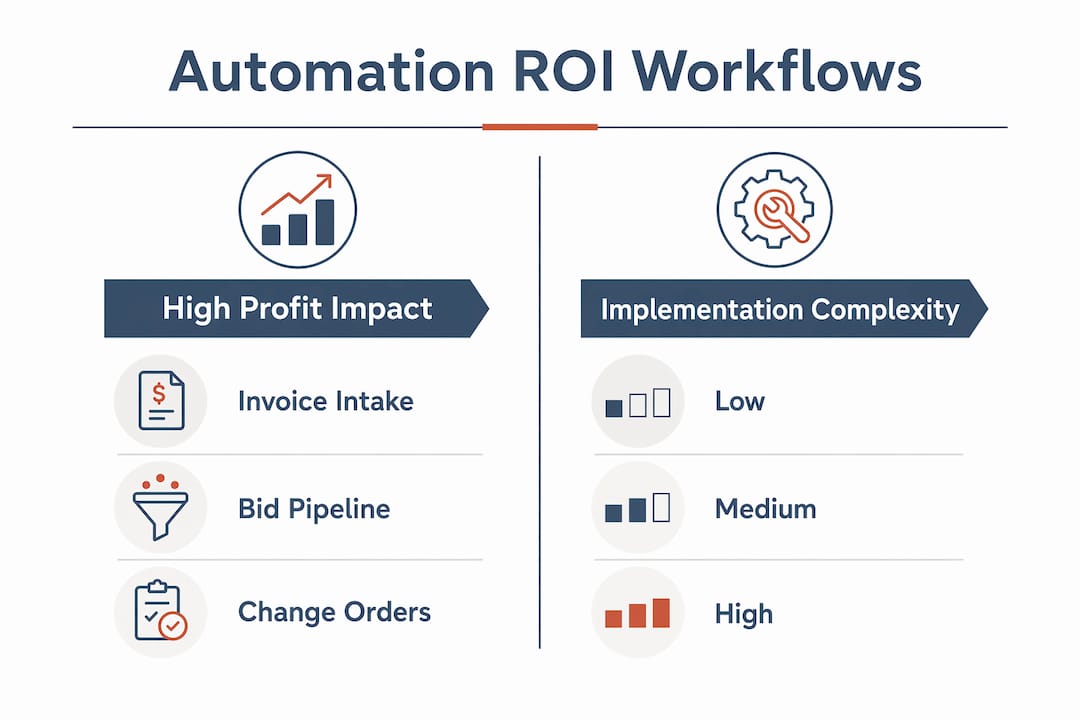
The table below compares common construction workflows by profit impact and implementation complexity.
| Workflow | Profit impact | Complexity |
|---|---|---|
| Subcontractor invoice intake | High: cuts cycle time and disputes | Low to medium |
| Bid pipeline tracking | High: improves win rate and follow-up speed | Medium |
| Change order documentation | Medium to high: reduces overruns | Medium |
| Lead follow-up (CRM) | Medium: recovers lost revenue | Low |
| Document collection and routing | Medium: reduces admin hours | Low |
Invoice intake delivers the fastest gains because it sits at the intersection of cash flow and dispute risk. Automating bid-to-invoice workflows extracts and matches invoice line items against approved scopes, cutting manual validation and cycle times dramatically. Lead follow-up automation, by contrast, is the easiest to implement and often the first place smaller firms start.
Pro Tip: Before selecting a workflow to automate, count how many times per month your team touches it manually. If the answer is more than 20, it belongs at the top of your list.
How does automation boost profit through efficiency and revenue growth?
Automation improves profit through three distinct mechanisms: faster collections, fewer errors, and higher bid win rates. Each one has a direct dollar value.

A GC-focused construction company reduced cost overruns from 5.8% to 2.3% of revenue after automating invoice intake, bid pipeline tracking, and change order documentation. That same firm cut invoice cycle time from 18 days to 6 days and improved its bid win rate from 22% to 29%. The combined annual profit impact was $280,000. Those numbers come from a single firm. They show what targeted automation does when applied to the right workflows.
The revenue side of the equation is just as real. 41% of AI-using small businesses report higher revenue after adopting automation, while only 2% report lower revenue. That asymmetry matters. The risk of automation is low. The upside is consistent.
Automation also enables growth without proportional hiring. One case study showed revenue growth of 34% with only an 11% headcount increase. That gap is the profit margin expansion automation creates. You absorb more transactional volume, redeploy your team toward higher-margin work, and grow without adding overhead at the same rate.
Key profit drivers from automation in construction SMBs:
- Faster invoice cycles reduce days sales outstanding and improve cash position
- Fewer manual errors cut rework costs and subcontractor disputes
- Automated bid follow-up recovers leads that would otherwise go cold
- Change order automation reduces scope creep and untracked costs
- Capacity freed from admin work goes toward estimating, client relationships, and new bids
Standardizing workflows through automation also improves decision-making accuracy. When data flows through a consistent system rather than spreadsheets and email threads, your numbers are reliable. Reliable numbers mean better project bids and fewer costly surprises.
What are common challenges and best practices for measuring automation ROI?
The biggest mistake construction SMBs make is measuring ROI too early or too loosely. Automation ROI is real, but it requires discipline to capture accurately.
Start with a pilot on one high-value workflow. Pick the process with the most friction, set a clear baseline, and define kill criteria before you launch. Kill criteria are the conditions under which you stop the pilot if results do not materialize. This protects your budget and forces honest evaluation. The median payback period on a well-scoped automation pilot is 4–6 months after accounting for implementation and change management costs. That timeline is realistic. Projects that promise payback in weeks are usually ignoring setup costs.
Follow these steps to measure automation ROI correctly:
- Record baseline metrics before launch: invoice cycle time, error rate, bid win rate, and hours spent per workflow per week.
- Run the pilot for at least four weeks with the same team and volume as normal operations.
- Track the same metrics post-launch and compare directly to baseline.
- Calculate net ROI by subtracting platform costs, staff training time, and any consultant fees from gross savings.
- Decide to scale, adjust, or stop based on data, not optimism.
Credible ROI measurement requires baseline metrics like cycle times, error rates, and bid win rates tracked continuously after launch. Firms that skip baseline tracking often overestimate returns by 30–50% because they have no reference point. That leads to poor decisions about scaling.
The honest net ROI concept also accounts for change management. Your team needs time to adopt new tools. That transition period costs real hours. Budget for it, and your ROI projections will hold up.
Pro Tip: Track your invoice cycle time in days, not weeks. The granularity reveals bottlenecks that weekly tracking hides, and it gives you a sharper before-and-after comparison.
How to choose and implement automation tools for construction SMBs
Selecting the right automation platform starts with fit, not features. A tool with 200 features you will never use is worse than a focused tool that handles your top three workflows well.
Criteria that matter most for construction SMBs:
- Workflow coverage: Does the platform handle bid tracking, invoice intake, and change order documentation natively, or does it require custom builds?
- Integration: Does it connect to your existing accounting software, project management system, and field operations tools without a complex setup?
- Ease of use: Can your project managers and office staff adopt it without weeks of training?
- Cost structure: Is pricing per user, per project, or flat rate? Flat rate works better for growing firms.
- Implementation speed: Platforms that take six months to deploy cost you months of potential savings.
Construction-specific features add real value. AI blueprint takeoff, invoice line-item matching against approved scopes, and automated bid pipeline tracking are not generic CRM features. They are built for how construction firms actually work. When evaluating platforms, look for AI construction software that combines project management, accounting, and field operations in one system. Switching between disconnected tools like Excel and QuickBooks creates the exact manual friction automation is meant to eliminate.
Phased implementation works better than a full rollout. Start with invoice intake or bid follow-up, measure results for 60 days, then add the next workflow. This approach keeps your team from feeling overwhelmed and gives you clean data at each stage. You can also use a construction software glossary to align your team on terms like ERP, AI takeoff, and workflow automation before you start evaluating vendors.
Eliminating repetitive manual tasks frees business owners to focus on growth-oriented work. That shift, from admin to strategy, is where the real long-term value of automation lives. A CRM workflow built for lead tracking is one practical starting point for construction firms that want to recover lost bids and improve follow-up speed without a complex platform change.
Key takeaways
Automation delivers the strongest profit gains in construction SMBs when applied to high-frequency, structured workflows like invoice intake, bid tracking, and change order documentation, measured against clear baselines from the start.
| Point | Details |
|---|---|
| Target high-frequency workflows | Focus on invoice intake, bid follow-up, and change orders for the fastest ROI. |
| Measure before you automate | Record baseline cycle times, error rates, and bid win rates before launch. |
| Expect 4–6 month payback | Well-scoped pilots recover costs within 4–6 months when net ROI is calculated honestly. |
| Automation enables growth | Firms grow revenue without proportional headcount increases by redirecting freed capacity. |
| Choose construction-specific tools | Platforms built for construction deliver faster adoption and better workflow fit than generic tools. |
Why I think most construction SMBs underestimate automation’s profit potential
Most construction owners I talk to think about automation as a cost-cutting move. They want to reduce admin hours or eliminate a data entry role. That framing is too narrow, and it leads to underinvestment.
The real value is capacity creation. When your office team stops manually processing 40 subcontractor invoices a week, they do not just save time. They free up bandwidth for estimating, client follow-up, and bid preparation. Those activities directly drive revenue. Automation absorbs transactional volume so your people can work on things that compound over time.
The other mistake I see is waiting for the perfect moment to start. Owners want to finish a big project first, or hire one more person, or find the ideal platform. Meanwhile, the bid win rate stays flat and invoice disputes keep eating margin. The firms that win with automation are not the ones with the best technology. They are the ones with the discipline to pick one workflow, measure it honestly, and build from there.
Construction is a relationship business, but it runs on data. Automation gives you better data faster. That is the real competitive edge.
— Keith
Designflow-build helps construction SMBs automate and grow
Construction SMBs that want to put these principles into practice have a direct path with Designflow-build’s AI-native ERP platform. It combines project management, accounting, and field operations in one system, so you are not stitching together disconnected tools.

Designflow-build reports a 70% reduction in manual data entry and monthly savings of up to $847,000 for contractors using the platform. Implementation takes 2–4 weeks, with a 98% user adoption rate. You can start with bid pipeline management or invoice intake, measure results, and scale from there. Explore the AI construction ERP platform to see how it fits your current workflows and where the fastest profit gains are for your firm.
FAQ
What is the role of automation in SMB profit improvement?
Automation improves SMB profits by cutting manual labor costs, reducing errors, and speeding up cash flow through faster invoice cycles and bid follow-up. Construction firms that automate their top five workflows recover $30,000–$80,000 annually.
Which construction workflows deliver the fastest automation ROI?
Subcontractor invoice intake and bid pipeline tracking deliver the fastest returns because they are high-frequency, structured, and directly tied to cash flow and win rates.
How long does it take to see ROI from automation?
The median payback period on a well-scoped automation pilot is 4–6 months after accounting for implementation and change management costs.
Does automation require replacing existing software?
Not always. The best construction automation platforms integrate with existing accounting and project management tools, though all-in-one systems eliminate the manual handoffs between disconnected tools.
How do I measure whether automation is actually working?
Track baseline metrics before launch, including invoice cycle time, error rate, and bid win rate, then compare the same metrics after at least four weeks of live operation to calculate honest net ROI.