
The Role of ERP in Engineering Operations: 2026 Guide

Enterprise Resource Planning, known as ERP, is defined as a unified software system that connects project management, procurement, engineering, and finance into a single source of operational truth. For construction engineering firms, the role of ERP in engineering operations goes far beyond basic accounting. It determines whether your projects finish on budget, whether your field teams have the right materials, and whether your project managers can see cost burn in real time. The construction industry runs on tight margins and complex workflows. ERP is the system that keeps those workflows from collapsing under their own weight.
How does ERP improve operational efficiency in engineering firms?
ERP improves operational efficiency by replacing disconnected spreadsheets and manual processes with automated, integrated workflows. Engineering firms that make this shift report measurable gains across every operational layer.
The numbers are direct. Dynamic engineering firms report 25% profit growth, doubled operational efficiency, and doubled project confidence after moving from manual tracking to integrated ERP systems. That result is not accidental. When your budget data, time logs, and billing live in the same system, project managers stop chasing numbers and start making decisions.

Automation is the core mechanism behind these gains. ERP eliminates repetitive data entry across procurement, scheduling, and invoicing. It also reduces the human error that compounds when teams re-enter the same data across multiple tools. One automation and engineering firm reduced operational errors by 30% after integrating sales, engineering, and production inside a single ERP environment. That error reduction directly translates to fewer rework cycles and faster project delivery.
Key efficiency gains ERP delivers to engineering operations include:
- Real-time cost visibility: Project managers see fee burn against budget without waiting for end-of-month reports.
- Automated invoicing: Billing triggers from time entries, removing manual invoice preparation.
- Procurement tracking: Purchase orders link directly to project budgets, preventing unauthorized spending.
- Scheduling integration: Resource allocation updates automatically when project timelines shift.
- Audit trails: Every change is logged, which supports compliance and reduces disputes.
Pro Tip: Automate your CAD-to-BOM workflow inside ERP. Manual transfer of bill-of-materials data from CAD files takes 4–8 hours per project. CAD-to-BOM automation cuts that to under one hour and eliminates transcription errors that cause costly downstream rework.
What challenges do engineering firms face without ERP?
Engineering firms without ERP face a specific and predictable set of problems. The root cause is always the same: data lives in too many places, and no single system connects project delivery to financial outcomes.
The most damaging problem is margin erosion from disconnected budgets, time tracking, and billing. When a project manager tracks hours in a spreadsheet, logs expenses in a separate tool, and invoices from a third system, errors accumulate at every handoff. Engineer-to-order firms that use generic ERP without project-based financial controls suffer this margin erosion consistently. Each project is a unique financial unit, and generic systems are not built to treat it that way.
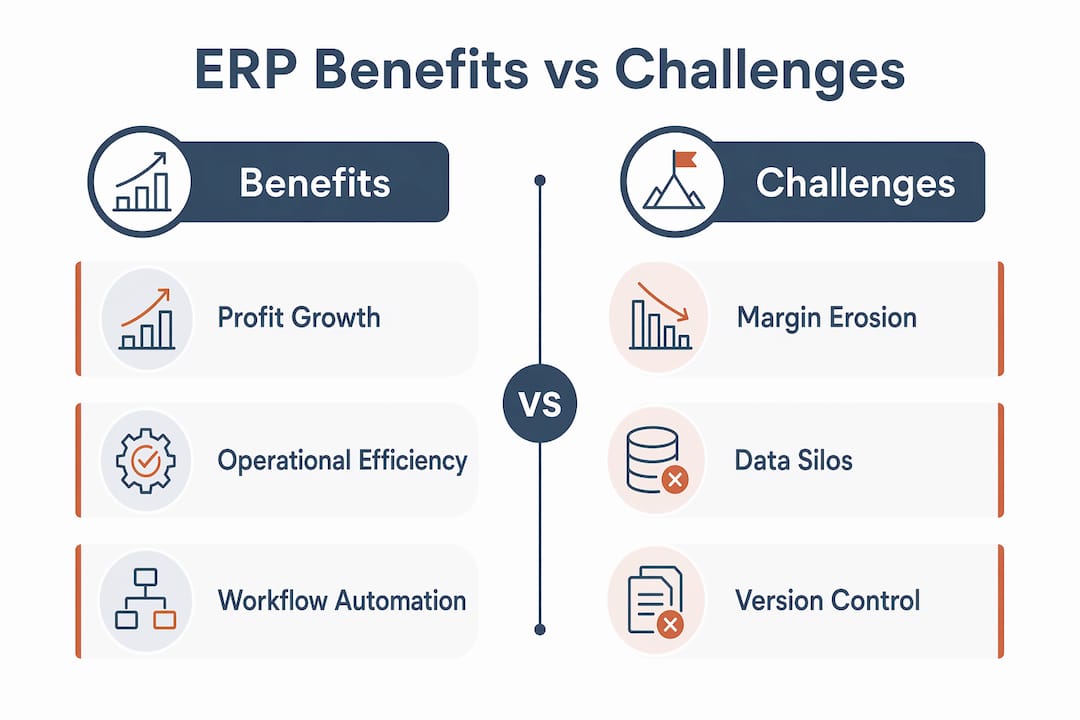
Version control is the second major failure point. Without ERP connected to engineering change management, teams work from outdated drawings and bills of materials. ERP connected to revision workflows prevents obsolete purchases, uncontrolled rework, and field issues by governing which revisions are approved for manufacturing. Without that control, a field crew can build from a superseded drawing and nobody catches it until the rework bill arrives.
The third challenge is the gap between PLM and ERP systems. Product Lifecycle Management (PLM) handles design iterations and pre-release data. ERP handles approved revisions and transactional execution. When these systems are not properly integrated, disconnected PLM and ERP creates duplicated item records and mismatched bills of materials. Defining clear system-of-record boundaries between PLM and ERP is the fix.
Common pain points for engineering firms without ERP:
- Budget overruns discovered only at project close, not during execution
- Time entries that never connect to client invoices
- Procurement decisions made without visibility into project budgets
- Rework caused by teams using outdated engineering revisions
- No single view of which projects are profitable and which are not
Pro Tip: Never deploy a generic manufacturing ERP for project-based engineering work without first confirming it supports phase-level budgeting and project-specific financial reporting. Generic systems treat all revenue as one pool. Engineering projects require individual financial tracking per engagement.
Which core ERP features support engineering project management?
The features that matter most in engineering ERP are the ones that connect financial data to project execution. A long feature list is not the point. Leaders should focus on connected views of budgets, time, and billing to prevent the operational inefficiencies that erode margins.
The table below maps the core ERP feature categories to their direct operational benefit for engineering and construction project managers.
| Feature category | Operational benefit |
|---|---|
| Phase-level budgeting | Tracks cost burn per project phase, not just total project spend |
| Time tracking linked to billing | Converts logged hours directly into client invoices without manual entry |
| Procurement and inventory management | Links purchase orders to project budgets and tracks 20,000+ parts in real time |
| Revision control and approval workflows | Prevents field teams from building from outdated engineering drawings |
| Real-time reporting dashboards | Gives project managers live visibility into schedule, cost, and resource status |
Procurement and inventory management deserves specific attention for construction engineering firms. Venture Engineering scaled from small projects to managing 50–60 live projects concurrently with ERP providing transparent inventory and cost visibility across more than 20,000 tracked parts. That level of operational control is not achievable with spreadsheets or disconnected field apps.
Revision control is equally critical. ERP governs which engineering changes are approved before they reach the shop floor or field crew. This single feature prevents the most expensive category of construction rework: building from the wrong version of a drawing or specification.
You can review definitions for key ERP terms used across construction engineering workflows to build a shared vocabulary with your team before selecting a system.
How to successfully implement ERP in engineering operations?
Successful ERP implementation in engineering operations follows a clear sequence. Skipping steps in this sequence is the primary reason deployments fail to deliver their promised returns.
-
Choose an industry-specific ERP. Generic manufacturing ERP systems lack the project-based financial controls that engineering firms require. Select a platform built for engineer-to-order or construction workflows, not one adapted from discrete manufacturing.
-
Define PLM and ERP system boundaries before go-live. PLM owns design data and pre-release revisions. ERP owns approved revisions and all transactional execution. Document these boundaries explicitly so teams know which system is the authoritative source for each data type.
-
Integrate scheduling with ERP from day one. Construction scheduling software that connects directly to ERP gives project managers a live view of how schedule changes affect cost and resource allocation. Treating scheduling as a separate tool creates the same data silos ERP is meant to eliminate.
-
Engage stakeholders early and train thoroughly. Stakeholder engagement and training are the most frequently cited factors in ERP adoption success. Project managers, field supervisors, and finance teams all need to understand how their daily tasks connect to the system before go-live.
-
Start with your highest-pain workflows. Identify where your team loses the most time or makes the most errors. Automate those processes first. Early wins build confidence and drive adoption across the rest of the organization.
-
Plan for scale, not just your current project load. Your ERP should handle your current volume and your projected growth. Firms that implement ERP with scalability in mind avoid the painful and expensive process of switching systems when project volume doubles.
ERP automation restores lost engineering time by replacing manual scheduling, data entry, and documentation with automated workflows. The goal is to free your engineers to do engineering work, not administrative work.
Key Takeaways
ERP is the single most effective tool for connecting engineering intent to financial outcomes in construction project management.
| Point | Details |
|---|---|
| ERP unifies operations | A single ERP connects budgets, time tracking, procurement, and billing to prevent data silos. |
| Efficiency gains are measurable | Firms report 25% profit growth and doubled operational efficiency after ERP adoption. |
| Revision control prevents rework | ERP governs approved engineering changes before they reach field crews or production. |
| Industry-specific ERP is required | Generic manufacturing ERP lacks project-based financial controls that engineering firms need. |
| Implementation sequence matters | Define PLM and ERP boundaries, train stakeholders, and automate high-pain workflows first. |
Why most ERP implementations underdeliver, and what actually fixes it
I have watched engineering firms spend significant money on ERP and then use it as an expensive spreadsheet replacement. The system goes live, the team enters data, and nothing fundamentally changes. The reason is almost always the same: the firm implemented ERP features without connecting them to the decisions that actually drive project outcomes.
The insight that changed how I think about this is simple. ERP connects engineering intent to production reality. That sentence sounds obvious, but most firms treat ERP as a record-keeping tool rather than a decision-support system. When your revision control, procurement, and scheduling all live in one place, you can catch a drawing version mismatch before a crew pours a foundation in the wrong location. That is not a feature. That is the entire value proposition.
The firms I have seen get the most from ERP are the ones that obsess over the automation checklist for project management before they go live. They map every manual handoff, every re-entry point, and every approval bottleneck. Then they eliminate those friction points systematically. The result is not just time saved. It is a fundamentally different quality of project oversight.
My honest advice: do not evaluate ERP by its feature count. Evaluate it by how clearly it shows you where your project money is going, in real time, at the phase level. If you cannot answer “what is my fee burn on Phase 2 of this project right now?” without pulling a report, your ERP is not doing its job.
— Keith
Designflow-build for engineering operations management
Engineering firms that want ERP without a six-month implementation and a team of consultants have a direct path forward with Designflow-build.
Designflow-build combines project management, accounting, and field operations in one AI-powered construction platform built specifically for construction engineering workflows. The platform reports a 70% reduction in manual data entry and implementation in 2–4 weeks, with a 98% user adoption rate. Project managers get real-time visibility into scheduling, procurement, and cost burn without switching between tools. If you are ready to see how integrated ERP works in practice, explore Designflow-build and request a demo tailored to your project type.
FAQ
What is ERP for engineering companies?
ERP for engineering companies is a unified software system that connects project management, procurement, finance, and engineering workflows into one platform. It replaces disconnected spreadsheets and point solutions with real-time, integrated data.
How does ERP improve operations in construction engineering?
ERP improves operations by automating time tracking, invoicing, procurement, and revision control, which reduces errors and gives project managers live visibility into cost and schedule. Firms report up to 30% fewer operational errors after full ERP integration.
What is the difference between PLM and ERP in engineering?
PLM manages design data and pre-release engineering revisions, while ERP manages approved revisions and all transactional execution including procurement and billing. Keeping clear boundaries between the two systems prevents duplicated records and mismatched bills of materials.
How long does ERP implementation take for engineering firms?
Implementation timelines vary by platform and firm size. AI-native platforms like Designflow-build report implementation in 2–4 weeks, while traditional enterprise ERP deployments can take several months.
Which ERP features matter most for engineering project management?
Phase-level budgeting, time tracking linked to billing, revision control, and real-time procurement visibility are the features that most directly prevent margin erosion and rework in engineering project management.