
6 Gates for GCs’ Subcontractor Prequalification: COI Tracking

Subcontractor prequalification is the formal gate that decides who gets invited to bid. Require a completed prequal packet, including a current certificate of insurance, a W-9, and a bonding letter, before any subcontractor sees your invitation to bid. Layer in safety and financial evidence behind that gate, then requalify every subcontractor annually so the file never goes stale.
TL;DR:
- Proper prequalification requires verifying insurance endorsements, bonding capacity, safety records, financial health, licensing, and references to avoid risks.
- Continuous monitoring and annual requalification are essential to prevent lapses that could lead to safety issues, payment disputes, or costly change orders.
- Using automated systems for document tracking and renewal alerts significantly reduces manual workload and improves credential validity over project timelines.
- Standardized scoring based on specific criteria ensures consistent evaluation, with thresholds adjusted for the project’s scope and complexity.
- Transparent communication about document requirements, response deadlines, and expiration notices enhances subcontractor trust and bid accuracy.
Table of Contents
- What Is Subcontractor Prequalification and Why Does It Matter?
- Core Prequalification Gates: Insurance, Safety, Bonding, Financials
- How to Run the Prequalification Process Step by Step
- Sample Subcontractor Qualification Checklist You Can Copy
- Legal and Compliance Considerations in Prequalification
- Protecting Subcontractor Data During Prequalification
- How to Score and Compare Subcontractor Qualifications
- How Should You Communicate with Subcontractors During Prequalification?
- What Disciplined Prequalification Actually Buys You
- Where Automation Fits Into Your Prequalification Process
- Reference Documents Worth Bookmarking
- Sources
- FAQ
What Is Subcontractor Prequalification and Why Does It Matter?
Prequalification is the screening process you run before a subcontractor ever touches your bid list. It’s not paperwork for its own sake. It’s how you keep a subcontractor with a lapsed insurance policy, a hidden lien, or a fabricated license off your job site before that risk becomes your risk.
The mechanics are simple to describe and easy to skip under deadline pressure: collect documentation, verify it against outside sources, score what you find, and decide pass or fail before a bid invitation goes out. Industry guidance frames it as gating subcontractors on insurance, bonding, safety, and financial health, with a full requalification cycle every year and continuous tracking of certificates in between. That combination, upfront gates plus ongoing monitoring, is what separates a real prequalification process for contractors from a folder of expired PDFs nobody has opened since last spring.
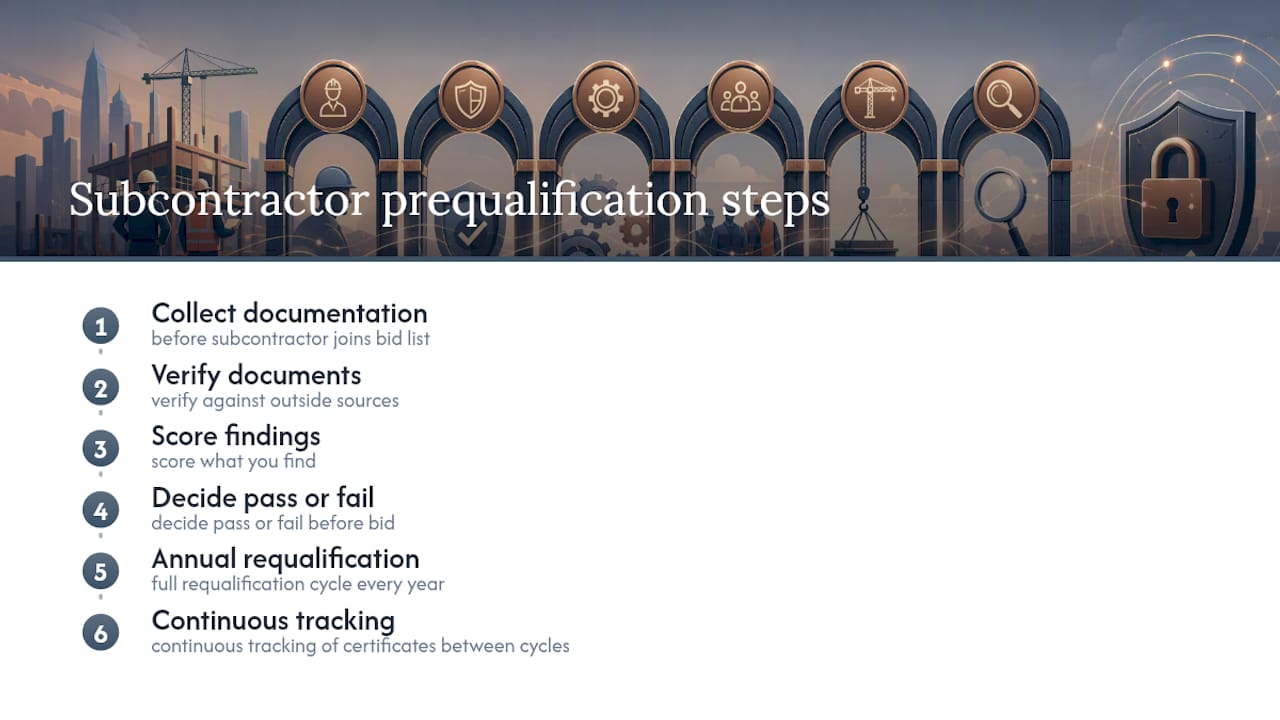
Skipping this step doesn’t just risk a bad hire. It risks payment disputes, safety incidents that land on your OSHA log, and change orders you can’t recover because the subcontractor never had the bonding capacity to back the promise they made at bid time.
Core Prequalification Gates: Insurance, Safety, Bonding, Financials
Six gates decide whether a subcontractor qualifies. Miss one, and you’ve built a subcontractor risk assessment with a hole in it.
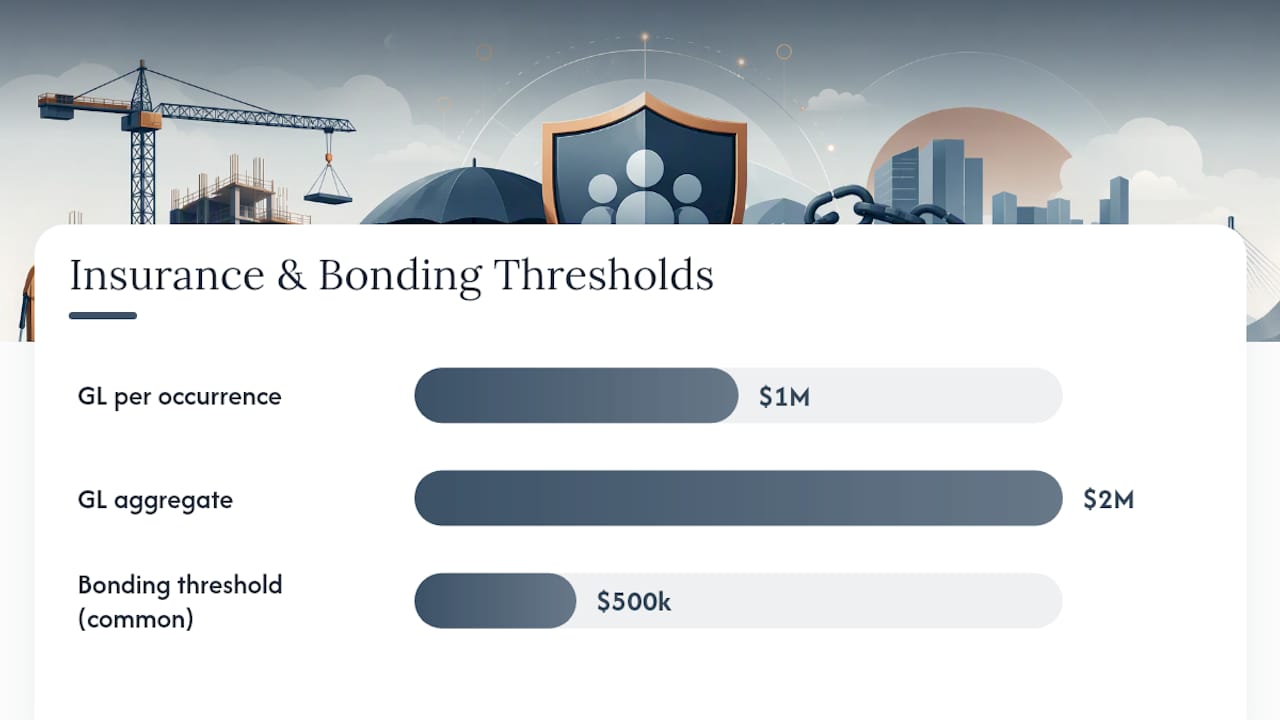
Insurance. Pull the certificate of insurance and check three endorsements: additional insured status, primary and non-contributory wording, and a waiver of subrogation. A COI without these endorsements is close to worthless in a claim. Minimum limits vary by trade and project size, but $1 million per occurrence and $2 million aggregate for general liability is a common baseline, with higher limits for structural or high-risk scopes.
Safety. Request the subcontractor’s Experience Modification Rate, OSHA 300 and 300A logs, and a written safety program. An EMR above 1.0 means the subcontractor files more workers’ comp claims than the industry average for its trade. Anything meaningfully above that, paired with a thin safety program, is a red flag worth a direct conversation before you go further.
Bonding. Ask for a current surety letter stating both single-job and aggregate bonding capacity. For projects above a threshold you set (many GCs use $500,000 as a starting point), require performance and payment bonds outright, and check the surety’s rating rather than taking the letter at face value.
Financials. CPA-prepared or audited financial statements beat self-reported numbers every time. Look at working capital, current backlog against bonding capacity, and the size of the largest project completed to date. Supplier liens or open judgments are the clearest signs of financial stress, and they should stop a file cold.
Licensing. Verify active status directly with the state licensing board, not from a photocopy the subcontractor hands you. Confirm the license class actually covers the scope you’re hiring for.
References. Call both general contractors and material suppliers. Suppliers often talk more freely about payment behavior than another GC will, and slow-pay patterns show up there first.
- Expired insurance or missing endorsements
- EMR significantly above industry norms with no improvement plan
- Active liens, judgments, or a bankruptcy filing
- License not current or scope mismatch
- Refusal to provide references or financials
Pro Tip: Treat the subcontractor evaluation forms as a credit application, not a formality. A subcontractor’s capacity, capital, and character predict payment risk the same way they predict it for a bank underwriting a loan. The Corpay analysis of subcontractor payment risk makes this case directly: financials, bonding, and backlog together tell you what a single document never will.
How to Run the Prequalification Process Step by Step
Running a consistent prequalification process for contractors means assigning an owner to each stage, not letting the packet drift between desks with no one accountable.
- Intake. A project administrator collects the submission packet and confirms every required document is present before anything moves forward.
- Verification. Someone on your risk or insurance team calls the carrier to confirm the COI is active, checks the EMR against state or carrier records, verifies the license on the state board’s site, and calls the surety to confirm the bonding letter is genuine.
- Approval and scoring. Procurement reviews the verified file, scores it against your criteria, and issues a pass or fail decision.
- Data entry. The approved subcontractor goes into your vendor master file or ERP system with expiration dates flagged.
- Monitoring. A compliance owner tracks certificate expirations continuously rather than waiting for the annual cycle to catch a lapse.
Automate the parts that break first: COI expiry alerts and renewal outreach. A vendor compliance tracking pilot shows how quickly this closes the gap between collecting a document once and actually knowing it’s still valid six months later. Many programs falter not at intake but at monitoring, since COIs collected once and never tracked quietly expire mid-project.
Set annual requalification as your baseline cadence. Force an immediate re-review outside that cycle when you see an ownership change, a new lien, a safety incident, or a scope that’s meaningfully larger than anything the subcontractor has handled before.
Pro Tip: Build your vendor portal so subcontractors can upload renewed documents themselves. It’s far less work than chasing forty subcontractors by email every January.
Sample Subcontractor Qualification Checklist You Can Copy
A minimum submission package should include:
- Completed prequalification questionnaire
- Current COI with additional insured, primary/non-contributory, and waiver of subrogation endorsements
- W-9 with legal name and EIN
- Surety or bonding letter (required above your project threshold)
- Two to three years of safety logs (EMR history, OSHA 300/300A)
- Two years of financial statements, CPA-prepared preferred
- State license documentation
- Three references, including at least one supplier
Scale these thresholds to the job. A $40,000 tenant improvement doesn’t need the same bonding scrutiny as a structural high-rise package. Deploy the packet as a web form, a vendor portal, or a standardized PDF with required upload fields, whichever fits how your subcontractors actually work.
Legal and Compliance Considerations in Prequalification
Prequalification criteria for construction work have to be applied evenly, or they expose you to legal risk that has nothing to do with the subcontractor’s actual qualifications.
Document every criterion in writing before you use it, and apply it the same way to every subcontractor bidding a given scope. If your insurance minimum is $1 million per occurrence for electrical work, that number can’t quietly shift depending on who’s asking. Inconsistent application is exactly what turns a routine rejection into a discrimination complaint.
Federal contracts and many state and local projects carry equal opportunity and non-discrimination obligations that flow down to subcontractor selection, along with participation goals for minority, women-owned, or disadvantaged business enterprises. Build these requirements into your prequalification form itself so certifications get collected upfront instead of chased down after a subcontractor has already been shortlisted.
Keep a paper trail. If you reject a subcontractor, the file should show a specific, documented reason tied to a published criterion, not a subjective impression. That record protects you if a rejected bidder ever challenges the decision, and it forces your own team to apply the rules consistently instead of by gut feel.
Review your criteria against current federal and state contracting requirements periodically. Rules around DBE participation and non-discrimination clauses shift, and a policy that was compliant two years ago can quietly fall out of date.
Protecting Subcontractor Data During Prequalification
A prequalification packet contains a subcontractor’s EIN, banking details for payment setup, financial statements, and insurance information. That’s a meaningful data privacy exposure if you’re not treating it carefully.
Store submissions in a system with access controls, not a shared drive folder open to anyone with a company login. Limit who can view financial statements and tax identification numbers to the people who actually need them for verification and approval. Set a retention policy: keep prequalification files for active and recently active subcontractors, and establish a schedule for purging records for subcontractors you no longer work with.
If you collect submissions through a web-based vendor portal or intake form, confirm the platform uses encryption in transit and at rest, and check that subcontractors are prompted to use an updated, secure browser like Firefox when submitting sensitive documents. That’s a small operational detail, but it closes an avoidable gap.
Be transparent with subcontractors about what you collect and how long you keep it. Trade partners increasingly expect the same data-handling standards from GCs that they’d expect from any vendor holding their financial information, and a vague or undocumented policy makes larger, better-capitalized subcontractors hesitant to bid your work at all.
How to Score and Compare Subcontractor Qualifications
A scoring model turns subjective judgment into a repeatable subcontractor risk assessment you can defend later.
Adjust those weights by trade. A structural steel subcontractor’s bonding capacity matters more than it does for a landscaping subcontractor on the same job.
Score each category on a simple scale, say 1 to 5, and set a minimum total score for approval rather than letting one weak category get buried in an otherwise decent average. A subcontractor scoring well everywhere except an EMR well above the industry norm shouldn’t pass just because the total looks fine on paper.
Use this same scoring sheet at annual requalification, not just at initial intake. A subcontractor’s EMR or backlog position a year ago tells you very little about their risk profile today.
How Should You Communicate with Subcontractors During Prequalification?
Subcontractors bid more accurately, and complain less, when they know exactly what you need and when you need it.
Publish your document requirements before you ever send a bid invitation, the way larger GCs post their prequalification requirements directly on their websites. That single step eliminates the back-and-forth of a subcontractor guessing which insurance endorsements you actually require.
Set a clear response window for submissions, typically 5 to 10 business days, and stick to it on both sides. If a file is incomplete, tell the subcontractor specifically what’s missing rather than sending a generic rejection. A subcontractor who’s missing a waiver of subrogation endorsement can usually get it from their broker within a day; a vague “does not meet requirements” note just creates a frustrated call to your office.
Notify subcontractors proactively as certificates approach expiration instead of waiting for a lapse to surface mid-project. That single habit, more than any scoring model, is what keeps a prequalified vendor list actually current rather than technically approved but practically expired.
What Disciplined Prequalification Actually Buys You
The value of subcontractor credentialing shows up months after the paperwork, in the change orders that never happen and the safety incidents that never make the log. Every gate in this process (insurance, bonding, financials, safety, references) exists because skipping it shows up later as a cost nobody budgeted for.
The friction most GCs underestimate isn’t the criteria themselves. It’s the tracking afterward. A completed COI from six months ago tells you nothing about a policy that lapsed last week. That’s why integrated tracking tools matter more than the initial questionnaire, and why platforms like DesignFlow Build report meaningful reductions in the manual chasing that usually falls on an already stretched project admin.
— Keith
Where Automation Fits Into Your Prequalification Process
Building a subcontractor risk assessment by hand works until you’re tracking forty active subs across a dozen jobs, and your compliance owner is buried in spreadsheets chasing renewal dates. Software solutions give you back the hours that manual COI tracking eats every month, without asking you to change how you run the underlying process.
The platform’s vendor portal handles intake so subcontractors upload documents directly instead of emailing PDFs into a folder. COI parsing flags expiring endorsements automatically, and renewal outreach goes out before a lapse becomes a job-site problem instead of after. Because it connects to your project management and accounting systems, an approved subcontractor’s status is visible everywhere you need it, not locked in a separate compliance tracker nobody else opens.
None of this replaces the judgment calls in your prequalification criteria. It just means fewer of your team’s hours go to manual entry and status checks. If you want to see how it fits your current process, some AI construction ERP platforms support a 2 to 4 week pilot, a practical way to test automated compliance tracking on a live vendor list before committing further. Take a look at the AI construction ERP platform to see what a pilot would cover.
Reference Documents Worth Bookmarking
- IRS Form W-9, the standard form for collecting taxpayer ID information
- Subcontractor prequalification form template for structuring your questionnaire
- New construction inspection checklist for related document expectations on site
Sources
- Form W-9 (Rev. October 2018)
- Subcontractor Prequalification Form: Free Template for GCs
- Subcontractor Prequalification: How General Contractors Vet Subcontractors for Payment Risk
FAQ
What Is Subcontractor Prequalification?
It’s the screening process a general contractor runs before inviting a subcontractor to bid, verifying insurance, bonding, safety records, financials, licensing, and references against set criteria.
How Much Does Subcontractor Prequalification Cost?
There’s no fixed industry fee; cost depends on whether you build the process in house with staff time or use a vendor portal or software platform, with staff hours for verification typically the largest expense.
What Are Subcontractor Prequalification Prelims?
“Prelims” refers to the preliminary documentation subcontractors submit before formal evaluation, usually the COI, W-9, bonding letter, and license information collected before deeper financial and safety review.
What Is a Subcontractor Prequalification System?
It’s the combination of forms, verification steps, scoring criteria, and tracking tools (spreadsheet, vendor portal, or a construction ERP like Designflow-build) that a GC uses to qualify and continuously monitor subcontractors.