
How to Manage Engineering Project Budgets Accurately

Engineering project budget control is the practice of defining, tracking, and adjusting costs throughout a project’s lifecycle to keep spending aligned with the approved plan. 43% of engineering projects exceed their original budget, and 35% of architecture and engineering firms face the same problem. That number reflects a systemic failure in scope definition, cost tracking, and accountability. You can manage engineering project budgets accurately by combining a detailed work breakdown structure, layered cost estimates, weekly tracking cadence, and earned value management into one repeatable process.
How to manage engineering project budgets accurately with a solid scope and WBS
The single most effective step in accurate project budgeting is defining what the project includes and, just as critically, what it does not. Vague scope statements are the root cause of most budget failures. Before you estimate a single dollar, write an explicit inclusion and exclusion list for every engineering discipline involved.
A Work Breakdown Structure (WBS) turns that scope into a cost-ready framework. Split the project into tasks and subtasks, each sized at 40–80 hours of effort. Tasks larger than 80 hours are too broad to estimate with confidence. Tasks smaller than 40 hours add administrative overhead without improving accuracy.
Once tasks are defined, assign hours by role rather than by generic “labor.” A senior structural engineer and a junior CAD technician carry different billing rates and different risk profiles. Mixing them into one line item hides cost variance before it starts.
- Write explicit inclusion and exclusion statements for each discipline (civil, structural, MEP, geotechnical)
- Use customized scope checklists by engineering type to avoid missing deliverables
- Break every phase into WBS tasks of 40–80 hours
- Assign hours to named roles, not generic labor categories
- Get sign-off on the scope document before any cost estimate is finalized
Pro Tip: Build a scope checklist template for each project type you repeat. A bridge rehabilitation checklist differs from a water treatment plant checklist. Reusing a generic template is where scope gaps begin.
Step-by-step process for building an engineering project budget
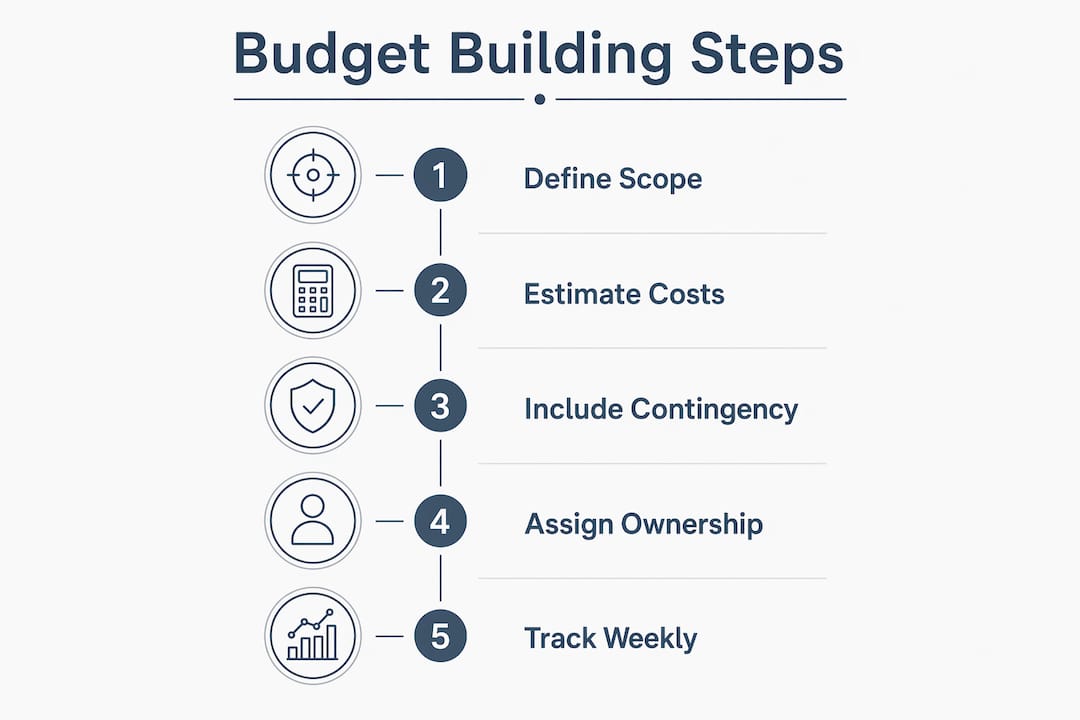
A complete engineering budget is not a single number. It is a layered document that builds from task-level labor costs up to a project total with contingency. Follow this sequence to reduce underestimation risk.
- Calculate labor costs by role. Multiply each role’s billing rate by the estimated hours per task. Do this at the WBS task level, not the phase level. Phase-level estimates hide where the money actually goes.
- Add direct expenses. Include travel, subconsultant fees, printing, survey equipment, and software licenses. These are often forgotten until the invoice arrives.
- Apply overhead markups. Your firm’s overhead rate covers indirect costs like office space, HR, and IT. Apply it consistently across all labor lines.
- Build in contingency. Add 10–15% contingency to initial labor estimates to cover hidden but inevitable tasks such as coordination calls, internal reviews, and client communications. Higher-risk or first-of-kind projects warrant the upper end of that range.
- Document assumptions. Every estimate rests on assumptions about team availability, design complexity, and client responsiveness. Write them down. When the project deviates, you need a baseline to compare against.
The contingency line is not a slush fund. It is a structured reserve tied to specific risk categories. A complex environmental remediation project carries more coordination risk than a routine site survey. Calibrate the percentage to the actual risk profile.
Pro Tip: Create a hidden labor register for each project. List every recurring task that does not appear in the deliverable list: weekly status calls, internal QA reviews, permit resubmittals. Estimate hours for each. This register becomes your contingency justification.
For project managers who want to understand how construction ERP systems handle these layered cost structures, the integration of labor, overhead, and direct costs into a single platform removes the manual reconciliation step entirely.
What techniques keep budgets accurate during project execution?
Budget accuracy during execution depends on three disciplines: tracking frequency, tracking completeness, and accountability assignment. Most teams fail on all three.

Weekly cost tracking increases budget discipline by making the team aware that spend is reviewed every seven days. Monthly reviews create a 30-day blind spot where scope creep and unauthorized work accumulate undetected. Weekly reviews surface problems while they are still correctable.
Tracking completeness means monitoring three numbers simultaneously, not just one.
- Budget: the original approved amount per task
- Committed costs: purchase orders, subcontracts, and approved change orders not yet invoiced
- Actual spend: costs already invoiced and recorded
Tracking commitments alongside actual spend reveals pipeline risk before it hits cash flow. Actual spend alone provides false security. A project can look on budget today while $200,000 in committed subcontractor costs sits unrecorded.
Earned Value Management (EVM) adds a fourth dimension: the value of work actually completed. EVM measures actual work progress against budget consumed, which is especially critical for fixed-fee contracts where overruns reduce profitability with no recovery path. Use the forecast-to-completion metric as your primary steering number. It tells you what the project will cost at current performance, not what it was supposed to cost.
| Tracking metric | What it measures | Why it matters |
|---|---|---|
| Budget vs. actual | Dollars spent vs. approved plan | Flags overspend at task level |
| Committed costs | Contracts and POs not yet invoiced | Reveals future cash exposure |
| Earned value | Work completed vs. budget consumed | Identifies efficiency gaps early |
| Forecast to completion | Projected final cost at current burn rate | Drives corrective action decisions |
Assigning cost ownership at the task and discipline level prevents accountability diffusion. When everyone owns the budget, no one does. Assign a named lead to each WBS task with authority and responsibility for that budget line.
Pro Tip: Automate timesheet collection to feed your cost tracking system in real time. Manual timesheet entry delays create the same blind spots as monthly reviews. Designflow-build’s timesheet automation feeds labor costs directly into project dashboards without manual data entry.
What causes engineering budget overruns and how do you control them?
Scope creep accounts for 35% of major budget overruns in engineering projects, averaging 30–45% of total variance impact. It is the largest single contributor to budget failure, and it is almost always preventable with a formal change control process.
The most common causes of engineering budget overruns break into four categories.
- Scope creep: Client requests, design revisions, and regulatory changes that expand work without a corresponding budget adjustment. Every change, no matter how small, needs a documented cost impact and written approval before work begins.
- Retroactive labor rate changes: Annual raises applied retroactively to ongoing projects can push labor costs above estimate without any change in scope. Invisible labor costs like premium contractor rates for unplanned absences can exceed the impact of scope creep on total variance.
- Seasonal overhead spikes: Overhead coefficients rise in peak construction seasons when shared resources are in high demand. A project that starts in january may face materially different overhead rates by july. Planning for flat overhead across a 12-month project is a common and costly mistake.
- Capacity overruns: Assigning work to team members already at full utilization forces overtime or contractor substitution, both of which carry cost premiums.
Change control is the primary defense against scope creep. Formal cost impact documentation and a defined approval authority prevent unauthorized work from entering the project. Every change order should include the scope description, cost impact, schedule impact, and the name of the person who approved it.
Variance analysis diagnoses budget performance after the fact. When actual costs exceed budget by more than 5% on any task, investigate the cause before moving forward. Categorize the variance as scope, rate, or efficiency. Each category has a different remedy.
Pro Tip: Set a change order threshold below which project leads can approve independently, such as changes under $5,000. Above that threshold, require written client approval. This keeps small changes moving without creating a governance gap for large ones.
Effective project management in construction consistently shows that teams with documented change control processes finish closer to budget than those relying on informal agreements.
How does technology support engineering budget management?
Real-time dashboards that integrate timesheets, procurement data, and accounting records transform cost tracking from a reactive monthly exercise into a predictive daily practice. The shift matters because budget problems identified in week two are fixable. Problems identified in week ten are not.
Modern project management platforms built for engineering and construction deliver several specific capabilities.
- Automated budget threshold alerts: The system flags when a task reaches 80% of its budget, giving the project lead time to act before the overrun occurs.
- Estimate at completion (EAC) calculations: The platform recalculates the projected final cost every time new actuals are recorded, removing the manual spreadsheet step.
- Integrated procurement tracking: Purchase orders and subcontract values flow directly into the committed cost column, eliminating the gap between accounting and project management.
- Reduced manual data entry: Designflow-build reports a 70% reduction in manual data entry for teams using its AI-native ERP platform. Less manual entry means fewer transcription errors and faster reporting cycles.
Designflow-build combines project management, accounting, and field operations into one system. That integration eliminates the reconciliation work that consumes hours every week when teams run separate tools for timesheets, procurement, and financial reporting. The platform’s AI construction software predicts cost risks before they become overruns, which is the operational shift that separates reactive teams from proactive ones.
Key Takeaways
Accurate engineering budget management requires scope clarity, layered cost structures, weekly tracking, and formal change control working together as a system, not as isolated practices.
| Point | Details |
|---|---|
| Define scope before estimating | Write explicit inclusion and exclusion lists for every discipline before building any cost estimate. |
| Build contingency into every budget | Add 10–15% to labor estimates to cover coordination, reviews, and client communications. |
| Track weekly, not monthly | Weekly cost reviews surface scope creep and rate changes while they are still correctable. |
| Monitor commitments, not just actuals | Committed costs reveal future cash exposure that actual spend figures hide entirely. |
| Assign named cost owners | Attaching a specific person to each WBS task budget line prevents accountability from diffusing across the team. |
Budget accuracy is a behavior problem, not a software problem
I have reviewed budget post-mortems on engineering projects ranging from $200,000 site assessments to nine-figure infrastructure programs. The pattern is consistent. The teams that finish on budget are not the ones with the most sophisticated tools. They are the ones where project leads treat the budget as a live document, not a contract artifact filed after kickoff.
The most damaging habit I see is the monthly review cycle. By the time a monthly report lands, the team has already spent three weeks making decisions without current cost data. Switching to weekly reviews feels like overhead until the first time it catches a $40,000 scope creep event in week two instead of week eight.
The second pattern is accountability diffusion. When the project manager owns the budget but the discipline leads own the work, no one is watching the intersection. Giving discipline leads direct visibility into their task budgets, and holding them accountable for variance, changes behavior faster than any reporting tool.
Technology accelerates all of this. But the behavior has to come first. A real-time dashboard connected to a team that reviews costs monthly is still a monthly review system. Build the weekly habit, assign the ownership, and then let the platform do the heavy lifting.
— Keith
Designflow-build brings budget control into one place
Engineering budget management breaks down when data lives in separate systems. Timesheets in one tool, purchase orders in another, and financial reports in a third create the reconciliation gaps where overruns hide.
Designflow-build’s AI construction ERP platform connects project management, accounting, and field operations into a single system. You get real-time budget dashboards, automated change order tracking, and forecast-to-completion calculations without manual data entry. Teams report up to $847K in monthly savings and a 70% reduction in manual work. Implementation takes 2–4 weeks with a 98% user adoption rate. Request a demo to see how it fits your project workflow.
FAQ
What is engineering project budget control?
Engineering project budget control is the process of monitoring, comparing, and adjusting project costs against an approved plan throughout the project lifecycle. It includes scope management, cost tracking, change control, and forecasting to keep spending aligned with the original estimate.
Why do so many engineering projects go over budget?
43% of engineering projects exceed their original budget, primarily due to poor scope definition, infrequent cost tracking, and the absence of formal change control processes. Scope creep alone accounts for 35% of major overruns.
What is earned value management in engineering projects?
Earned Value Management (EVM) is a technique that compares the budgeted value of work completed against the actual cost incurred. It identifies whether a project is over budget, behind schedule, or both, giving project managers an early warning before problems compound.
How often should engineering teams review project costs?
Weekly cost reviews are the recommended standard. Weekly tracking drives timesheet accuracy, surfaces scope changes early, and gives project leads time to correct course before variances become unrecoverable overruns.
What contingency percentage should engineering budgets include?
Add 10–15% to initial labor estimates to cover hidden costs like coordination, internal reviews, and client communications. Higher-risk or first-of-kind projects warrant the upper end of that range, while routine repeat-scope projects may use the lower end.