
Construction Operational Efficiency Explained for PMs

Construction operational efficiency is defined as the optimized use of resources and processes to deliver projects on time, within budget, and at the required quality level. It is the core driver behind construction productivity strategies and effective project management. Construction projects globally waste enormous resources through poor planning and coordination. Lean construction research shows that over 600 million tons of debris are generated annually in the U.S. alone, largely from inefficient processes. Understanding construction operational efficiency explained in practical terms gives project managers the framework to close that gap.
What is construction operational efficiency in practice?
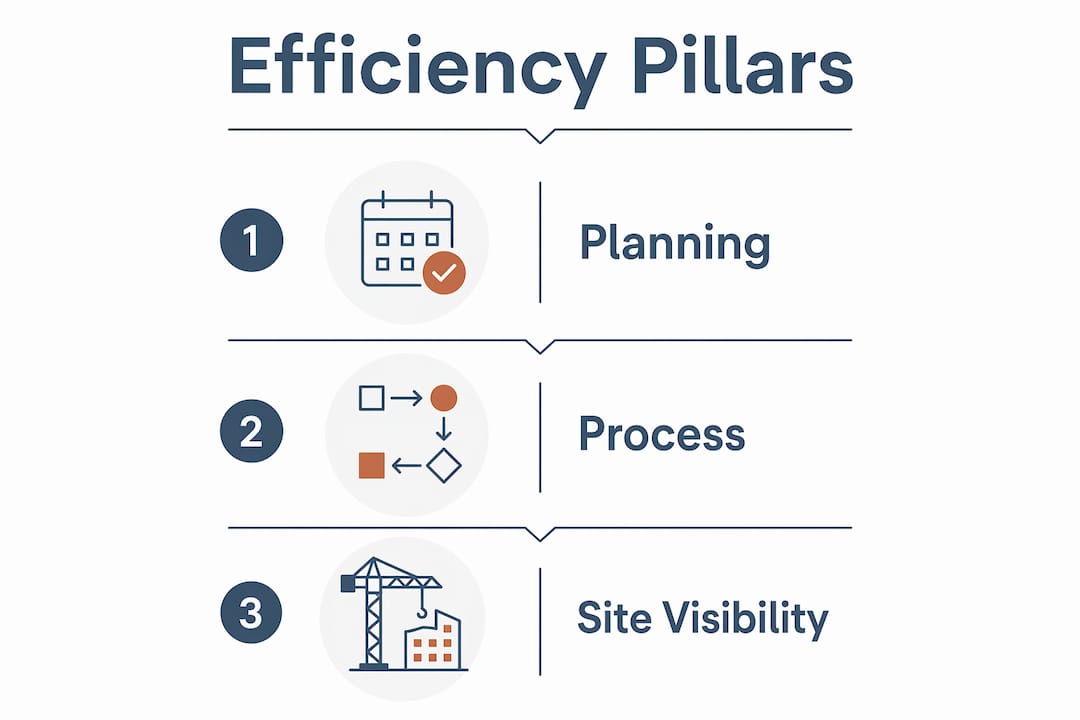
Construction operational efficiency, known in the industry as operational excellence, is built on three pillars: planning efficiency, process efficiency, and site visibility efficiency. Each pillar addresses a distinct failure point that causes cost overruns and delays. Neglecting any one of them creates compounding problems across the project lifecycle.
Planning efficiency
Planning efficiency covers sequencing, resourcing, procurement, and coordination before a single crew hits the site. A project with a weak plan forces teams into reactive mode from day one. Poor sequencing alone can idle expensive equipment for days while waiting on materials or permits that were never pre-ordered.
Process efficiency
Process efficiency governs how information moves through your organization. Communication gaps, slow document approvals, and unclear decision-making workflows are the most common culprits behind schedule slippage. A change order that takes five days to approve when it should take one day costs you four days of crew productivity.
Site visibility efficiency
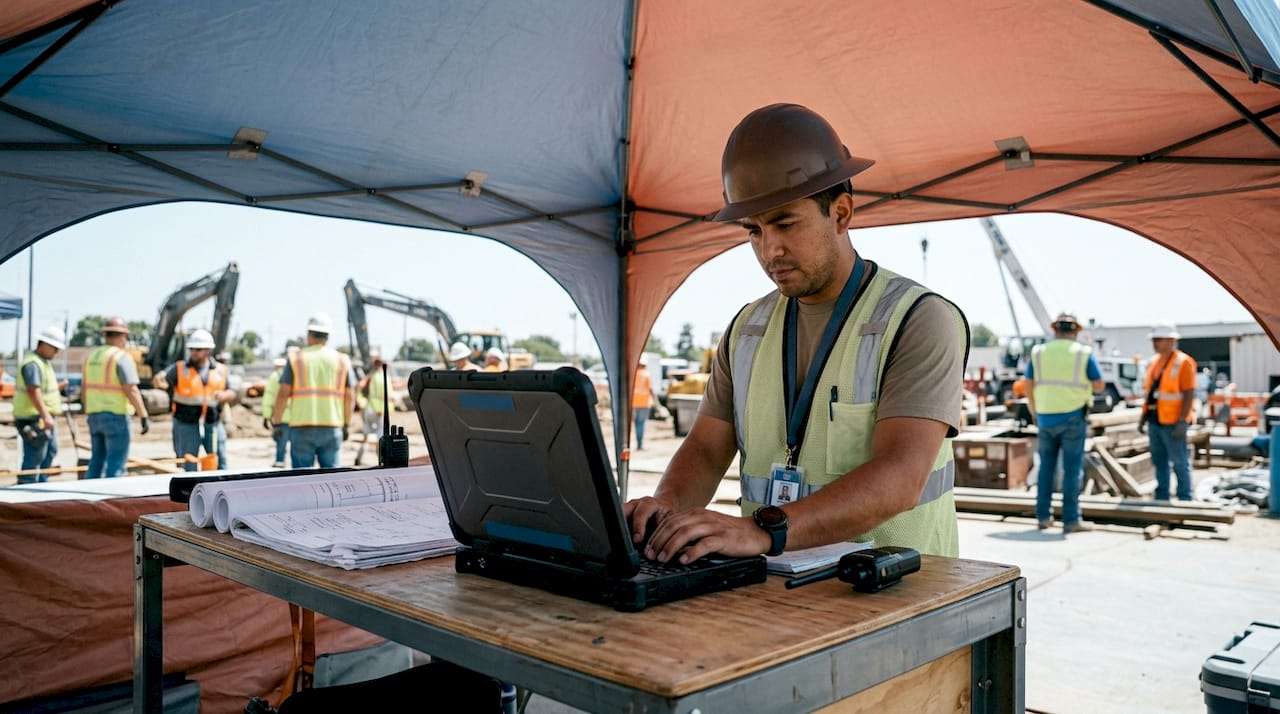
Real-time site visibility is the most underestimated pillar. Without it, problems compound silently until they become expensive emergencies. Research confirms that problems detected late cost exponentially more. A defect found within two days costs a fraction of what the same defect costs when discovered two weeks later.
Pro Tip: Map your current information flow from field to office before buying any technology. Most visibility gaps are process failures, not technology failures.
| Pillar | Core Activities | Efficiency Impact |
|---|---|---|
| Planning efficiency | Sequencing, procurement, resource scheduling | Prevents idle time and material delays |
| Process efficiency | Document control, approvals, communication | Reduces schedule slippage from admin bottlenecks |
| Site visibility | Real-time progress capture, proactive alerts | Cuts cost of late-detected defects and delays |
How do you measure labor productivity in construction?
Labor productivity in construction is best measured at the cost code level, linking installed quantities directly to labor hours. Project-level averages mask underperformance. A crew finishing 90% of tasks on time can still be burning 30% more labor hours than planned on specific cost codes.
The two most useful metrics are:
- Labor productivity rate: Output produced per labor hour, tracked by cost code and crew. This tells you where efficiency is breaking down, not just that it is.
- Productivity factor (PF): Planned labor hours divided by actual labor hours. A PF above 1.0 means you are ahead of plan. A PF below 1.0 signals a problem that needs investigation now, not at month-end.
Tracking verified output against planned production rates is more useful than tracking hours or completed tasks alone. Hours tell you what your crew did. Verified output tells you what they actually produced. That distinction prevents the reactive trap where cost overruns are discovered too late to correct.
| Metric | Formula | What It Reveals |
|---|---|---|
| Labor productivity rate | Units installed ÷ labor hours | True output per crew hour by cost code |
| Productivity factor (PF) | Planned hours ÷ actual hours | Whether you are ahead or behind plan |
| Equipment utilization | Active hours ÷ available hours | Idle time and scheduling gaps |
| Cycle time | Start to finish per work unit | Bottlenecks in production sequences |
Shop floor control systems that track equipment utilization, cycle time, downtime, and material availability give project managers the data to make faster, better decisions. The result is fewer wasted labor hours and less idle equipment across the site.
What technologies drive construction process optimization?
AI combined with BIM data is the most significant technology shift in construction process optimization right now. Research shows that AI integrated with BIM can reduce project durations by up to 3.52% and lower embodied carbon by up to 68.1%, with risk classification accuracy reaching 94.5–99.7%. Those numbers represent real schedule and cost savings on large projects.
Digital twin frameworks take this further. Closed-loop digital twin systems enable dynamic scheduling that reduces resource idle rates by 15% and advances project schedules by 3 days compared to traditional approaches. The key word is closed-loop: the system continuously feeds real-world site data back into the schedule model, so your plan reflects reality rather than assumptions.
The technologies delivering the most measurable results include:
- AI risk classification: Flags schedule and cost risks before they materialize, using BIM-derived data and historical project patterns.
- Digital twin scheduling: Updates resource allocation dynamically as site conditions change.
- Automated progress monitoring: Replaces manual site walks with continuous data capture, freeing project managers to focus on decisions rather than data collection.
- Integrated ERP platforms: Combine field operations, accounting, and project management in one system, eliminating the data silos that cause coordination failures.
Designflow-build’s AI construction software applies these principles directly, combining AI-driven risk prediction with integrated field and financial data. The platform reports a 70% reduction in manual data entry for contractors who adopt it.
Process standardization must come before automation. Digitizing an unstandardized workflow does not fix it. It accelerates bad data creation. Successful firms establish clear, repeatable processes first, then apply technology to scale them.
Pro Tip: Before implementing any AI or digital twin tool, document your current workflows in writing. If you cannot describe the process clearly on paper, the software will not clarify it for you.
What are the best practices for improving construction efficiency?
Operational excellence in construction requires discipline at the process level, not just better tools. The following practices produce consistent, measurable results across project types and sizes.
-
Adopt the Last Planner System. Lean construction principles like the Last Planner System produce 15–30% faster completion times and significantly reduce waste. The system works by pulling commitments from the crews doing the work, not just pushing schedules down from the office.
-
Manage information flow as a program-level activity. Information gaps between office and field are not a communication problem. They are a systems problem. Assign ownership of information flow at the program level and audit it weekly.
-
Use near real-time site visibility to catch problems early. Reactive site management is the single most expensive habit in construction. Proactive visibility closes the gap between when a problem starts and when it costs you money.
-
Treat site layout as a continuous optimization activity. Site layout optimization is not a one-time pre-construction task. The best firms revisit it dynamically throughout the project to balance productivity, safety, and cost as conditions change.
-
Distinguish activity from productivity. A busy site is not an efficient site. Crews can be active all day while producing less than planned. Measure verified output against production targets, not just hours logged.
-
Standardize before you scale. Establish repeatable coordination, communication, and verification processes before adding technology. A project management automation checklist helps project managers identify which manual tasks are ready to automate and which need process fixes first.
A BIM-based optimization model in steel fabrication demonstrated what standardization plus technology can achieve. The model reduced labor costs by 12.99% while maintaining 99% correlation between estimated and actual productivity. That level of accuracy is only possible when the underlying process is clean and measurable.
Key Takeaways
Construction operational efficiency requires three pillars working together: planning, process control, and real-time site visibility.
| Point | Details |
|---|---|
| Measure at the cost code level | Project-level averages hide underperformance; track labor hours against installed quantities by crew. |
| Standardize before automating | Digitizing a broken process accelerates bad data; fix workflows before scaling with AI or digital twins. |
| Detect problems early | Issues found within two days cost far less than those discovered after two weeks. |
| Use verified output, not hours | Productivity factor and installed quantities reveal true efficiency; logged hours alone do not. |
| Treat site layout as ongoing | Revisit spatial planning continuously throughout construction to protect productivity and safety. |
What I’ve learned from watching projects win and lose on visibility
The most common mistake I see project managers make is confusing a detailed schedule with actual control. A 10,000-line CPM schedule tells you what should happen. It tells you nothing about what is happening right now on the site. The firms that consistently deliver on time are the ones that close that gap with real data, not more meetings.
The second mistake is buying technology before earning it. I have watched teams implement expensive platforms on top of chaotic processes and end up with faster chaos. The discipline has to come first. Write the process down. Run it manually for a few weeks. Then automate it. That sequence sounds slow, but it is the only one that actually works.
The third thing I would tell any project manager is to stop measuring activity and start measuring output. Your crew can be 100% busy and 60% productive. Those are not the same number, and treating them as equivalent is how projects quietly bleed budget until it is too late to recover. Track what gets installed, not just what gets done.
The good news is that the tools available now, particularly AI-integrated ERP platforms, make all of this significantly more achievable than it was five years ago. The gap between knowing what to do and having the technology to do it has closed considerably. The remaining gap is almost always process discipline.
— Keith
How Designflow-build supports operational efficiency
Designflow-build is built specifically for contractors who need project management, accounting, and field operations in one place, without the complexity of a traditional ERP rollout.

The platform’s AI-powered ERP predicts project risks, automates resource allocation, and cuts manual data entry by 70%. Implementation takes 2–4 weeks, and the platform reports a 98% user adoption rate. For project managers who want to move from reactive to proactive site management, Designflow-build connects field data to financial outcomes in real time. You can also use Designflow-build’s construction scheduling tools to apply CPM and Monte Carlo scheduling directly within the same system.
FAQ
What is construction operational efficiency?
Construction operational efficiency is the ability to deliver projects with minimal time, cost, and waste while maintaining quality and safety. It is measured through metrics like labor productivity rate, productivity factor, and equipment utilization.
How do you measure operational efficiency on a construction project?
Track labor productivity at the cost code level by linking installed quantities to labor hours. The productivity factor, planned hours divided by actual hours, is the most direct indicator of whether a project is on track.
What is the Last Planner System in lean construction?
The Last Planner System is a lean construction scheduling method that pulls commitments from the crews doing the work rather than pushing top-down schedules. Projects using it achieve 15–30% faster completion times and generate significantly less waste.
Why does site visibility matter for construction efficiency?
Problems detected late cost exponentially more than those caught early. Near real-time site visibility shifts project management from reactive to proactive, reducing the cost of defects, delays, and coordination failures.
Should you automate construction processes before standardizing them?
No. Automating unstandardized workflows accelerates bad data creation. Firms must establish repeatable, documented processes before implementing AI or digital twin technologies to get reliable results.