
Commercial Construction Workforce Planning: A 2026 Guide

Commercial construction workforce planning is the process of aligning skilled labor with project timelines and requirements to reduce cost overruns and schedule delays. Known formally as construction labor resource management, this discipline covers forecasting, skill gap analysis, scheduling coordination, and contingency planning across every phase of a commercial build. 98% of large projects face cost overruns tied directly to labor inefficiencies. That single statistic explains why workforce planning has moved from a preconstruction checkbox to a core operational discipline for every serious commercial contractor.
What is commercial construction workforce planning?
Commercial construction workforce planning is a structured process for identifying, securing, and deploying the right labor at the right project phase. It sits at the intersection of scheduling, procurement, and human resources. The goal is predictive resource mobilization rather than reactive staffing, which means you are solving labor problems before they appear on the critical path.
The process covers four stages:
- Current workforce analysis: Audit your existing team’s skills, certifications, availability, and capacity across active projects.
- Future needs forecasting: Map labor requirements against the project schedule, phase by phase, from site prep through commissioning.
- Gap identification: Compare what you have against what you need, then flag roles that require long lead times to fill.
- Implementation and adjustment: Execute hiring, subcontractor engagement, and union coordination while updating the plan as conditions change.
Workforce planning in construction also integrates forecasting frameworks. The BIM and Line of Balance (LOB) method, for example, provides a visual, structured approach to crew allocation and scheduling verification in repetitive building work. A study evaluating the BIM-LOB approach with 31 professionals recorded a utility rating of 0.90 for reducing estimation errors. That level of accuracy is not achievable with spreadsheets alone.
Pro Tip: Treat your workforce plan as a living document. Update it at every major project milestone, not just at preconstruction. Labor markets shift, and a plan that is six months stale can expose you to the same risks you were trying to avoid.

How does workforce planning reduce risk in commercial projects?
Workforce planning is a risk management tool that shifts your focus from filling open roles to preventing the conditions that create them. The difference between reactive and proactive approaches shows up directly in project margins.
| Approach | Trigger | Typical outcome |
|---|---|---|
| Reactive staffing | Role becomes vacant or urgent | Overtime costs, schedule compression, mis-hires |
| Proactive workforce planning | Forecast identifies future gap | Controlled hiring timeline, right-fit candidates, cost certainty |
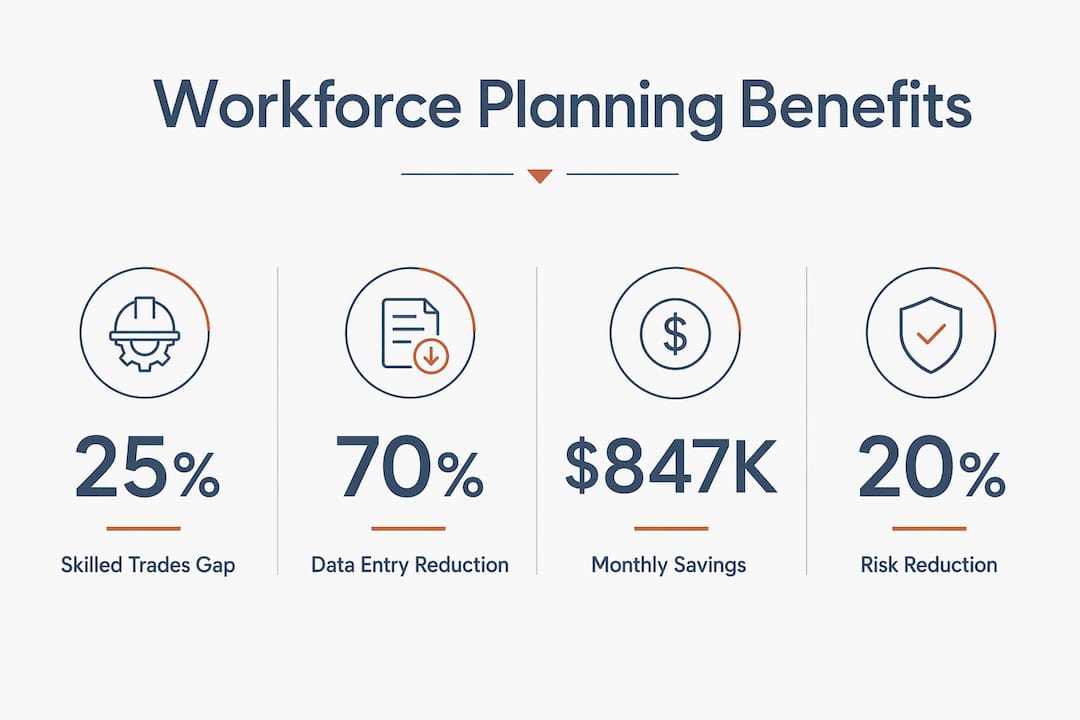
The construction industry faces a 25% deficit in electricians and similar shortages across other skilled trades. Waiting until a trade is needed on site to begin recruiting guarantees delays. Proactive planning treats specialty roles like long-lead procurement items, the same way you would order a custom curtain wall system months before it is needed.
Workforce gaps also create cascading problems beyond the immediate hiring delay. Staffing shortfalls trigger entitlement friction, design coordination breakdowns, and schedule compression that ripple across multiple trades. A single unfilled superintendent role can stall a $50 million project for weeks. Proactive commercial construction resource allocation prevents that chain reaction before it starts.
Pro Tip: Build contingency procedures directly into your workforce plan for every role with a scarcity rating. If your primary source for a specialty trade falls through, your backup path should already be documented, not improvised.
What role does technology play in construction labor management?
Technology has changed what is possible in construction labor management. The BIM-LOB integrated framework gives project managers a visual tool to allocate crews and verify scheduling feasibility before a single worker sets foot on site. That kind of upstream verification used to require weeks of manual coordination between estimators and schedulers.
AI takes the process further. AI in workforce planning analyzes factors like past working relationships, certifications, project experience, and availability at a scale no manual process can match. The result is smarter team assembly, not just faster hiring. AI does not reduce headcount. It enables better staffing decisions by processing workforce data that would otherwise go unused.
The key components that technology addresses in workforce planning include:
- Data centralization: Pulling HRIS records, project management data, and certification databases into one accessible system
- Predictive scheduling: Flagging labor demand spikes weeks before they hit the critical path
- Team chemistry analysis: AI processing unstructured data to identify which crew combinations have performed well together on past projects
- Recruitment targeting: Matching open roles to candidates based on project-specific requirements, not just job titles
The quality of AI outputs depends entirely on data quality. AI tools must be fed with comprehensive, updated workforce data including project history, experience, and certifications to produce reliable recommendations. A system built on incomplete records will generate incomplete answers. Maintaining clean, current data is not optional. It is the foundation that makes every other technology investment pay off.
Platforms like Designflow-build integrate AI-driven project management with workforce forecasting, giving commercial contractors a single system rather than a patchwork of disconnected tools.
How should managers implement workforce planning effectively?
Effective implementation starts with synchronizing your hiring timeline to your project schedule and financing milestones. Vacant senior roles cause measurable cost and schedule impacts, and proactive hiring regimes deliver direct margin advantages. The moment a project secures financing, workforce planning should begin in parallel with design development.
Follow these steps to build a workforce plan that holds up through construction:
- Audit your current team. Document every active employee’s skills, certifications, project commitments, and availability windows.
- Map labor demand by phase. Use your project schedule to identify when each trade and leadership role is needed, and for how long.
- Classify roles by scarcity and lead time. Treat hard-to-fill roles as long-lead items and begin sourcing immediately.
- Choose your hiring approach by role type. Use in-house recruiting for high-volume roles, agency partnerships for specialty trades, and embedded recruiters for senior leadership searches.
- Document the plan formally. A documented workforce plan reduces mis-hires by 40% and serves as a reference document during labor or scheduling disputes.
- Schedule quarterly reviews. Workforce planning is an ongoing, iterative process aligned with project phases, not a one-time preconstruction exercise.
Collaboration with unions, trade schools, and staffing agencies should be built into the plan from the start. For commercial projects with complex trade sequencing, coordinating with union halls early secures access to skilled workers before competing projects absorb the available pool. Durable recruiting programs aligned with project milestones consistently improve both schedule and financial outcomes.
Pro Tip: Treat your workforce plan the same way you treat your project schedule. Assign an owner, set review dates, and track variances. A plan without accountability is just a document.
For contractors looking to connect workforce planning with commercial project lead generation, aligning your staffing capacity with your pipeline gives you a real competitive edge when bidding new work.
Key Takeaways
Commercial construction workforce planning is the single most effective tool for preventing labor-driven cost overruns and schedule failures on large commercial projects.
| Point | Details |
|---|---|
| Start planning at financing | Begin workforce planning when the project secures funding, not at preconstruction. |
| Treat scarce roles as long-lead items | Source specialty trades and senior leaders early, the same way you procure custom materials. |
| Use BIM-LOB and AI together | Combine visual scheduling frameworks with AI data analysis for accurate crew allocation. |
| Document and review quarterly | A formal, updated workforce plan reduces mis-hires and protects you in disputes. |
| Proactive planning cuts cost overruns | Identifying labor gaps early can reduce project risk and cost overrun exposure by up to 20%. |
Why workforce planning is the most underused tool in commercial construction
Most project managers I talk to treat workforce planning as something that happens before the project starts and then gets filed away. That is the wrong model, and it is the reason so many commercial projects hit labor crises in the middle of their most critical phases.
The projects that run cleanest are the ones where the workforce plan is treated as a live document, updated alongside the schedule every time a milestone shifts. I have seen a single unfilled project executive role delay a ground-up commercial development by six weeks, not because the talent did not exist, but because no one started looking until the role was already urgent. That is a planning failure, not a market failure.
AI tools are genuinely useful here, but only if you feed them good data. The contractors getting the most value from AI-assisted staffing are the ones who have already done the hard work of centralizing their workforce records. The technology amplifies what you already know. It does not substitute for knowing it.
My honest advice: assign one person on your team to own the workforce plan the same way a scheduler owns the CPM schedule. Make it a parallel workflow, not an afterthought. The margin protection alone justifies the investment.
— Keith
Designflow-build: AI-powered workforce and project management
Managing labor across a commercial build requires more than spreadsheets and gut instinct. Designflow-build’s AI construction software combines workforce forecasting, project scheduling, and field operations into one platform, so your labor plan and your project schedule stay in sync automatically.

Designflow-build reports a 70% reduction in manual data entry and monthly savings of up to $847K for contractors who replace disconnected tools with its AI-native ERP. Implementation takes 2–4 weeks with a 98% user adoption rate. If you want your workforce plan to drive real project outcomes, construction scheduling software built for commercial contractors is the place to start.
FAQ
What is commercial construction workforce planning?
Commercial construction workforce planning is the process of forecasting, securing, and deploying skilled labor to match project phase requirements. It integrates scheduling, skill gap analysis, and contingency planning to prevent labor-driven delays and cost overruns.
How does workforce planning reduce cost overruns?
Proactive workforce planning can reduce project risk and cost overrun exposure by up to 20% by identifying labor gaps before they reach the critical path. Reactive staffing, by contrast, forces overtime, schedule compression, and rushed hiring that drives up costs.
What technology supports construction labor management?
BIM and Line of Balance integration improves crew quantification accuracy, while AI tools analyze certifications, experience, and team history to support smarter staffing decisions. Platforms that centralize HRIS and project data give managers a single source of truth for workforce decisions.
When should workforce planning begin on a commercial project?
Workforce planning should begin when the project secures financing, not at the start of construction. Synchronizing hiring timelines with financing and design milestones gives you the lead time needed to fill specialty and senior leadership roles without schedule pressure.
How often should a construction workforce plan be updated?
A workforce plan should be reviewed and updated at every major project milestone, with formal quarterly reviews at minimum. Workforce planning is an ongoing process aligned with project phases, not a one-time preconstruction document.