
AI in Commercial Construction Scheduling: 2026 Guide

AI in commercial construction scheduling is defined as the application of machine learning, predictive analytics, and autonomous agents to automate, monitor, and optimize project timelines from preconstruction through closeout. The industry term for this practice is AI-driven contractor scheduling, and it covers everything from automated Work Breakdown Structure (WBS) generation to live Critical Path Method (CPM) updates. AI agents can cut planning time from 480 minutes to just 20 minutes, with a human error probability under 1%. That single shift changes what your scheduling team can accomplish in a day. For commercial project managers facing tighter margins and more complex builds, understanding the role of AI in commercial construction scheduling is no longer optional.
How does AI improve the pre-construction scheduling process?
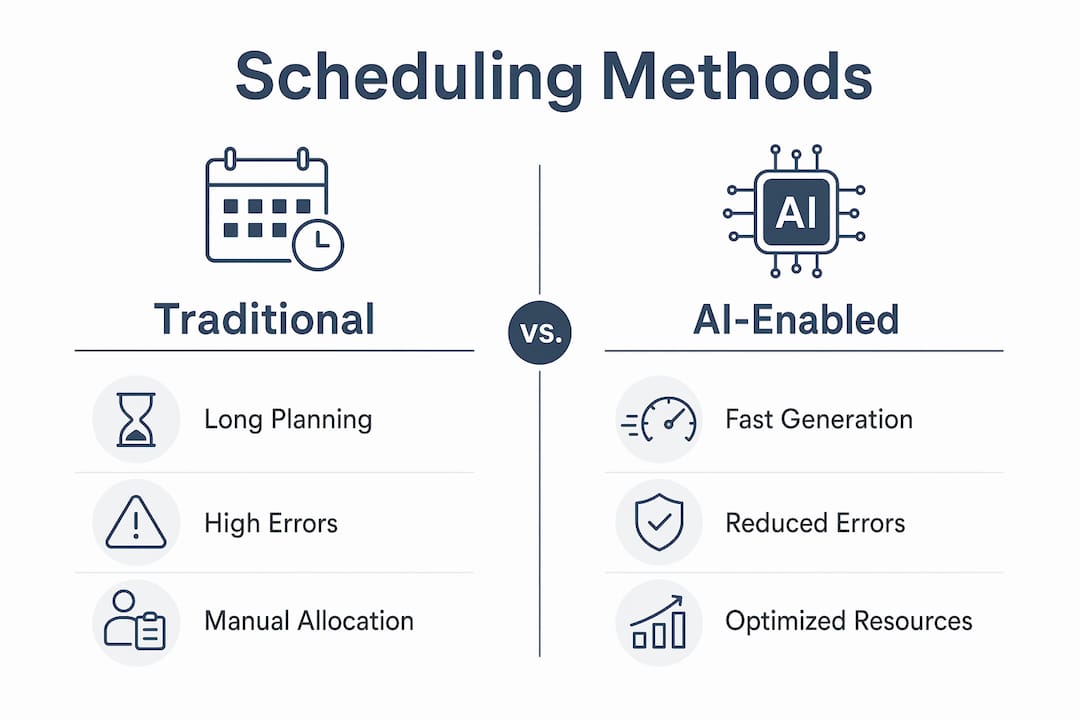
AI compresses the most time-consuming part of project planning into a fraction of the original effort. Traditional WBS and CPM generation requires a scheduler to manually sequence hundreds of activities, assign durations, and validate logic. AI-driven planning acceleration reduces that process from 480 minutes to 20 minutes. That is a 96% reduction in planning time, which frees your team to focus on scope review and subcontractor coordination before a single shovel hits the ground.
The error rate improvement is equally significant. Manual schedule builds carry compounding logic errors that only surface weeks into a project. AI agents maintain a human error probability under 1%, which means fewer missed predecessors, fewer float miscalculations, and fewer surprises at the first owner review. The practical result is a schedule baseline your team can defend on day one.
Resource allocation also benefits directly. AI validates crew assignments, equipment availability, and material lead times against the schedule logic automatically. You get a schedule that reflects real-world constraints, not optimistic assumptions.
| Planning Element | Traditional Method | AI-Enabled Method |
|---|---|---|
| WBS/CPM generation time | 480 minutes | 20 minutes |
| Human error probability | High (compounding logic gaps) | Under 1% |
| Resource validation | Manual, often incomplete | Automated against live data |
| Schedule baseline readiness | Days to weeks | Same session |
Pro Tip: Integrate AI scheduling tools at the very start of preconstruction, before design documents are finalized. Early integration lets the AI flag scope gaps and sequencing conflicts while changes are still cheap to make.
What happens when AI meets BIM in commercial projects?
Combining AI with Building Information Modeling data produces measurable gains that neither technology delivers alone. AI-BIM integration reduces total project durations by up to 3.52% and pushes risk classification accuracy above 99.7%. On a 24-month commercial office build, a 3.52% duration reduction translates to roughly 25 days returned to the schedule. That is time you can use to absorb weather delays or accelerate a critical trade package.
The sustainability impact is harder to ignore. The same AI-BIM framework cuts energy consumption by up to 70% through optimized sequencing of mechanical, electrical, and plumbing work. Efficient sequencing reduces rework, which reduces material waste and site energy use. For projects pursuing LEED certification or owner-mandated sustainability targets, this is a direct scheduling benefit, not a separate green initiative.
Integrating AI with weather data and 4D/5D BIM consolidates fragmented project domains into a single digital workflow. Procurement timelines, activity-based costing, and schedule logic all live in one system. The benefits of this integration include:
- Risk classification accuracy above 99.7%, reducing schedule contingency padding
- Project duration reductions up to 3.52% through tighter activity sequencing
- Energy consumption reductions up to 70% from optimized trade coordination
- Improved transparency for owners, lenders, and general contractors
- Support for construction phase compliance and safety planning within the schedule
- Faster change order resolution because cost and schedule impacts calculate simultaneously
The practical takeaway is that BIM without AI gives you a detailed model. AI without BIM gives you a fast schedule. Together, they give you a schedule that reflects the physical reality of the building as it is being built.
How does AI predict delays before they appear on the critical path?
Predictive analytics is where AI delivers its most direct financial return for commercial project managers. AI scheduling agents detect potential 6-week delays up to 8 weeks before those delays reach the critical path. That 8-week window is the difference between a recovery plan and a liquidated damages conversation.

The financial stakes are clear. Early detection reduces recovery costs by 40–60% and cuts liquidated damages exposure by 30–45%. Recovery costs drop because you have time to add resources, resequence work, or negotiate with subcontractors before the delay becomes a crisis. Liquidated damages exposure drops because you can document mitigation efforts and demonstrate proactive management to the owner.
A real-world example makes this concrete. A $380M mixed-use project used AI to detect a 6-week foundation pour delay 8 weeks before it would have appeared on the critical path. The project team resequenced above-grade steel work, accelerated concrete procurement, and avoided a schedule slip that would have triggered significant penalties. The AI flagged the risk by analyzing daily field progress data against the CPM baseline, not by waiting for a foreman to report a problem.
AI achieves this by continuously ingesting daily field reports, subcontractor updates, weather data, and procurement status. It compares actual progress against the CPM baseline and runs probabilistic forecasts on every activity with float below a defined threshold. CPM schedules remain the contractual backbone while AI layers probabilistic risk forecasting on top. You keep the legal protection of a CPM schedule and gain the early warning system of predictive analytics.
Pro Tip: AI predictive accuracy depends entirely on the quality of daily field data. Assign a dedicated field engineer to submit progress updates by 2:00 PM each day. Inconsistent or incomplete field data degrades AI forecasts faster than any software limitation.
What does an AI-augmented scheduling workflow look like day to day?
AI changes the daily rhythm of schedule management in ways that are practical and immediate. AI handles repetitive data ingestion and report generation, freeing schedulers to focus on logic review and the conversations that actually drive the project. A scheduler who previously spent four hours updating a P6 schedule from field reports can now spend those four hours reviewing logic gaps and coordinating with trade foremen.
The core capabilities that define an AI-augmented workflow are natural-language query, agentic monitoring, automated status capture, and generative scheduling. Natural-language query lets a project manager ask “What is the float on the curtain wall package?” and receive an answer in seconds without opening a schedule file. Agentic monitoring watches the schedule continuously and sends alerts when float drops below a defined threshold. Automated status capture pulls field data directly into the schedule without manual re-entry. Generative scheduling proposes recovery sequences when a delay is detected.
Reducing data-entry friction between field and office transforms a static schedule into a live decision-making tool. A schedule updated once a week is a historical record. A schedule updated continuously is a management instrument. That distinction matters when an owner asks for a recovery plan on a Tuesday afternoon.
A typical AI-assisted schedule update in a commercial project follows this sequence:
- Field engineers submit daily progress reports through a mobile app by early afternoon.
- AI ingests the reports and compares actual versus planned progress for every active activity.
- The system flags activities where actual progress deviates more than 5% from the plan.
- The scheduler reviews flagged activities, confirms logic, and approves or adjusts AI-proposed recovery sequences.
- The updated schedule publishes automatically to the project management platform, visible to the owner and all trade partners.
The most common pitfall in this workflow is a poor schedule baseline. AI bridges procurement and scheduling gaps only when the underlying CPM logic is sound. Garbage-in, garbage-out applies directly. Invest in a clean, logic-driven baseline before you activate any AI layer.
Key Takeaways
AI-driven contractor scheduling delivers measurable gains in planning speed, risk detection, and project duration when built on quality data and sound CPM logic.
| Point | Details |
|---|---|
| Planning time drops 96% | AI cuts WBS/CPM generation from 480 minutes to 20 minutes with under 1% error rate. |
| BIM integration multiplies gains | Combining AI with BIM reduces project duration by up to 3.52% and risk classification error to under 0.3%. |
| Early delay detection saves money | AI flags 6-week delays 8 weeks early, cutting recovery costs by 40–60%. |
| Field data quality is non-negotiable | Inconsistent daily progress reports degrade AI forecasts and eliminate the early-warning advantage. |
| Schedulers shift roles, not jobs | AI automates data entry so schedulers focus on logic review, risk analysis, and owner communication. |
AI is a force multiplier, not a replacement
I have watched construction firms adopt AI scheduling tools with two very different mindsets. The first group treats AI as a replacement for their scheduler. They cut headcount, reduce oversight, and expect the software to run the project. Within three months, they are dealing with inaccurate forecasts, missed alerts, and a schedule that no one trusts. The second group treats AI as a force multiplier. They keep their experienced schedulers, give them better tools, and let the AI handle the data work. Those firms consistently outperform on schedule and cost.
The uncomfortable truth is that AI does not replace human schedulers. It amplifies what a skilled scheduler can do. A good scheduler with AI can manage twice the project volume with better accuracy. A poor scheduler with AI produces poor forecasts faster. The technology does not fix a weak baseline or compensate for a team that does not understand CPM logic.
The firms I have seen succeed with AI scheduling share one habit: they treat risk assessment integration as a continuous process, not a monthly report. They feed the AI daily, review its alerts seriously, and act on early warnings before they become schedule events. That discipline is what separates a firm that uses AI from a firm that benefits from it. The tools are ready. The question is whether your team’s data habits and scheduling fundamentals are ready to support them.
— Keith
Designflow-build’s AI scheduling tools for commercial projects
Commercial project managers who want to put these capabilities to work immediately have a direct path forward with Designflow-build.

Designflow-build’s AI-native ERP combines automated construction scheduling with risk forecasting, live field data sync, and BIM integration in a single platform. The system reports a 70% reduction in manual data entry and monthly savings of up to $847K for contractors. Implementation takes 2–4 weeks with a 98% user adoption rate, so your team is running live schedules quickly without a lengthy rollout. You can also use the construction software glossary to get your team aligned on AI scheduling terminology before go-live. Request a demo to see how Designflow-build fits your current project workflow.
FAQ
What is AI-driven contractor scheduling?
AI-driven contractor scheduling is the use of machine learning and autonomous agents to automate CPM generation, monitor live project progress, and forecast delays before they reach the critical path. It reduces planning time and improves schedule accuracy compared to manual methods.
How much time does AI save in construction schedule creation?
AI agents reduce WBS and CPM generation from 480 minutes to 20 minutes, a 96% acceleration, with a human error probability under 1%. That time savings applies directly to the preconstruction phase.
Can AI scheduling tools predict delays in commercial projects?
AI scheduling agents detect potential 6-week delays up to 8 weeks before critical path impact. Early detection reduces recovery costs by 40–60% and cuts liquidated damages exposure by 30–45%.
Does AI replace CPM scheduling in commercial construction?
AI does not replace CPM scheduling. CPM remains the contractual backbone of the project schedule, while AI layers probabilistic risk forecasting and continuous updates on top of the existing CPM structure.
What data does AI need to produce accurate schedule forecasts?
AI predictive accuracy depends on consistent, high-quality daily field progress reports. Incomplete or delayed field data degrades forecast accuracy and eliminates the early-warning advantage that makes AI scheduling valuable.